Introduction
In the early Chunxi era of the Southern Song, Shi Zhengzhi, who had served as supply commissioner[1] and vice minister of personnel, completed a residence and a flower nursery near Daicheng Bridge in Suzhou, and this was the predecessor of the Master of the Nets Garden. Within the residence he built a library hall named the Hall of Ten Thousand Volumes, its books ranged in forty-two cabinets, most of them manuscripts; the nursery was called Fisherman’s Seclusion, and the Shi household also grew five hundred tree peonies. When the flowers opened in spring, the people of Wu set out feasts and invited guests to enjoy them; collecting books, growing flowers, and feasting with friends formed the earliest life of this house-and-garden estate.
Tradition has it that when Shi Zhengzhi first returned home, the boats of his retinue stretched bow to stern in an unbroken line from the Feng Gate all the way to his residence. Yet the estate passed down only one generation in the Shi family. First the nursery fell into neglect; then the residence was put up for sale at one hundred thousand strings of cash[2], long attracting no buyer, and was finally sold to the Ding family of Changzhou for fifteen thousand strings — although building it had cost 1.5 million strings. At the end of the Shaoding era of the Southern Song, the Ding brothers divided the family property, splitting the estate into four shares; Zhao Ruchou, the judicial commissioner of western Zhejiang, then seized the old residence as government property and converted it into the Million-Bushel Granary and a government grain-purchasing depot[3], used for storing and buying in grain. The library of the Hall of Ten Thousand Volumes also gradually dispersed: at first it was bought by the pound as waste paper, and later powerful families paid only ten thousand cash per cabinet and swept the books away. By the early Zhengde era of the Ming, the Hall of Ten Thousand Volumes was still registered among the residences of Suzhou as Shi Zhengzhi’s former home, but the stone record at the old residence had already been ground away by monks, and nothing remained of the Song-dynasty nursery.
During the Qianlong era of the Qing, Song Zongyuan, vice minister of the Court of Imperial Entertainments, purchased the former site of the Hall of Ten Thousand Volumes. While still in office, he had his family build halls and towers on the old nursery grounds, laying out ponds, pavilions, and a small boat, in preparation for retiring from office to care for his aged mother at home. He named the garden the Master of the Nets Retreat — “Master of the Nets” means a fisherman, which both carried on the old nursery’s name, Fisherman’s Seclusion, and punned on the name of the neighboring Wangsi Lane; Song Zongyuan took it as his own literary name and used it for the garden. Before reaching fifty, he petitioned to return home on account of his mother’s age; on fine days he supported her on strolls along the winding paths, and in his leisure invited friends to drink and compose poetry. The garden contained twelve scenes, among them the Northern Mountain Thatched Hall, the Ribbon-Washing Waterside Pavilion, the Studio of the Small Hill and Osmanthus Grove, and the Fragrance-Crossing Skiff, for which Song Zongyuan himself composed the Twelve Poems on the Master of the Nets Retreat. When his mother died and the mourning period was over, he returned to official service, appointed circuit intendant of Tianjin. Once he had left Suzhou, the music and song in the garden fell silent.
After Song Zongyuan’s death, the garden fell steadily into ruin; most of its great trees and ancient rocks were lost, and only a single expanse of pond water remained as clear as ever. At the end of the Qianlong era, the wealthy merchant Qu Yuancun chanced to pass by; sighing at the sight, he bought the garden and rearranged it on its original scale, piling rocks and planting trees and adding pavilions, so that the garden also came to be called the Qu Garden. Among the scenes of the newly made garden were the Pavilion Where the Moon Comes with the Breeze, the Cloud Ridge Pavilion, and the Studio of a Branch Beyond the Bamboo; on the day of its completion, the host gathered his friends for a feast within it. In the Jiaqing and Daoguang eras the garden’s herbaceous peonies were at their finest and were said to be the best in Wu; the Qu family’s descendants often invited guests to enjoy them in the flowering season. By the Daoguang era, the Master of the Nets Garden had, together with the Humble Administrator’s Garden, the Cold Green Villa, and others, become one of the celebrated excursion gardens of Wu, opening to visitors on fine days in spring and autumn. The garden’s famous couplet that begins with “wind and rain, warmth and chill,” weaving together blossoms and leaves, orioles and swallows, dusk and dawn, exactly matched the mood of visitors winding through its pavilions and corridors.
In the Daoguang era the garden changed hands to Wu Jiadao of Huizhou; in the Tongzhi era it passed to Li Hongyi, provincial surveillance commissioner of Jiangsu. Having resigned on account of an ear ailment, he moved to Suzhou and repaired the garden; its old trees and strange rocks, ponds, pavilions, and lodges remained as before, and he gathered tens of thousands of books, passing his days among bronze vessels, stone inscriptions, calligraphy, and paintings. After Li Hongyi died in the eleventh year of the Guangxu era (1885), the garden changed owners several times and was for a time renamed the Garden of Ease. In 1940 the collector He Cheng (courtesy name Yanong) purchased the garden and restored its old name, Master of the Nets Garden. In 1950 his descendants donated the garden to the state; in 1958 the Suzhou Municipal Garden Administration took it over and renovated it, after which it opened to the public. In 1980 the Metropolitan Museum of Art in New York recreated a courtyard modeled on the garden’s Peony Study courtyard — the first instance of a classical Chinese garden being built abroad.
Today the Master of the Nets Garden stands on Kuojiatou Lane in Gusu District, still laid out with the residence to the east and the garden to the west. Within the residence, the Hall of Ten Thousand Volumes and the Tower of Gathered Elegance connect from south to north, while to the west pavilions and corridors unfold around the Rosy Clouds Pool. The name of the Southern Song library hall survives on the main hall, while the plan of the present house and garden rests on the foundations built by the Song and Qu families of the Qing.
Historical Documents
Wuzhong Jiushi (Old Matters of Wu)
史发运宅,在带城桥。淳熙初,宅成,计其费一百五十万𦈏,仅一传不能保,僦直十万𦈏,久不售,后为丁季卿以一万五千𦈏得之。绍定末,丁又不能保。赵汝櫄来为浙西提刑官,占为百万仓和籴场。故老说发运初归时,舳舻相衔,凡舟自葑门直接至其宅前,用发运司按纸黏窗煮黏面六七石,自后仅易目前耳。万卷堂环列书四十二厨,写本居多。始则论斤买为故纸,其后势家每厨止得一十千,席卷而去。
The residence of Supply Commissioner Shi stood at Daicheng Bridge. When the residence was completed early in the Chunxi era, the expense was reckoned at 1.5 million strings of cash, yet it could not be kept for even one succession. It was offered for sale at one hundred thousand strings and long went unsold, until Ding Jiqing acquired it for fifteen thousand strings. At the end of the Shaoding era, the Dings likewise could not keep it. When Zhao Ruchou came as judicial commissioner of western Zhejiang, he took it over for the Million-Bushel Granary and the government grain-purchasing depot. The elders used to tell that when the Supply Commissioner first returned home, his boats stretched bow to stern in an unbroken line, sailing straight from the Feng Gate to the front of his residence, and that he drew on the supply commission’s paper to paste the windows, cooking six or seven dan of flour paste, which afterwards sufficed only for present needs. In the Hall of Ten Thousand Volumes, books stood ranged in forty-two cabinets, most of them manuscripts. At first they were bought by the pound as waste paper; later powerful families paid no more than ten thousand cash for each cabinet and swept them all away.
吴俗好花,与洛中不异。其地土亦宜花,古称长洲茂苑,以苑目之,盖有由矣。吴中花木不可殚述,而独牡丹、芍药为好尚之最,而牡丹尤贵重焉。旧寓居诸王皆种花,往往零替,花亦如之。盛者唯蓝叔成提刑家最好事,有花三千株,号万花堂。尝移得洛中名品数种,如玉盌白、景云红、瑞云红、胜云红、玉间金之类,多以游宦,不能爱护,辄死。今惟胜云红在。其次林得之知府家有花千株。胡长文给事、成居仁太尉、吴谦之待制家种花亦不下林氏。史志道发运家亦有五百株。如毕推官希文、韦承务俊心之属,多则数百株,少亦不下一二百株,习以成风矣。至谷雨为花开之候,置酒招宾就坛,多以小青盖或青幕覆之,以障风日。父老犹能言者,不问亲疏,谓之看花局。今之风俗不如旧,然大槩赏花则为宾客之集矣。
The people of Wu love flowers, no differently from those of Luoyang, and the soil here suits flowers as well; in ancient times this was called the Luxuriant Garden of Changzhou, and to name the place a garden was not without reason. The flowers and trees of Wu cannot all be named, but among them the tree peony and the herbaceous peony are loved above all, and the tree peony is prized most of all. The princes who once lodged here all planted flowers, yet as their houses declined, so did the flowers. The most flourishing in later times was the household of Judicial Commissioner Lan Shucheng, the fondest of flowers of all, with three thousand plants in what was called the Hall of Ten Thousand Flowers. He had transplanted several famed varieties from Luoyang, such as Jade Bowl White, Rosy-Cloud Red, Auspicious-Cloud Red, Surpassing-Cloud Red, and Gold-Threaded Jade, but most of them died, since his official travels left no one to tend them; today only Surpassing-Cloud Red survives. Next came the household of Prefect Lin Dezhi, with a thousand plants. The households of Supervising Secretary Hu Changwen, Commandant Cheng Juren, and Academician-in-waiting Wu Qianzhi also planted no fewer than the Lins. The household of Supply Commissioner Shi Zhidao likewise had five hundred plants. Others, such as Judge Bi Xiwen and Court Gentleman Wei Junxin, kept several hundred at most, and none fewer than one or two hundred — so it had become a prevailing custom. When the Grain Rain solar term brought the flowers into bloom, people set out wine and invited guests to the beds, often covering them with small blue canopies or blue screens to shield them from wind and sun. The elders who could still speak of those days, whether kin or stranger, called such gatherings flower-viewing parties. Today’s customs are no longer what they were, yet broadly speaking, flower viewing remains an occasion for assembling guests.
Gusu Zhi (Gazetteer of Gusu)
万卷堂,侍郎史正志所居,在带城桥南,旧有石记,为僧磨毁。施氏丛抄云:正志,扬州人,造带城桥宅及花圃,费百五十万𦈏,仅一传。圃先废,宅售与常州丁卿昆季,仅得一万五千𦈏。绍定末,丁折为四,其后提举赵汝櫄占为百万仓籴场。
The Hall of Ten Thousand Volumes, the residence of Vice Minister Shi Zhengzhi, lay south of Daicheng Bridge; it formerly had a stone record, which was ground away by monks. The Shi Family Collectanea notes: Zhengzhi was a man of Yangzhou who built the residence and flower nursery at Daicheng Bridge at a cost of 1.5 million strings of cash, yet it passed down only one generation. The nursery fell into ruin first, and the residence was sold to the Ding brothers of Changzhou, fetching only fifteen thousand strings. At the end of the Shaoding era, the Dings divided it into four, and afterwards Superintendent Zhao Ruchou seized it for the Million-Bushel Granary and grain-purchasing depot.
Wangshiyuan Tuji (Record of a Painting of the Master of the Nets Garden)
予读欧阳文忠公思颍诗,叹士大夫一执仕版,欲遂其山林之乐而不易得也。公留守东都,即思买田颍上,阅二十载,愿迄未遂。自序云:有志于强健之年,未偿于衰老之后,良可悯也。同年观察宋君悫庭,以名孝廉为令畿辅,有廉能声。数年中瀳历监司,政和民治,大吏重之,天子知之,行将畀以节钺,入参机务,如文忠之致位两府。乃年未五十,以太夫人年老陈情,飘然归里。先是,君在官日,命其家于网师旧圃,筑室构堂,有楼有阁,有台、有亭,有沜、有陂,有池、有艇,名网师小筑,赋十二景诗,豫为奉母宴游之地。至是果符其愿。既归,循陔采兰,凌波捕鲤,奉太夫人晨餐夕膳。每当风日晴美,侍鱼轩,扶鸠杖,周行曲径,以相娱悦。时或招良朋,设旨酒,以觞以咏,凭高瞻眺,幽崖耸峙,修竹檀栾,碧流渺弥,芙蕖娟靓,以及疏梧蔽炎,丛桂招隐,凡名花奇卉,无不萃胜。于园中指点少时游钓之所,抚今追昔,分韵赋诗。座客啧啧叹羡,谓君遭逢之威,邱壑之佳,当与子美、沧浪、仲瑛、玉山并传。子谓子美仕宦不得志,扁舟来吴,买木石以寄其诧傺无聊之感。仲瑛饩馆声伎,甲于东南,然时丁末造,轻财结客,比于燕雀处堂而已。孰若君中岁抽簪,啸歌自得,处太平之世,展将母之怀,无累于中,不求乎外,此其乐文忠公所不能遽遂者,而君早遂之,虽遭逢使然,而亦君之知几恬退,有以自致乎此也。园名网师,比于张志和、陆天随,放浪江湖,盖其自谦云尔。命画师绘图,又以师卢鸿乙王摩诘,欲使图画之并传于后也。予与君比屋而居,昕夕过从,咏少陵高枕乃吾庐句,殆有因君之乐以乐予之乐者乎?故不辞而为之记。
I once read Ouyang Xiu’s poems of longing for Ying, and sighed that once a scholar-official takes up an official post, the joys of mountain forests are not easily had. When Ouyang Xiu was serving as regent of the Eastern Capital, he already thought of buying fields on the Ying River, yet after twenty years his wish remained unfulfilled; as his own preface says, he formed the resolve in the years of strength and vigor but could not realize it in age and decline — truly pitiable. My examination classmate, Surveillance Commissioner Song Queting, was a distinguished provincial graduate who served as magistrate in the capital region and won a name for incorruptibility and ability. Within a few years he rose through the supervisory offices, government was harmonious and the people well ruled, his superiors valued him, the emperor knew of him, and he was about to be entrusted with military authority and admitted to the councils of state, rising as Ouyang Xiu did to the two chief offices. Yet before reaching fifty, he pleaded his aged mother’s years and drifted lightly back to his hometown. Earlier, while still in office, he had ordered his family to build on the old nursery of the Master of the Nets: rooms and halls, a tower and a pavilion, a terrace and a kiosk, banks and dikes, a pond and a boat, naming it the Master of the Nets Retreat and composing twelve scene-poems, preparing it in advance as a place to care for his mother and to feast and roam. Now his wish was truly fulfilled. After returning home, he plucked orchids along the riverside in filial devotion, caught carp across the waves, and served his mother her morning and evening meals. Whenever the wind and sun were fine, he attended her carriage, supported her dove-headed staff, and walked with her along the winding paths for their mutual delight. From time to time he summoned good friends, set out fine wine, and drank and chanted; gazing from the heights, he saw secluded cliffs rising steeply, tall bamboo swaying, green waters stretching broad, lotuses graceful and fair, and then the sparse parasol trees shading the summer heat and the clustered osmanthus inviting the recluse — every famed flower and rare plant gathered there in perfection. In the garden he would point out the spots where he had roamed and fished in his youth, and touching the present and recalling the past, his company divided rhymes and composed poems. His guests sighed in admiration, saying that his fortunate lot and the beauty of his hills and ravines deserved to be handed down together with Zimei’s Canglang Pavilion and Zhongying’s Jade Mountain. I said: Zimei, thwarted in office, came to Wu in a small boat and bought rocks and trees to lodge his disappointed melancholy; Zhongying kept musicians in his lodge, foremost in the southeast, yet living at the end of a dynasty he scattered his wealth gathering guests, like swallows nesting in a hall. Neither compares with our friend, who withdrew his hairpin in middle age, whistled and sang at his ease, lived in a time of peace, fulfilled his heart’s duty to his mother, unencumbered within and seeking nothing without — this joy is what Ouyang Xiu could not readily attain, yet our friend attained it early; though fortune played its part, it was also his own sense of the moment and quiet withdrawal that brought it about. The garden is named Master of the Nets in the spirit of Zhang Zhihe and Lu Tianmeng, who drifted free upon the rivers and lakes — it is his gesture of modesty. He ordered a painter to depict the garden, in emulation of Lu Hong and Wang Wei, wishing that the pictures too might be handed down to later ages. I lived wall-to-wall with him and visited morning and evening, chanting Du Fu’s line “with a high pillow, here is my hut” — perhaps I took his joy as the cause of my own? And so I did not decline, but wrote this record.
Yuanhe Xianzhi (Gazetteer of Yuanhe County)
网师小筑,宋副使宗元构以养母者。内有北山草堂、无喧庐、小山、丛桂轩、濯缨水阁、梅花、铁石山房、蹈和室、溪西小隐、度香艇、花影亭、半巢居、斗屠、丽瞩楼十二景。
The Master of the Nets Retreat was built by Vice Commissioner Song Zongyuan for the care of his mother. Within it are twelve scenes: the Northern Mountain Thatched Hall, the Lodge of No Clamor, the Small Hill, the Osmanthus Grove Studio, the Ribbon-Washing Waterside Pavilion, the Plum Blossom and Ironstone Mountain Studio, the Chamber of Treading Harmony, the Small Retreat West of the Stream, the Fragrance-Crossing Skiff, the Flower Shadow Pavilion, the Half-Nest Dwelling, the Doutu Cloister, and the Tower of Beautiful Views.
Wangshi Xiaozhu Shi’er Yong (Twelve Poems on the Master of the Nets Retreat)
北山草堂
Northern Mountain Thatched Hall
树萱堂之北,结屋山之南。屋敝谋还葺,山幽许更探。为贫归未得,济胜具犹堪。比舍多贤达,花时兴正酣。
North of the hall where daylilies are planted, I built a house on the southern slope. The house is worn, yet I plan to repair it; the hill is secluded and invites further exploring. For poverty I cannot yet come home, but my strength for climbing to scenic heights still serves. The neighboring houses hold many worthies, and in the flowering season our spirits run high.
梅花铁石山房
Plum Blossom and Ironstone Mountain Studio
敢托余芬远,芳型属在兹。赋中窥骨干,花外想丰姿。韵自开元胜,香宁邓尉差。肝肠期共证,只索可人知。
I dare not claim its lingering fragrance travels far, yet the model of its grace resides right here. In rhapsodies one glimpses its bony frame; beyond the blossoms one imagines its full bearing. Its charm surely surpasses that of Kaiyuan times; its fragrance is no whit inferior to Dengwei’s. I hope our hearts may bear mutual witness — let only the kindred spirit know.
濯缨小阁
Small Ribbon-Washing Pavilion
倒影吞飞阁,波澄似镜明。晨光涵其洁,晚唱溜同清。脱帽三杯醉,枕肱一榻横。觉来临槛照,咄咄尚尘缨。
Its inverted reflections seem to swallow the soaring pavilion; the clear waves are bright as a mirror. Morning light harbors their purity; evening songs glide away as clear. Cap off, three cups and I am drunk; head on arm, I stretch across the couch. Waking, I come to the rail to look at myself — and exclaim that my cap-strings are still dusty with the world.
花影亭
Flower Shadow Pavilion
孤亭空所有,笛弄落花天。雁漏云间字,苔沉石上泉。筠帘风细细,镜槛月娟娟。好共歌喉转,蹁跹趁舞筵。
The lone pavilion empties itself of everything, while a flute plays in the sky of falling blossoms. Wild geese let slip their written characters among the clouds; moss sinks into the spring upon the rock. Bamboo blinds stir in a fine, soft wind; moonlight glows lovely over the mirrored balustrade. Let it turn together with the singers’ throats, and whirl in time with the dancers’ feast.
丽瞩楼
Tower of Beautiful Views
底似凭楼好,南园淑景回。日筛花影碎,莺逗柳烟开。四野霞成幄,千村锦作堆。谁当一揽尽,取次付敲推。
What compares to leaning on this tower’s rail, as the fine prospect of the southern garden returns? Sunlight sifts the flower shadows into fragments; orioles tease open the willow mist. Across the four fields the rosy clouds form a canopy; a thousand villages pile up like brocade. Who could gather it all in at a single sweep? I shall take it turn by turn, weighing each line as I compose.
度香艇
Fragrance-Crossing Skiff
信宿怜渔父,生涯足钓船。萧疏一箬雨,杳霭半池烟。遮莫浮家久,相将系艇偏。风来香满座,何似棹前川。
Two nights spent here make me fond of the old fisherman, whose whole life is filled by a single fishing boat. Sparse and fine, one rain upon the rushes; dim and distant, mist over half the pond. Rather than long adrift with my house afloat, let me moor my skiff off to one side. When the breeze comes, fragrance fills every seat — what need is there to row out upon the river?
半巢居
Half-Nest Dwelling
古风怀木处,野性惬巢居。借得一枝足,依然三匝余。妥红裀自满,生白室偏虚。只欲摩吾腹,凭高好晒书。
The ancient way made me long for dwelling in the trees; my wild nature is content with a nest. Borrowing a single branch is enough, and still there are more than three turns to spare. The fallen reds settle, and the cushion fills of itself; where whiteness is born, the room keeps its emptiness. I only wish to rub my belly at ease, and from this height give my books a good airing in the sun.
溪西小隐
Small Retreat West of the Stream
小有天何在,源深径欲迷。双扉开隐现,一水界东西。虹夏林悄渡,云锄屋角畦。浇书閒觅酒,隔岸唤山妻。
Where is the little heaven within? The source runs deep and the path is all but lost. The paired doors open, now hidden, now revealed; a single stream marks off east from west. Under summer rainbows I quietly cross the wood; with cloud-hoe I tend the plot at the corner of the house. Washing down my books, I idly look for wine, and from across the bank call to my mountain wife.
小山丛桂轩
Studio of the Small Hill and Osmanthus Grove
结山不厌小,种桂却成丛。位置三椽屋,婆娑一亩宫。影摇歌扇月,香趁酒旗风。更爱轩东望,排青蔽远空。
Piling a hill, one need not disdain its smallness; plant osmanthus, and they grow into a grove. Three rafters’ worth of house finds its place, rambling within an acre-sized palace. Shadows sway in the moon over the singers’ fans; fragrance rides the wind from the tavern flags. Better still I love the view east from the studio, where rows of green screen off the distant sky.
斗屠庑
Doutu Cloister
山静日逾永,消磨寄一廛。打头成率尔,容膝便悠然。吟罢焚香坐,酣来倚枕眠。何须营广厦,只此足安禅。
The hills are still and the days grow longer; I while them away lodged in this small plot. It was run up offhand, just big enough for my knees, and at once I am at leisure. Done with chanting, I sit among burning incense; when the wine takes hold, I sleep propped on a pillow. What need is there to build broad mansions? Right here is enough to settle in meditation.
无喧庐
Lodge of No Clamor
避喧漫道幽栖稳,心达何妨近市居。好鸟劝人一尊酒,清风窥我半床书。萧疏竹影初晴候,历落棋声午梦余。除把未偿诗债了,应无剥啄到吾庐。
Fleeing the noise, let no one say that only secluded lodging is secure; if the heart is free, what harm in living near the market? Fine birds urge me to another cup of wine; a clear breeze peeps at the books on half my bed. Sparse bamboo shadows in the first clear after rain; the scattered click of chess pieces after a noon dream. Apart from paying off my unpaid debts of verse, no knock should come rapping at my hut.
蹈和馆
Hall of Treading Harmony
自笑栖栖谋室处,书生头脑故冬烘。大裘万丈香山老,广厦千间锦里翁。怜我一寒聊自异,愧他三昧与人同。构来燠馆犹蜗舍,也假人工辅化工。
I laugh at myself, bustling about to find a roof — the bookman’s head was always muddled. Old Xiangshan dreamed of a great fur ten thousand zhang wide; the old man of Brocade Village wished for a thousand broad rooms. Pity me, cold and poor, choosing to differ; I blush that my understanding matches other men’s. The warm lodge I built is still but a snail’s hut, yet it too borrows human craft to aid the work of creation.
Wumen Yuanshu Wenxian (Documents on the Gardens and Villas of Wu)
予妻弟鲁儒,字宗元,筑园于沧浪亭之东,名曰网师,沈尚书曾为之记。方其以养亲归也,有隐居晦之志。既亲没,终丧,再上长安,授天津道,鞅掌王事,而田园之乐荒矣。适予归里,复裴裛至止,俯仰之间,鸟啄于林,鱼游沼,而昔时丝竹之声,咏吟之会,不可复得,为怃然者久之。子尝泛舟五湖之滨,见彼之为网师者,终其身出没于风涛倾侧中而不知止,徒志石得鱼而已矣。乃如古三闾大夫之所遇者,又何其超然志远也。鲁儒于斯二者将何从马?
My brother-in-law Luru, styled Zongyuan, built a garden east of the Canglang Pavilion and named it Master of the Nets; Minister Shen once wrote a record of it. When he came home to care for his mother, he had the resolve to live in seclusion and obscurity. When his mother died and the mourning was done, he went up to the capital again and was appointed circuit intendant of Tianjin; busy with the sovereign’s service, the joys of field and garden fell into neglect. It happened that I too returned home, and he came again to visit; as we looked about us, birds pecked in the woods and fish swam in the ponds, but the music and song and chanting gatherings of former days could not be had again, and for a long while I was despondent. I once boated along the shores of the Five Lakes and saw those who are masters of the nets, spending their whole lives in and out of wind and wave, tipping this way and that, never knowing when to stop, their minds set only on catching fish. But then, like the fisherman whom the ancient Minister of the Three Gates encountered, how transcendent and far-reaching his purpose was! Between these two, Luru, which will you follow?
古人为园以树果,为圃以种菜。诗三百篇言园者田有桃、有棘、有树擅,非以侈游观之美也。汉魏西下,西园冠盖之游,一时夸为盛事,而士大夫亦各有家园,罗致花石,以豪举相尚。至宋而洛阳名园之记,传播艺林矣。然亭台树石之胜,必待名流䜩赏,诗文唱酬以传,否则辟疆驱客,徒资后人嗢噱而已。
The ancients made orchards to grow fruit and plots to grow vegetables. When the three hundred poems of the Book of Songs speak of gardens, they have peaches, jujubes, and sandalwood trees in the fields; they were not for vaunting the beauty of excursions and sights. After the Han and Wei, the excursions of capped officials in the Western Garden were acclaimed in their day as splendid affairs, and scholar-officials each had family gardens, gathering flowers and rocks to vie with one another in lavish gestures. By the Song, the records of the famous gardens of Luoyang had spread through the world of letters. Yet the finest pavilions, terraces, trees, and rocks must await the feasts and appreciation of famous men and the exchange of poems and writings to be handed down; otherwise they drive away their visitors like Pijiang’s garden, merely furnishing a laughingstock for later ages.
吴中为都会,城郭以内,宅第骈间,肩摩趾错。独东南隅负郭临流,树木丛蔚,颇有半村半郭之趣。带城桥之南,宋时为史氏万卷堂故址,与南园沧浪亭相望,有卷曰网师者,本名王思,曩三年前宋光禄悫庭购其地,治别业,为归老之计,因以网师号,并颜其园,盖托于鱼隐之义,亦取卷名,音相似也。
Wu is a great metropolis; within its walls the residences stand side by side, shoulder to shoulder and heel to heel. Only the southeastern corner, backing the wall and facing the stream, thick with trees, has much of the charm of being half village, half city. South of Daicheng Bridge, in the Song dynasty, was the former site of the Shi family’s Hall of Ten Thousand Volumes, facing the Canglang Pavilion of the Southern Garden across the way. There is a lane called Master of the Nets, whose original name was Wangsi; three years ago Song Queting of the Court of Imperial Entertainments bought the land and built a villa, planning for his retirement in old age. He therefore took Master of the Nets as his own name and inscribed it upon his garden, resting on the meaning of a fisherman’s seclusion and also borrowing the lane’s name, whose sound is similar.
光禄既没,其园就颓圮,乔木古石大半损失,惟池水一泓,尚清澈无恙。瞿君远村偶过其地,惧其鞠为茂草也,为之太息问。旁舍者知主人方求售,遂买而有之。因其规模,别为结构,叠石种木,布置得宜,增建亭宇,易旧为新。既落成,招予辈四五人说䜩为竟之集。
After the vice minister died, his garden fell into ruin; the tall trees and ancient rocks were for the most part lost, and only one expanse of pond water remained as clear and unharmed as ever. Master Qu Yuancun chanced to pass the place and, fearing it would be wholly given over to rank grass, sighed over it and inquired. A neighbor told him the owner was seeking a buyer, so he purchased it and made it his own. Following its existing plan he built it anew, piling rocks and planting trees with apt arrangement, adding pavilions and halls, changing the old into the new. When it was completed, he invited four or five of us to feast, making a day of it from start to finish.
石径屈曲,似往,而沧浪渺然,一望无际。有堂曰梅花,铁石山房,曰小丨丛树轩,有阁、濯缨水阁。有燕居之室,曰𧽻和馆。有亭于水者曰到风来,有亭于厓者曰云冈,有斜轩曰竹外一枝,有斋曰集处。皆远村营手画而名之者也。
The stone paths wind and twist, seeming to end, while the Canglang stream stretches faint and boundless as far as the eye can see. There is a hall called Plum Blossom, the Ironstone Mountain Studio; there is the Studio of the Small Hill amid Clustered Trees; there is a pavilion, the Ribbon-Washing Waterside Pavilion. There is a chamber for leisurely dwelling called the Hall of Treading Harmony. There is a pavilion over the water called the Coming of Moon and Breeze, a pavilion on the bank called Cloud Ridge, a slanting studio called A Branch Beyond the Bamboo, and a study called the Gathering Place. All of these Yuancun designed with his own hand and named himself.
地祗数亩,而有纡回不尽之致,居虽近尘,而有云水相忘之乐,柳子厚所谓奥如旷如者,殆兼得之矣。园已非昔,而犹存网师之名,不忘旧也。予尝读松陵集,赋任氏园池云:池容淡而古,树意苍然僻,不知清景在。尽什任君宅,辄欣然神往,令乃于斯园遇之。予虽无皮、陆之诗才,而远村之胜情雅尚,视任晦实有过之。爰记其事,以继二游之复古,今人何遽不相及也。
The ground measures only a few mu, yet it holds the charm of endless winding return; though the dwelling lies near the dust of the world, it holds the joy of forgetting oneself among clouds and waters — what Liu Zongyuan called “secluded and yet open,” it nearly possesses both. The garden is no longer what it was, yet the name Master of the Nets survives, not forgetting the old. I once read in the Songling Ji the poem on the Ren family’s garden pool: “The pool’s aspect is placid and ancient; the trees’ mood is gray and secluded; I did not know where the clear scene lay — all of it in your dwelling, Master Ren,” and reading it I was always carried away in spirit; now I have met that scene in this garden. Though I lack the poetic talent of Pi Rixiu and Lu Guimeng, Yuancun’s surpassing feeling and refined taste truly exceed those of Ren Hui. So I have recorded the affair, to follow those two poets’ revival of the past — for how should the men of today be so inferior?
Yinglian Conghua (Collected Talks on Couplets)
谢默卿云:吴下园亭最胜,如齐门之吴氏拙政园,阊门之刘氏寒碧庄,葑门之瞿氏网师园,娄门之黄氏五松园。其尤著者,每春秋佳日,辄开园纵人游观,扇如云,蝶围蜂绕,裙屐年少,恣其评骘,于衣香人影之间,了不为忤。金閰名姬,反以此增声价焉。各园楹帖不少,今仅记网师园中有一联云:风风雨雨,暖暖寒寒,处处寻寻觅觅,莺莺燕燕,花花叶叶,卿卿暮暮朝朝。语涉纤巧,而状艳冶之景,如在目前,固自妙丽无匹也。按此联与西湖花神庙一联相仿,而简炼稍逊之。
Xie Moqing said: the gardens and pavilions of Wu are the finest, such as the Wu family’s Humble Administrator’s Garden by the Qi Gate, the Liu family’s Cold Green Villa by the Chang Gate, the Qu family’s Master of the Nets Garden by the Feng Gate, and the Huang family’s Five Pines Garden by the Lou Gate. The most celebrated of them, on fine days in spring and autumn, would open their gates and let people roam and look: fans like clouds, butterflies circling and bees swarming, young men in skirts and clogs freely passing their judgments amid the fragrance of robes and the shifting figures, without the least offense; the famed courtesans of Jinchang, on the contrary, added to their reputations thereby. Every garden has no few couplets on its pillars; here I record only one from the Master of the Nets Garden: “Wind and rain, warmth and chill, everywhere searching and seeking; orioles and swallows, blossoms and leaves, fond lovers morning and night.” The wording verges on the delicate and clever, yet the lovely, voluptuous scene it paints stands before one’s eyes — truly matchless in its marvelous beauty. Note: this couplet resembles one at the Temple of the Flower God by West Lake, though it is slightly less concise and polished.
Hong Beijiang Shiwen Ji (Poetry and Prose of Hong Beijiang)
才从识面便忘形,饭我城东水上亭。老友瘦真同野寉,残荷多尚比天星。百身未易酬恩遇,一石偏教吐性灵。归去且营耕钓好,得闲陇畔便横经。
No sooner had we met than all ceremony fell away, as he feasted me in the waterside pavilion east of the city. My old friend, grown thin, truly resembles a wild crane; the many fading lotuses still outnumber the stars in the sky. A hundred lives could hardly repay such kindness; a single rock alone can pour out its spirit. Going home, better to make ready for plowing and fishing; when leisure comes, I shall unroll my classics beside the field.
Chuanshan Shicao (Poetry Drafts of Chuanshan)
即网师园,丙辰夏日曾寄题二诗。
That is, the Master of the Nets Garden; on a summer day in the bingchen year I once sent two inscribed poems.
题诗曾寄网师园,万里来游一践言。何止画图开绣轴,真从城市见桃源。诗书气涌山逾秀,花竹丛深鸟不喧。十八年如春梦杳,照人春水尙潺湲。
I once sent an inscribed poem to the Master of the Nets Garden; coming ten thousand li to visit, I have kept my word at last. It is more than a painted scroll of brocade unrolled — truly, within the city walls, one sees the Peach Blossom Spring. The air of poetry and books wells up, making the hills still fairer; deep in the flowering bamboo thickets, the birds are hushed. Eighteen years have drifted away like a spring dream, yet the spring water that once mirrored me still ripples on.
Juanyou Yin (Chants of Weary Wandering)
三月廿八日,瞿亦陶公子招往网师园赏玩芍药,因李桐皋赞府亦订是日看花,遂由李园顺过结草庵,小憩三处花光目不给赏,步芝岩兄原韵。饮酒犯重叠折简,殿春正放皆围栏。更闻禅房有嘉植,中道小憩许叩关。后先赴约向晨起,次第品题较红紫。李园乍过草庵连,一角天孙割锦绮。网师四面花作筵,浓香丽色泛杯船。座中有客拜花下,以酒饮花酒似泉。鲁阳驻日倘常午,行乐无涯岂小补。
On the twenty-eighth day of the third month, the young master Qu Yitao invited me to the Master of the Nets Garden to enjoy the herbaceous peonies; since Magistrate Li Tonggao had also fixed that day for flower viewing, we went by way of Li’s garden and stopped in passing at the Jiecao Nunnery, resting briefly at three places where the blaze of flowers was more than the eye could take in, following the original rhymes of my friend Zhiyan. At the drinking, the invitations overlapped one upon another; the late-spring peonies were in full bloom, all fenced about with railings. Hearing further that there were fine plantings at the monks’ quarters, we stopped midway and were allowed to knock at the gate. We rose at dawn to keep our several engagements, and judged the reds and purples one after another in turn. We had scarcely passed Li’s garden when the thatched nunnery adjoined it, a corner of brocade cut from the Weaving Maid’s own. In the Master of the Nets the flowers made a feast on every side, their dense fragrance and gorgeous colors floating about the wine cups. Among the guests was one who bowed down beneath the blossoms, giving the flowers wine to drink till the wine ran like a spring. If only the sun, as it did for Luyang, would halt its course and hold forever at noon, then joy without end would be no small blessing.
对花试问种花年。鹒蟀迭更巳十五,今朝观止记葑溪。蝶舞𧊵狂花影迷。底事吟笺分优劣,人间好景本难齐。网师园芍药甲于吴中,不亚扬州。前诗意有未尽,叠韵再赋。
Facing the flowers, I venture to ask in what year they were planted. Orioles and crickets have come and gone in turn — fifteen years now — and this morning’s sight, worth remembering, I note down by the Feng stream. Butterflies dance, moths dart madly, the flower shadows daze the eye. Why must the sheets of verse be ranked better or worse? The fine scenes of this world were never equal to begin with. The herbaceous peonies of the Master of the Nets Garden are the best in Wu, no whit inferior to Yangzhou’s. The former poem left my meaning unfinished, so I compose again on the same rhymes.
茂苑名葩徧芳圃,惜少红药围雕栏。城南网师独擅胜,主人爱护门常关。将离惜别每早起,为殿千红与万紫。朵朵娇娆备色香,丛丛烘染张云绮,列坐开尊艳舞筵,如乘绣被鄂君船。一年一度名花放,旧游不让第五泉,春日已阑花正午。广陵佳丽吴中补,平山堂下祠贤三。蜀都冈上楼尺五。仙源今复到渔溪,老眼花看雾里迷。芳醽共举婪尾盏,一醉应教物我齐。再叠前韵。
The famed blossoms of the Luxuriant Garden spread through every fragrant plot, yet I regret how few red peonies are fenced by carved railings. South of the city the Master of the Nets alone carries off the prize, its owner tending it lovingly behind ever-closed gates. The herbaceous peony — the “parting gift” — we grudge to leave, rising early each day, for it brings up the rear of a thousand reds and ten thousand purples. Bloom upon bloom in seductive grace, perfect in color and scent; cluster upon cluster dyed and baked, unfurling cloud-brocade; guests ranged in their seats with wine cups opened, at a feast of gorgeous dance, as though riding Lord E’s boat beneath embroidered coverlets. Once a year the famed flowers open; this old haunt yields nothing to the Fifth Spring. The spring days are waning, yet the flowers stand at high noon: the beauties of Guangling are here made good in Wu — below Pingshan Hall are the shrines of the three worthies, and on Shugang rises the Tower Five Chi from Heaven. Today the immortal fountainhead comes again to the fisherman’s stream; my old eyes, dazzled by flowers, grow lost as in a mist. Together we raise the sweet wine in the parting cup — one drunken spell shall teach us that things and self are one. Again on the former rhymes.
丁丑送春已七日,牡丹翦罢空凭栏。米囊虽艳亦凡品,惟有殿春犹心关。名园忽报光华起,孰定公侯耀朱紫。招来旧雨谊如云,咏到新诗句必绮,非缘金带欲开筵。不问今朝过客船,入座耆英同隐逸。闭门城市即林泉,步障周遮日忘午。频年会少今年补。绿莎芳软径开三,翠黛玲珑峰列五。尘境桃源亦有溪,盈盈一水岂愁迷。贪心岁岁花前到,携杖相期不速齐。
It was already the seventh day of seeing spring off in the dingchou year; the tree peonies had been cut, and I leaned idly on the rail. Though the poppy is showy, it is still a common thing; only the late-spring peony remains close to my heart. Word suddenly came from the famous garden that splendor had arisen — who was to say which lords and dukes outshone the vermilion and purple? Old friends were summoned, loyal as clouds; every new line chanted had to be lovely. It was not for the golden-sash peony that the feast was spread, nor did we ask after the passing boats of the day. Those who took their seats were elders joined in seclusion; closing the gate on the city made a forest and springs. Screened about by windbreaks, we forgot the noonday sun; the gatherings that had grown few in recent years were this year made good. Green sedge, fragrant and soft, opened three paths; kingfisher-dark and pierced, five peaks stood in a row. Even the dusty world’s Peach Blossom Spring has its stream — with the gleaming water before us, how should we fear losing the way? Greedy at heart, I come before the flowers year after year; with staffs in hand we promised to gather again, uninvited, all together.
Qingjia Lu (A Record of Pure Splendor)
阔街头巷网师园,本为淸河道宋宗元搆以养母,有网师小筑十二咏,今归太仓瞿氏,俗称瞿园。
The Master of the Nets Garden in Kuojietou Lane was originally built by Song Zongyuan, river conservancy intendant in the Qing, for the care of his mother, and has the Twelve Poems on the Master of the Nets Retreat; it now belongs to the Qu family of Taicang and is commonly called the Qu Garden.
Lüyuan Conghua (Collected Talks from the Lü Garden)
瞿园,即宋氏网师园故址,嘉定瞿远村氏增筑之,其西数十步,即前大宗伯沈归愚先生旧宅也。嘉庆戊寅四月,余尝同范芝岩、潘榕皋、吴槐江诸先生看园中芍药,其花之盛,可与扬州尺五楼相埒。范有诗云:“看花车马声如沸,谁问尚书旧第来。”今又归天都吴氏矣。
The Qu Garden is the former site of the Song family’s Master of the Nets Garden, enlarged by Qu Yuancun of Jiading; a few dozen paces to its west stands the former residence of the former minister Shen Guiyu. In the fourth month of the wuyin year of the Jiaqing era, I went with Messrs. Fan Zhiyan, Pan Ronggao, and Wu Huaijiang to view the garden’s herbaceous peonies, whose profusion could rival that of the Tower Five Chi from Heaven in Yangzhou. Fan has a poem: “The sound of carriages and horses coming to see the flowers boils like a cauldron — who asks anymore after the old residence of the minister?” It has now passed again to the Wu family of Tiandu.
Langji Xutan (Further Talks from a Wandering Life)
苏州之瞿园,即宋氏网师园故址,后归嘉定瞿远村,复增筑之。园中结构极佳,而门外途径极窄,陶文毅公最所不喜。盖其筑园之初心,即借此以避大官之舆从也。余在苏藩任内,曾招潘吾亭、陈芝楣、吴棣华、朱兰坡、卓海帆、谢椒石在园中看芍药,其西数十步即沈归愚先生旧庐,尝约同人以诗纪之,且拟绘图以张其事,而迁延不果作。此数君子皆老斫轮,果皆有诗,必可以传,今则如抟沙一散,不可聚矣。越十馀年重到,为之慨然!
The Qu Garden of Suzhou is the former site of the Song family’s Master of the Nets Garden; it later passed to Qu Yuancun of Jiading, who enlarged it further. The construction within the garden is exceedingly fine, while the lane outside its gate is exceedingly narrow, which Minister Tao Wenyi most disliked. Yet the founder’s original intention in building the garden was precisely to use this to keep the retinues of great officials at bay. While I held the post of provincial administration commissioner in Suzhou, I once invited Pan Wuting, Chen Zhimei, Wu Dihua, Zhu Lanpo, Zhuo Haifan, and Xie Jiaoshi to view the herbaceous peonies in the garden; a few dozen paces to the west was the old lodge of Shen Guiyu, and I proposed to my companions that we commemorate it in verse, intending also to have a painting made to celebrate the occasion — but delays mounted and it was never done. These several gentlemen were all old hands at the wheel; had each indeed produced a poem, the works could surely have been handed down, but now they are scattered like a clod of sand come apart, never to be gathered again. When I revisited the place after more than ten years, I was overcome with feeling!
Zhuozunyuan Conggao (Collected Manuscripts from the Zhuozun Garden)
君讳鸿裔,字眉生,别号香严,晚以居近苏子美沧浪亭,又号苏邻,四川中江李氏。曾祖纯,祖敦鲁,考崧霖,举人,崇世蕴德。君以拔贡生中咸丰辛亥顺天乡试举人,旋入赀为兵部主事。才高而学赡,声誉翔起,公卿多折节枉交。有达官讽使出其门,许以鼎甲,不应。某相国素与君善,君见其权势日盛,亦谢绝。咸丰十年,不乐在京,将南游江淮,未至鄂,为胡文忠公林翼奏调赴英山大营。未几胡公薨,从曾文正公国藩于安庆。君本文正门下士,文正开幕府治事,辟召天下英俊,程其器能,君恒为之冠,参与机要。文正尝曰:眉生豁达精敏,应世才也。密疏荐君,堪任大受。江南平,明年遂权十府粮道。及北征勦捻,又奏补君徐海道。徐州绾毂南北,时湘淮各军之讨贼者数万人,更番休替,粮械军火皆以徐州为总汇。君内筦胥储,外充营务,又以余力治民,所设施方略甚具。淮勇锐气正新,铭字营勇尝杀人,君擒而治之,卒张军法。与诸将接纳,抚以欢好,主客大和。逾年,擢江苏按察使,论功晋加布政使衔,赏戴花翎。寖寖大用矣,而君遽以耳疾再请开缺,竟不复出云。君既罢官,闲居乐吴中山水,徙家苏州,得瞿氏网师园葺治之。园故有老树怪石、池沼亭馆之胜,积书数万卷,益蓄三代彝鼎、汉唐以来金石碑版、法书名责以自娱。闭门谢客,倘祥物外,身与世不复相关。性内介,无妄交,交必有终始。生平游宴甚广,而其契谊最笃,若吴县潘尚书祖荫、湘乡曾袭侯纪泽、开县李制军宗羲、嘉兴钱太仆应溥、吴县潘方伯曾玮、归安吴观察云、剑州李方伯榕、湖口高大令心夔、独山莫徵君友芝,此尤海内共知者,可以观所与已。君卒于光绪十一年八月十五日,春秋五十有五。娶敖氏,荣昌望族,遘心疾不瘉。妾二,俱吴氏。无子,以从兄子赓猷嗣,廪贡生候选道。孙五人:惊,候选知县;鹄、鹓、鹗、鹍。某年月日,葬君吴县四都十二图善人桥金牛坞。君书法甚精,诗古文亦窥古人堂奥,晚又好释典,皆以为寄。没后,赓猷仅得诗二百余首刻之。君之至鄂也,与庶昌从兄伯庸善,即弟视余,越二十六年矣。铭君之墓,其曷有辞。铭曰:高才步追,渊云躅厥踪,治彭麟一角,急流不居,此其卓。退栖吴中山水曲,灵岩之宫与木渎,精魄永绥藏此麓。
The gentleman’s name was Hongyi, his courtesy name Meisheng, his literary name Xiangyan; late in life, because he lived near Su Zimei’s Canglang Pavilion, he took the further name Sulin, “Neighbor of Su.” He was of the Li family of Zhongjiang in Sichuan. His great-grandfather was Chun, his grandfather Dunlu, his father Songlin, a provincial graduate; the family had nurtured virtue for generations. As a selected tribute student, the gentleman passed the Shuntian provincial examination in the xinhai year of the Xianfeng era, and soon after obtained by contribution the post of secretary in the Ministry of War. His talents were lofty and his learning ample; his reputation soared, and many high ministers condescended to befriend him. A certain dignitary hinted that if he would attach himself to his following, he promised him a place among the top three of the palace examination; the gentleman did not respond. A certain grand councilor had long been on good terms with him, but when the gentleman saw his power growing daily, he broke off relations as well. In the tenth year of the Xianfeng era (1860), weary of the capital, he made to journey south to the Jiang-Huai region; before reaching Hubei, he was memorialized by Hu Linyi, Duke Wenzhong, for transfer to the great camp at Yingshan. Not long after, Duke Hu died, and he followed Zeng Guofan, Duke Wenzheng, at Anqing. The gentleman had originally been a disciple of Duke Wenzheng; when the duke opened his headquarters to conduct affairs, summoning the finest talents of the realm and assessing their capacities, the gentleman always stood at their head and took part in vital counsels. Duke Wenzheng once said: “Meisheng is broad-minded and keen, a talent for dealing with the world,” and recommended him in a secret memorial as fit for great responsibility. When Jiangnan was pacified, the next year he acted as grain intendant of ten prefectures. When the northern campaign against the Nian came, the duke again memorialized to appoint him circuit intendant of Xuzhou and Haizhou. Xuzhou is the hub joining north and south; at that time the several tens of thousands of the Xiang and Huai armies campaigning against the rebels relieved one another in turn, and grain, matériel, and munitions all converged on Xuzhou as their central depot. The gentleman managed the stores within and supported the campaigns without, and with his remaining strength governed the people, his measures and plans most complete. The Huai braves were then at their sharpest; soldiers of the Ming Battalion once committed murder, and the gentleman seized and punished them, in the end upholding military law. In his dealings with the various generals he soothed them with cordiality, and host and guests were in great harmony. After a year he was promoted to provincial surveillance commissioner of Jiangsu, and for his merit advanced to the brevet rank of provincial administration commissioner and granted the privilege of wearing the peacock feather. He was moving steadily toward great office, when he suddenly petitioned twice on account of an ear ailment to be relieved of his post — and in the end never came out again. Once retired, he lived at ease, delighting in the mountains and waters of Wu, moved his household to Suzhou, and acquired the Qu family’s Master of the Nets Garden, which he repaired and put in order. The garden already boasted fine old trees and strange rocks, ponds, pavilions, and lodges; he gathered a library of tens of thousands of volumes and further amassed bronze vessels of the Three Dynasties and bronze and stone inscriptions and rubbings from the Han and Tang onward, as well as model calligraphy and famous paintings, for his own delight. Closing his gate to visitors, he roamed beyond the things of the world, his person no longer concerned with it. His nature was inwardly strict; he formed no careless friendships, but those he formed had a beginning and an end. His feasts and travels in life were wide, yet his closest and most faithful bonds — such as Minister Pan Zuyin of Wu County, Marquis Zeng Jize of Xiangxiang, Governor-General Li Zongxi of Kaixian, Vice Minister Qian Yingpu of Jiaxing, Financial Commissioner Pan Zengwei of Wu County, Surveillance Commissioner Wu Yun of Gui’an, Financial Commissioner Li Rong of Jianzhou, Magistrate Gao Xinkui of Hukou, and Summoned Scholar Mo Youzhi of Dushan — these are known throughout the realm, and from them one may see the company he kept. The gentleman died on the fifteenth day of the eighth month of the eleventh year of the Guangxu era (1885), aged fifty-five. He married a lady of the Ao family, of a noted clan of Rongchang, who suffered an illness of the heart that never healed. He had two concubines, both of the Wu family. He had no son, and took Gengyou, the son of his elder cousin, as heir, a stipend student and expectant circuit intendant. There were five grandsons: Jing, an expectant county magistrate; and Hu, Yuan, E, and Kun. On a recorded month and day he was buried at Jinniu Hollow by Shanren Bridge, in the twelfth tithing of the fourth ward of Wu County. The gentleman’s calligraphy was most accomplished; his poetry and prose too entered the very halls of the ancients, and late in life he also loved the Buddhist scriptures — all of which he took as lodgings for his spirit. After his death, Gengyou obtained only some two hundred of his poems, which he had carved and printed. When the gentleman reached Hubei, he became friendly with my cousin Boyong, and treated me as a younger brother; twenty-six years have passed since then. To inscribe his tomb — how could I decline? The inscription reads: A lofty talent striding in pursuit, treading in the tracks of Ziyuan and Ziyun; governing like a single horn of the unicorn; amid the rushing torrent he did not linger — this was his distinction. He retired to roost where Wu’s mountains and waters bend, by the palace of Numinous Cliff and the banks of Mudu; may his spirit forever rest in peace, hidden at the foot of this ridge.
Historical Photographs
Before 1949
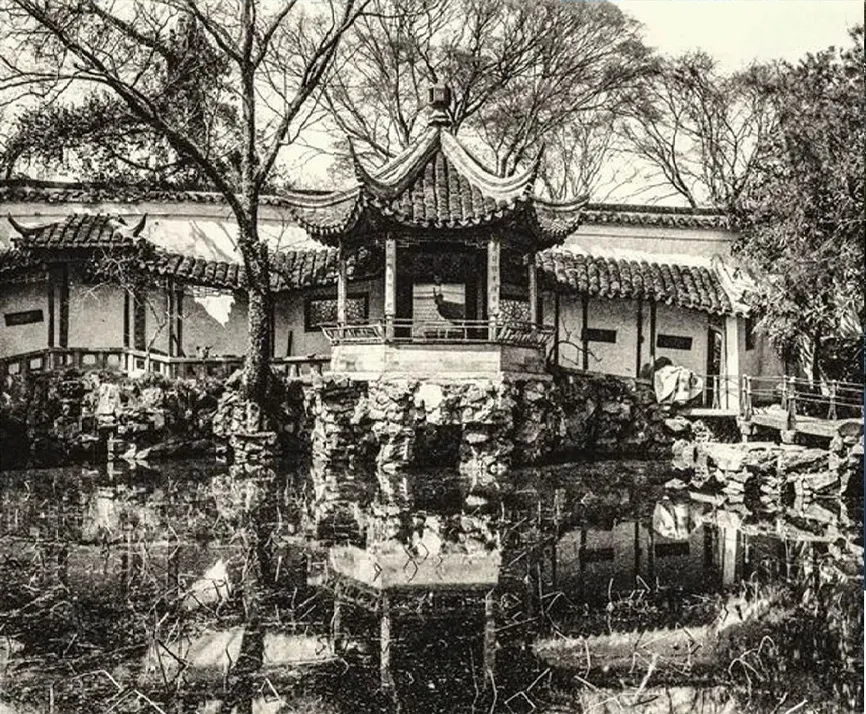
Photographic source: Osvald Sirén, Gardens of China, New York: The Ronald Press Company, 1949. The same group of images is also discussed in Gu Jiuwen, Shi Yuanfeng, and Jia Shan, “The Change of Narratives: How Osvald Sirén’s Photography Shaped the Study of Modern Chinese Gardens.”
Osvald Sirén’s photographs of the Master of the Nets Garden are collected in Gardens of China (1949). The six images below record three views of the Pavilion Where the Moon Comes with the Breeze, as well as the Bridge Leading to Tranquility, the Duck-Shooting Corridor, and the Peony Study. In the photographs, tree branches reach out over the pool, while pavilions, corridors, and rocks shelter one another.
References
- Suzhou Municipal Administration of Gardens and Greening: “The Master of the Nets Garden,” Garden Directory.
- Suzhou Municipal Administration of Gardens and Greening: “The Master of the Nets Garden,” World Heritage.
- Suzhou Municipal Administration of Gardens and Greening: “Fisherman’s Seclusion West of the Pool”.
- Suzhou Municipal Administration of Gardens and Greening (ed.): Wangshiyuan Zhi (Gazetteer of the Master of the Nets Garden), Shanghai: Wenhui Press, 2014.
- Tong Jun: Jiangnan Yuanlin Zhi (Gazetteer of the Gardens of Jiangnan), Beijing: China Architecture & Building Press, 1984.
- Gu Jiuwen, Shi Yuanfeng, and Jia Shan: “The Change of Narratives: How Osvald Sirén’s Photography Shaped the Study of Modern Chinese Gardens”, Landscape Architecture, vol. 32, no. 1 (2025), pp. 133–140.
- Osvald Sirén: Scanned original of Gardens of China, New York: The Ronald Press Company, 1949.