Introduction
In the twentieth year of Kaiyuan (732), Emperor Xuanzong of the Tang ordered the two capitals and every prefecture to establish temples to the Xuanyuan Emperor[1] and to found Chongxuan academies, teaching Taoist classics such as the Daodejing and the Zhuangzi. In the twenty-sixth year of Kaiyuan (738), the court further ordered every prefecture to choose from among the temples within its city one with suitably situated ground, to give them all the name tablet “Kaiyuan,” and to hold at the Kaiyuan temples such official ceremonies as the walking of the Way and the setting out of fasts on the Qianqiu Festival and the days of the Three Primes[2]. Under this system, the prefect Ren Zhaoqing established the Kaiyuan Palace within the city of Suzhou. The temple’s Taoists later built the Shrine of Lord Ren to commemorate this founder.
The late-Tang rebellion of Sun Ru burned the buildings surrounding the Kaiyuan Palace; only the Three Gates and the main hall survived, and they were repaired afterward. In the second year of Dazhong Xiangfu (1009), Emperor Zhenzong of the Song ordered that temples be built in every prefecture and county that had no Taoist temple or palace, and upon completion all were given the name tablet “Tianqing Temple.” In the fifth year of Dazhong Xiangfu (1012), Emperor Zhenzong declared that the Heavenly Honored One Siming Baosheng of the Nine Heavens was Zhao Xuanlang, the primordial ancestor of the Zhao clan, and honored him as the “Sage Ancestor”; he further ordered every Tianqing temple in the realm to add a Hall of the Sage Ancestor, with materials supplied by the government and images installed after the model of the Yuqing Zhaoying Palace in the capital. The Kaiyuan Palace of Suzhou likewise changed its name tablet to Tianqing Temple in this period and enshrined Zhao Xuanlang. Thereafter the temple was expanded with four cloisters, a number of halls, the Jingle Palace, and the Hall of the Eight Immortals; in the Huangyou era the Three Gates were rebuilt, and in the seventh year of Xuanhe (1125) the temple was granted fifty qing of fields in Kunshan as incense-and-lamp land.
In the Jianyan era (1127–1130) of the early Southern Song, the temple buildings were again destroyed in the turmoil of war. In the sixteenth year of Shaoxing (1146), the prefect Wang Huan rebuilt the two galleries and entrusted their walls to a number of painters: some painted mountains and forests, some figures, some towers and pavilions, and some flowers and trees, together forming a great cycle of murals illustrating the Lingbao Scripture of Salvation.
In the Chunxi era, the prefect Chen Xian allocated public funds; the magistrate of Wu County, Huang Baizhong, supervised the work; and the Taoist Lu Jingping directed the construction of the Hall of the Three Pure Ones[3]. The work began in the spring of the second year of Chunxi (1175) and was completed in the winter of the fourth year (1177). In the sixth year of Chunxi (1179), the Hall of the Sage Ancestor caught fire; Zhao Bosu, then administering the affairs of the prefecture, directed the rebuilding after the fire and painted a “Design for the Tianqing Temple of Gusu,” which he presented to Emperor Xiaozong of the Song. Xiaozong ordered that it be built according to the painted design, and in the eighth year of Chunxi (1181) he personally wrote the six characters “Jinque Liaoyang Treasure Hall” to serve as the hall’s name tablet.
In the twenty-sixth to twenty-seventh years of Zhiyuan (1289–1290), the Taoist Yan Huanwen directed repairs to the Hall of the Three Pure Ones; the official Zhu Wenqing, together with his wife and children, donated a great sum of money, and the temple also purchased timber shipped from the Jianghuai region. In the twenty-ninth year of Zhiyuan (1292), Yan Huanwen went on to rebuild the Three Gates; the lady Hu Miaoneng donated her own hairpins and earrings to fund the work, and only when the new gates were completed did they match the towering Hall of the Three Pure Ones. In the first year of Yuanzhen (1295), the Yuan court abolished the spirit tablets of the Song Sage Ancestor enshrined in the Tianqing temples south of the Yangtze and decreed that the Tianqing temples of the various circuits of Jiangnan be renamed Xuanmiao temples. The Tianqing Temple of Suzhou from then on took the name Xuanmiao Temple.
At the end of the Yuan, in the Zhizheng era, Xuanmiao Temple was destroyed once more by war. In the fourth year of Hongwu of the Ming (1371), the court put the Taoist religion in order, turning Xuanmiao Temple into a Zhengyi convent and establishing within it the Daoji Office[4], which administered Taoist affairs in Suzhou. The halls and galleries were repaired one after another thereafter; only the costly Miluo Treasure Pavilion long remained unbuilt. In the third year of Zhengtong (1438), Suzhou suffered a great drought; the grand coordinator Zhou Chen and the prefect Kuang Zhong came to the temple to pray for rain, and afterward donated their salaries and organized the rebuilding of the treasure pavilion. The Taoists responsible for purchasing the timber met a great wind on the Yangzi River, and the rafts were blown apart; the stele record says that after they prayed and saw the Xuantian Emperor appear amid the clouds, the scattered timbers had all gathered together at the mouth of the Mengdu Creek. In the summer of the fifth year of Zhengtong (1440), the Miluo Treasure Pavilion was completed.
By the late Ming, the space before the gates of Xuanmiao Temple had become the place where Suzhou’s silk weavers waited for work. Every morning, several hundred “small households,” who made their living weaving for others, gathered at the “Xuanmiaokou,” the crossing by the temple, waiting to be hired by the loom-owning “great households,” working a day in exchange for that day’s meals.
In the Qing, Xuanmiao Temple was renamed Yuanmiao Temple to avoid the personal name Xuanye of the Kangxi Emperor. In the sixteenth year of Qianlong (1751), Suzhou officials retired to their hometown set up a scripture altar at Yuanmiao Temple to pray for the Empress Dowager’s longevity, and when the Qianlong Emperor first came to Suzhou on his southern tour, he visited the altar ground in person. In the first year of the Republic (1912), the Miluo Treasure Pavilion behind the Hall of the Three Pure Ones caught fire and burned down; the Southern Song Hall of the Three Pure Ones survived, however, and is today the main hall of Xuanmiao Temple.
Historical Documents
Gusu Zhi (Gazetteer of Gusu)
汉任使君祠祀唐剌史任昭庆也。在天庆观,即今之玄妙观。唐名开元宫,宫为任所置,故道流祀之。庆历中,观毁,其像犹存。
The Shrine of Lord Ren of the Han sacrifices to Ren Zhaoqing, prefect of the Tang. It is in the Tianqing Temple, the present Xuanmiao Temple. In the Tang it was called the Kaiyuan Palace; the palace was established by Ren, and so the Taoists sacrifice to him. In the Qingli era the temple was destroyed, but his image still survives.
Wu Jun Zhi (Gazetteer of Wu Commandery)
天庆观,在长洲县西南,即唐开元观也。兵火前,栋宇最为宏丽。绍兴十六年,郡守王唤重作两廊,画灵宝度人经变相,召画史工山林、人物、楼橹、花木,各专一技者,分任其事,极其工致。淳熙六年,圣祖殿火,提刑赵伯骕摄郡,重建三清殿。淳熙三年,郡守陈岘建。初,道士募缘,御前亦有所赐,始克成就。八年,至尊寿皇圣帝赐御书金阙寥阳宝殿六字为殿额。伯骕跋语:上既诏新平江府天庆观三清殿,乃亲御翰墨,书金阙寥阳宝殿六大字以揭之。云藻昭回,龙凤翔翥,万目耸瞻,威颜咫尺,猗欤盛哉!臣观唐文皇书画,居钟王表,凡形篇咏,赐臣工,载在汗简,侈为美谭。然于明道阐教,为生民福者,未始有闻。恭惟皇帝陛下,天纵多能,游艺八法,夐出神所,奚唐足云。矧方玩意昭旷,储神穆清,观道妙于化原,跻斯民于寿域,固非下民所能测窥其万分。第自今仰观勾吴之墟,奎壁垂光,王气所钟,奔走百神,㧑诃护持,罔敢或后,当与天无极云。郡守赵伯骕恭题。郡人龚颐正作上梁文以进,寿皇嘉焉。在昔吴都,于今汉辅。诞惟仙圣之宅,有严壮丽之区。与日月以蔽亏,式表中天之华阙;帅云霓而来御,蔚为上帝之高居。庆基岳峙以当阳,琳宇星罗而拱极。南端洞达,正殿穹崇。维时三境之常尊,骈集九光之法驾。螭蟠万础,遗址故存;翚飞百楹,群目未睹。方重熙累洽之运,正远至迩安之时,曾是殊庭,莫还旧观。其何以伫飙游于肸蚃,甄灵贶于幅员?皇上睠言,不吝有司之费;寿宫申祝,亶储二圣之休。守臣承睿志以致䖍,上士不崇朝而乐施。至人示化,高道勤心。占营室于瑶光,萃梓材于荆楚。莫不霞舒引墨,雷动挥斤。是度而是宜,不震而不竦。琼檐绣栱,倐若化城;金戺玉阶,殆非人境。伫结𦂶粲朝暾之采,想觚棱宿非烟之祥。仰规太紫之圆方,俯尽鬼神之情状。下锵鸣之玉珥,知足称于降临;睨帖妥之瑶坛,庶永蕃于祠奉。考其经始,曾不淹辰。斯举应龙之修梁,可后巨鳌之窃抃。敢伸善颂,以佐欢谣。抛梁东,沧海微茫一望中。旸谷扶桑朝玉殿,郁然和气御灵风。抛梁西,震泽重湖玉浪低。风雨调和时节好,不烦香火咏朝𬯀。抛梁南,咫尺神都汉辅三。丙位有星长灿烂,两宫天寿与之参。抛梁北,金榜云房新表出。一念通神本圣功,八荒有道开皇极。抛梁上,风马云车来有象。上元八景是天宫,万岁千秋输景贶。抛梁下,日夕曾坛隆报谢。昭垂乾象报丰年,开阐坤珍资道化。伏愿上梁之后,慈闱康寿,宸扆尊隆。德教并恢于彤管,仁恩长楙于青宫。国栋无挠,王臣尽忠。边圉永消于兵革,民编益劭于耕农。千里绝札瘥之盩,四民均亭毒之工。协气旁薄而扶舆,下九凤五龙于平世;高灵偃蹇而姣服,肃千乘万骑于浮空。来佑太平之极治,普臻希静之真风。皮日休伤开九顾道上协晨宫上启金扉,诏使先生坐蜕归。鹤有一声应是哭,丹无余粒恐潜飞。烟凄玉笥封云篆,月惨琪花葬羽衣。肠断雷平旧游处,五芝无影草微微。观中有金宝牌,真宗所赐永镇于地者,兵火独全,六朝旧物也。殿后通神庵,淳熙八年,左街道箓李若济奉命建,庵额三字亦御书。先是,有何道人者,自绍兴初往来提举司或观前真武堂草积中,披发颠狂,以蓑衣蔽形,故号蓑衣道人。寒暑不避,不与人亲。或云时有一语,中人灾福。两朝间遣使降香,问其安否,然庵则未始迁也。
The Tianqing Temple lies southwest of Changzhou County; it is the Kaiyuan Temple of the Tang. Before the fires of war, its buildings were the most grand and beautiful. In the sixteenth year of Shaoxing, the prefect Wang Huan rebuilt the two galleries, painting transformation tableaux of the Lingbao Scripture of Salvation; he summoned painters skilled in mountains and forests, in figures, in towers and belvederes, and in flowers and trees, each a master of a single art, and divided the tasks among them, with the utmost refinement. In the sixth year of Chunxi the Hall of the Sage Ancestor burned; the judicial commissioner Zhao Bosu, administering the prefecture, rebuilt the Hall of the Three Pure Ones. It had been built by the prefect Chen Xian in the third year of Chunxi. At first the Taoists raised subscriptions, and the imperial presence also made gifts, and only then could it be completed. In the eighth year, the Supreme One, the August Sage Emperor Shouhuang, bestowed the six imperially written characters Jinque Liaoyang Treasure Hall as the hall’s name tablet. Bosu’s colophon says: “The Emperor having decreed the renewal of the Hall of the Three Pure Ones at the Tianqing Temple of Pingjiang Prefecture, thereupon with his own brush he wrote the six great characters Jinque Liaoyang Treasure Hall to be displayed above it. Cloud-patterned and resplendent, dragons and phoenixes soar and swoop; ten thousand eyes gaze up in awe, the majestic countenance but a foot away—ah, how splendid! Your servant observes that the calligraphy and painting of Emperor Wen of the Tang stood in the rank of Zhong [Yao] and Wang [Xizhi]; whatever took form in his verse and was bestowed upon his officers was recorded on the bamboo slips and is extravagantly told as fine talk. Yet of illuminating the Way and expounding the teaching, of being a blessing to the living people, nothing was ever heard. Reverently I consider that Your Majesty, abundantly endowed by Heaven, disports in the art of the eight methods of the brush, far surpassing the reach of the divine—how could the Tang suffice for comparison? Moreover, now delighting in the luminous and vast, storing the spirit in the serene and pure, beholding the wondrous Way at the fountainhead of transformation and raising this people into the realm of long life—this is surely not something the lowly folk can fathom in its ten-thousandth part. From this day forth, looking up upon the soil of Gouwu, where the constellations Kui and Bi shed their light and the royal aura converges, the hundred spirits hasten to guard and protect it, not daring to lag behind: may it be without end, together with Heaven.” Respectfully inscribed by the prefect Zhao Bosu. The townsman Gong Yizheng composed a beam-raising text and presented it, and Shouhuang praised it: “Of old the capital of Wu, today a bulwark of the Han. Truly it is the abode of immortals and sages, a precinct of solemn grandeur. Rivaling the sun and moon in overshadowing, it marks out the floriate towers of mid-heaven; leading the clouds and rainbows as its retinue, it rises luxuriant as the high dwelling of the Lord on High. Its felicitous foundations stand mountain-like, facing the sun; its gemmed roofs spread like stars, arching to the pole. Its southern face opens through and through; its main hall vaults on high. There the ever-honored ones of the Three Realms gather, the dharma carriages of the Nine Radiances ranged side by side. Hornless dragons coil upon its myriad plinths—the old foundations still remain; pheasant-wing eaves fly from its hundred columns—a sight the multitude had never seen. At a time of redoubled brightness and accumulated harmony, when the distant arrive and the near are at peace, this extraordinary court had not yet returned to its former aspect. How then might it await the wind-borne wanderings of the spirits, or gather numinous gifts within its bounds? The Emperor turned his regard upon it and did not grudge the officers their expense; the Palace of Longevity extended its prayers, truly storing up the blessings of the two sage ones. The governor, receiving the imperial intent, gave it utmost devotion; the gentlemen gladly gave alms before the morning was out. The perfected ones showed their transforming power; the lofty Taoists bent their hearts to the task. They took the omens of the constellation Yingshi by the Yaoguang star; they gathered catalpa timbers from Jing and Chu. Everywhere mist unfurled as the ink-lines were stretched, thunder rolled as the adzes swung. Measured and fitting, neither shaken nor hurried. Jasper eaves and embroidered brackets—in an instant like a conjured city; golden plinths and jade stairs—scarcely of the human realm. One awaits the braided brilliance catching the colors of the morning sun, and imagines the ridge-poles lodging the auspice of unclouded mist. Above, it takes its measure from the round and square of the Great Purple; below, it exhausts the forms and shapes of ghosts and spirits. The tinkling jade earrings hanging below are fit to be praised at their descent; the gemmed altar, gazed upon in settled order—may its sacrifices ever flourish. Examining its commencement, it took no long season. This raising of the long beam answers to the winged dragon; the applause of the giant turtle may follow after. I dare to extend these good praises, to accompany the songs of joy. Casting the beam to the east: the gray-green sea stretches faint within a single gaze; the Valley of Sunshine and the Fusang tree pay morning court to the jade hall; luxuriant, a harmonious aura rides the numinous wind. Casting the beam to the west: Lake Zhenze’s doubled waters lower their jade waves; wind and rain are tempered and the season is fair; no need to trouble the incense fires to chant the morning litany. Casting the beam to the south: a foot away lies the divine capital, third among the bulwarks of the Han; in the bing quarter a star shines ever brilliant; the Heaven-granted longevity of the two palaces makes a triad with it. Casting the beam to the north: golden tablets and cloud chambers newly stand forth; a single thought that reaches the spirits is rooted in the sage’s merit; the eight directions possess the Way, opening the imperial ultimate. Casting the beam upward: wind-horses and cloud-carriages come in visible forms; the Eight Radiances of the Supreme Primes are this heavenly palace; for ten thousand years and a thousand autumns it pours down its resplendent gifts. Casting the beam downward: morning and evening upon the tiered altar, grand are the offerings of thanks; the images of heaven hang bright above, repaying a fruitful year; the treasures of earth are opened forth, aiding the transformation of the Way. We humbly pray that after the raising of the beam, the compassionate palace may have health and long life, the imperial screen honor and exaltation. May virtuous teaching be magnified alike by the red brush; may benevolent grace long flourish in the Green Palace. May the pillars of the state never bend; may the king’s servants be wholly loyal. May the border marches forever be free of weapons and war; may the registered people grow ever better in plowing and farming. May a thousand li be free of pestilence and blight; may the four classes of people equally share in nurturing care. May harmonious vapors surge abroad to uphold the world, bringing down nine phoenixes and five dragons upon an age of peace; may the high spirits, proud and finely dressed, marshal a thousand chariots and ten thousand riders in the empty sky. May they come to aid the utmost governance of great peace, and may all attain the true manner of the rarefied and still.” Pi Rixiu’s lament for Taoist Gu of Kaiyuan: “In the Palace of Attendant Dawn the golden doors opened above; the summoning envoy found the master already shed like a cicada, returned. The crane’s single cry must be a weeping; of the elixir no grains remain, feared to have flown away in secret. Mists grieve over the jade case sealing the cloud-script; the moon is sere on coral blossoms burying the feathered robe. The heart breaks at Leiping, the place of former wanderings; the five magic fungi have vanished, the grasses faint and few.” In the temple there is a golden treasure tablet, bestowed by Emperor Zhenzong to be eternally buried in the earth; it alone survived the fires of war whole, an old object of the Six Dynasties. Behind the hall is the Tongshen Hermitage, built by command in the eighth year of Chunxi by the Left-Road Taoist registrar Li Ruoji; the three characters of its name tablet are also in the imperial hand. Earlier there was a certain Taoist He, who from the beginning of Shaoxing came and went between the superintendent’s office and the piles of straw before the Zhenwu Hall in front of the temple, his hair disheveled and his manner mad, covering his form with a straw raincoat—hence he was called the Raincoat Taoist. He avoided neither cold nor heat and kept close to no one. It was said that from time to time he uttered a word that struck upon men’s disasters or fortunes. During the two reigns envoys were sent to present incense and ask after his well-being, yet the hermitage was never moved.
Tuhui Baojian (Precious Mirror of Painting)
赵伯骕字希远,千里弟,善画山水、人物,尤长于花禽,傅染轻盈,顿有生意。尝画姑苏天庆观样进呈,孝宗书其上,令依元样建造。今玄妙观是也。
Zhao Bosu, courtesy name Xiyuan, was the younger brother of [Zhao] Qianli. He excelled at painting landscapes and figures, and was especially strong in flowers and birds, applying his colors with a lightness that gave them sudden life. He once painted a design for the Tianqing Temple of Gusu and presented it; Emperor Xiaozong wrote upon it and ordered that it be built according to the original design. This is the present Xuanmiao Temple.
Ting Shi (Notes from the Bedside Table)
姑苏有二异人,曰何蓑衣,曰呆道僧,踪迹皆奇诡。淳熙间名闻一时,士大夫维舟者,率往访之,至今吴人犹能言其大略。何本淮阳朐山人,书生也。祖执礼,仕至朝议大夫,世为鼎族,遭乱南来,寓于郡。尝授业于父,已能文,一旦焚书裂衣遁去,人莫之知。既乃归,被草结庐于天庆观之龙王堂,佯狂妄谈,久而皆有验。卧草中,不垢不秽;晨必一至吴江,溲焉。郡至吴江五十里,往反不数刻,人固讶之。会有一瘵者,拜谒乞医,何命持一草去,旬而愈,始翕然传蓑可愈病。亦有求而不得,随辄不起者,于是远近稍敬异之。
Gusu had two extraordinary men, one called He Suoyi—Raincoat He—and one called the Doltish Taoist Monk, whose traces were all strange and uncanny. In the Chunxi era their names were heard throughout the age; the gentlemen whose boats moored there all went to visit them, and to this day the people of Wu can still relate the gist. He was originally from Qushan in Huaiyang, a scholar. His grandfather Zhili rose in office to Grand Master of Court Discussion; the family had been a great clan for generations, but fleeing the troubles they came south and lodged in the prefecture. He had received instruction from his father and could already compose, when one day he burned his books, tore his clothes, and fled, no one knew where. Later he returned, clad himself in straw, and built a hut at the Dragon King Hall of the Tianqing Temple, where he feigned madness and raved wildly, all of which over time proved true. He lay in the straw, neither foul nor soiled, and every morning he went once to the Wujiang to relieve himself. The prefecture is fifty li from the Wujiang, yet he went and returned within a few quarter-hours; people were indeed astonished. It happened that a consumptive man bowed in audience and begged for medicine; He bade him take away a stalk of straw, and within a ten-day week he was cured. Thence it spread with one accord that his straw coat could cure illness. There were also those who begged and did not receive and soon thereafter died; and so from near and far people grew somewhat reverent and amazed.
先是观中诸黄冠以殿宇既毁,欲试其验,群造其庐,拜且白之,何从求疏轴。主者谩以与,何笑曰:“来日自有施者。”至午,使者果来,既答,则曰:“我不能入觐,以此累使者。”上闻而益奇之。会浙西赵宪伯骕亦为之请,遂肆笔金阙寥阳殿额,出内帑缗钱万,绘事一新,以答其意。
Earlier, when the halls of the temple had been destroyed, the various Taoists, wishing to test his powers, went in a body to his hut, bowed, and told him of it; He then asked them for a subscription scroll. The one in charge gave it to him carelessly, and He laughed and said: “Tomorrow a donor will come of himself.” At noon an imperial envoy indeed came, and having answered, He said: “I cannot enter for an audience; I trouble the envoy with this.” The emperor heard and marveled at him the more. It happened that Zhao Bosu, the judicial commissioner of western Zhe, also made a plea on his behalf, and so the emperor freely brushed the name tablet of the Jinque Liaoyang Hall and released ten thousand strings of cash from the privy purse, so that the painted work was wholly renewed, in answer to his wish.
Zhao Jian Sanqing Dian Ji (Record of the Imperially Ordered Construction of the Hall of the Three Pure Ones)
君人者欲表仪天下,无以示国家尊祖之意。凡今诸郡之天庆观,所以祠圣祖也。人本乎祖,矧我国家仙源衍庆,圣系流禧,肆不藏崇上灵之祀,其何以炳圣祖在天之灵也。孝宗皇帝有旨,平江府天庆观建三清殿,殿成,亲洒宸翰,金阙寥阳宝殿六大字扁之殿眉,示吾尊祖也。若夫汉太初之处神明,通天之台,束元嘉之用净轮天官之法,盖异矣。姑苏佳山水,秀辅未央,葱连阊阖。嘉定辛巳𥧃月𬐍望,臣小舣长桥,将如虎丘,过自祖庭,目其正殿雄伟,为诸郡冠,诘其所自知,为诏建之也。自祥符中,额此观矣。建炎戎烬之余,绍兴乙丑,太守、贰卿王侯换剡于朝,赐缗钱,复殿圣祖,而未暇三清,适以召去弗遂。黄冠朱直猷,鸠众市财,欲踵其志,复以疾奄。淳熙乙未,道录李若济奉御香藏𬋕于兹,回奏得旨,令郡侯殿撰陈岘发公贿,属吴县尹黄百中董役。经始于乙未之春,讫成于丁酉之冬。星锤月斧,旦氤花工,霞拱云甍,人神胥庆,实大洞法师陆景平主其盟为甚力。嗟乎!事物之兴,机会之来,必韪其人,然亦有所待也。琼檐宝楯,星月相攒;金祀玉墀,云霓为御。金碧蒨灿,粉藻华鲜。螭础千蟠,翚楹万舞。觚棱峭翠,结绮流丹,恍睹九光,何殊三境。俨为华阙,蔚庆壮基。幻玉清、上清、太清之规模,奉天宝、云宝、神宝之晨梵。是宜六龙宴驾,九虎严阍,凤导飙轮,鸾骖羽乘,锡尔戬榖,贶我国家。此殿长宁,与宋无极。良由仙灵之所宅,是以明圣之留神。昔仙二易翁葛孝先炼丹此地,丹井犹存,雨夕风朝,时流丹现。于皇圣朝,高真应世,圣作明述,卫教崇真,非特奉禋祧,是亦为尔冠裳之地也。晨登陛槛,目注帝直,盍思所以报国家者乎?无使曰:朝帝夕烛,藐藐而已。冲隐大师马大同,嗣陆景平之后,悯往事之已远,畏来者之弗知,应相谓曰:此殿既成,几五十载,属臣为记。且如天上成玉楼,地下修文阙,往昔人间。士以为记文。今兹庙谟所式,当代盛事,帝监不远,宜不得辞。臣于是黾勉不逮,弗思而成,但觉如操觚弄椠于蕊珠之上,虚皇之前也。
A ruler who would set a standard for the realm has no better means to show the state’s intent to honor its ancestor. All the Tianqing temples of the various prefectures today are the means by which the Sage Ancestor is worshipped. Man is rooted in his ancestors; how much more our state, whose immortal fountainhead spreads its felicity and whose sage lineage flows with blessings! If we did not amply honor the sacrifices to that lofty spirit, by what means could we make brilliant the Sage Ancestor’s spirit in Heaven? Emperor Xiaozong decreed that the Tianqing Temple of Pingjiang Prefecture build a Hall of the Three Pure Ones; when the hall was completed, he personally sprinkled the imperial ink, and the six great characters Jinque Liaoyang Treasure Hall were set as a tablet upon the hall’s brow, showing our honoring of the ancestor. As for the Han Taichu era’s lodging of the spirits and its Heaven-Reaching Terrace, and the gathering in the Yuanjia era of the methods of the pure-wheel celestial offices—those were of a different kind. Gusu is a landscape of fine mountains and waters, fair as a bulwark of the Weiyang Palace, verdant and joining the Changhe Gate. In the xinsi year of Jiading, in that month on the day after the full moon, your servant moored his small boat at the Long Bridge, intending to go to Tiger Hill; passing by the Ancestral Court, I saw that its main hall was grand and majestic, the crown of all the prefectures, and asked those who knew how it had come to be: it had been built by imperial decree. Since the Xiangfu era this temple had borne its tablet. In the yichou year of Shaoxing, amid the embers left by the Jianyan fighting, the prefect, Vice Minister Lord Wang, petitioned the court and was granted strings of cash; he restored the hall of the Sage Ancestor, but had no leisure for the Three Pure Ones, being summoned away before he could carry it out. The Taoist Zhu Zhiyou gathered the faithful and raised funds, wishing to follow in his intent, but again was cut off by illness. In the yiwei year of Chunxi, the Taoist registrar Li Ruoji, bearing imperial incense, deposited it here; on his return he memorialized and received a decree ordering the prefect and palace drafter Chen Xian to disburse public funds and charging the magistrate of Wu County, Huang Baizhong, with directing the work. The work began in the spring of yiwei and was finished in the winter of dingyou. Hammers fell like stars and axes like the moon; at dawn the mists wreathed the flowered work; rosy clouds arched the brackets and misted the ridges; men and spirits alike rejoiced. In truth it was the Great Cavern Master Lu Jingping who led the undertaking with the greatest strength. Ah! The rise of a thing, the coming of an opportunity, must find the right man, yet it also has that for which it waits. Jasper eaves and jeweled balustrades, clustered with stars and moon; golden offerings and jade stairs, driven on clouds and rainbows. Gold and azure, madder-bright; powdered tracery, floriate and fresh. Hornless dragons coil a thousandfold upon the plinths; pheasant-wing columns dance in their tens of thousands. The ridge-poles rise sheer and green, binding gauze and streaming cinnabar; dimly one beholds the Nine Radiances—how is this different from the Three Realms? Solemn, it is a floriate palace-tower; luxuriant, it celebrates its mighty foundations. Conjuring the measure of the Jade Pure, the Supreme Pure, and the Great Pure, it serves the dawn litanies of the Heavenly Treasure, the Cloud Treasure, and the Divine Treasure. Fitting it is that six dragons should draw the feasting chariot, nine tigers keep the stern gate, phoenixes lead the whirlwind wheels and simurghs flank the feathered carriage, bestowing on you full blessing and granting gifts upon our state. May this hall be ever tranquil, without end together with the Song. Truly because it is the dwelling of immortal spirits, the brightly sage emperor has fixed his attention here. Of old the immortal Ge Xiaoxian, the Elder of the Two Changes, refined his elixir in this place; the elixir well still remains, and on rainy evenings and windy mornings flowing cinnabar from time to time appears. O august, the sacred dynasty! The high perfected ones respond to the age; the sage creates and the enlightened continues, guarding the teaching and exalting the true—not only offering the ancestral sacrifices, but also making this a place for you capped-and-gowned ones. As you mount the palace steps at dawn, your gaze fixed upon the imperial presence, why not think on the means by which to repay the state? Let it not be said: “Court the emperor at morn, hold the candle at eve—mere trifling, nothing more.” The master Chongyin, Ma Datong, succeeding after Lu Jingping, grieving that past events had grown distant and fearing that those to come would not know them, said to me: “This hall has been completed nearly fifty years; I charge you, minister, to make a record of it.” Moreover, as when in heaven the jade tower was completed, or below the earth the literary towers were built, in days past the men of the world took such things as matter for record-writings. Now here is a pattern laid down by the ancestral counsel, a grand affair of the present age; the emperor’s mirror is not far, and I properly may not decline. Your servant therefore strove though unequal to the task, and completed it without reflection, feeling only as though I plied the writing tablets atop the Pearl-Bud Palace, before the Empty August One.
Pingjiangfu Chongjian Sanqing Dian Ji (Record of the Rebuilding of the Hall of the Three Pure Ones in Pingjiang Prefecture)
混沌既判,惟天为大,不可俄而度。据逺视之,其色苍苍,以形体则谓之天。作善降之百祥,作不善降之百殃,以主宰则谓之帝。元始而亨,亨而利贞,以性情则谓之乾。不疾而速,不行而至,以妙用则谓之神。合理为气,其可得而名言者如此。古者祀天,𨿽有坛壝之制,配侑之礼,五方之名,粢盛牲玉之荐,大抵一精二纯,尚忠质而已。非若后世为之尊号焉,为之宫室焉,为之冠冕衣裳焉。自唐封天寳以来,追尊本始,加上徽称,益崇以备,岂非神而明之,章尔灵度,震动宇内,俾知所寅奉欤?平江𤣥妙观三清殿,寔再建于淳熈丙申。殿凡七楹,雄杰冠浙右。越八十年甲寅,住持严守柔重复屋。又八年辛酉,蒋处仁重葺周栏。又三十四年,为至元戊子,阮籍郡乘政赐额。旧观浸隳,处仁之徒严焕文兴仁作新,而为费甚重。𤼵心縁募,善诱乐施。时则今左辖朱公文清与妻若子,大捐金钱,以相其役。焕文不避寒暑,致木江淮,官易其梁柱,以致方圎偃植,靡不坚壮;圬墁陶甃,靡不完㝊;斧藻像饰,靡不严洁。始于已丑二月,成于𢈏寅十月。焕文𡮢贱事淳祐大魁黄由之孙,嗣得其奥㫖,恬静有守,人人皆倾。住持许嗣祖、张善渊、滕伯淳,皆志同虑协,故所为必成,焯有可记也。大徳壬寅十月,因吴兴赵孟頫谂于陵阳牟巘曰:殿成十有三年矣。淳熈之役,适遇三丙申,殆非偶然。已治石庑下,愿为记成事。固辞勿获。夫气有盈虚,物有成壊,事有因革,惟理独不杼。昭昭灵灵,千载一日,盖覆冒中之主宰,性情中之神化也。洪惟新殿,有严典领,焕文不有其功,方且夙夜祗格,用对越在天。凡所为民祷禬者,固有出于土木科仪、𤓰花香灯之外。上帝溥临,降观有赫,尚敬之哉!是为记。
Once chaos divided, Heaven alone is great and cannot be measured in a moment. Looking up at it from below, its color is azure; in respect of its form and body it is called Heaven. To those who do good it sends down a hundred blessings; to those who do not good it sends down a hundred calamities; in respect of its lordship it is called the Emperor. Originating and flourishing, flourishing, benefiting, and steadfast, in respect of its nature and feeling it is called Qian. Not hasty yet swift, not moving yet arriving, in respect of its wondrous working it is called the Divine. Joining principle into breath—such is what may be put into words. Of old, in sacrificing to Heaven there were the rules of the altar mound and its enclosures, the rites of the paired attendants, the names of the five quarters, the offerings of grain vessels, sacrificial beasts, and jades—for the most part a single purity and a doubled purity, esteeming loyalty and plain substance and no more. It was not like later ages, which made for it honored titles, made for it palaces and halls, made for it caps, crowns, robes, and garments. Since the Tianbao era of the Tang, when they posthumously honored the primal beginning and added fine appellations, ever more exalted and complete—was this not to make it divine and bright, to manifest its numinous measure, to shake all within the four seas and make them know what to reverently serve? The Hall of the Three Pure Ones of the Xuanmiao Temple of Pingjiang was in truth rebuilt for the second time in the bingshen year of Chunxi. The hall is seven bays in all, in its grandeur the crown of the lands right of Zhe. Eighty years later, in the jiayin year, the abbot Yan Shourou re-roofed it. Eight years further, in the xinyou year, Jiang Churen again repaired the surrounding railings. A further thirty-four years brought the wuzi year of Zhiyuan, when Ruan Ji, holding the government of the commandery, bestowed the name tablet. The old temple gradually fell to ruin; Churen’s disciple Yan Huanwen raised it up in benevolence and made it new, but the cost was very heavy. He opened his heart to soliciting donations, and the good rejoiced to give. At that time the present Left Administrator, Lord Zhu Wenqing, together with his wife and children, gave great sums of money to aid the work. Huanwen avoided neither cold nor heat and brought timber from Jianghuai; by official leave he replaced its beams and pillars, so that every square and round, every horizontal and upright member was strong and stout; of the plastered and tiled paving, none but was whole and firm; of the carved and painted image ornaments, none but was solemn and clean. It was begun in the second month of the jichou year and completed in the tenth month of the gengyin year. Huanwen once, in humble station, served the grandson of Huang You, the first-place graduate of the Chunyou era, and in turn obtained his profound purport; quiet and retiring, he kept his charge, and all men inclined to him. The abbots Xu Sizu, Zhang Shanyuan, and Teng Bochun were all of like will and harmonious counsel; therefore what they did was sure to be accomplished, brilliant and worthy of record. In the tenth month of the renyin year of Dade (1302), through Zhao Mengfu of Wuxing they made known to Mou Yan of Lingyang, saying: “The hall has been completed thirteen years. The undertaking of the Chunxi era happened to fall upon the third bingshen—scarcely, one would think, by chance. The stone has been prepared beneath the portico; we beg you to record the completed work.” I firmly declined, but was not permitted. Now breath has its fullness and emptiness, things their completion and decay, affairs their continuity and change; only principle alone does not wear away. Bright, bright, numinous, numinous, a thousand years as a single day—it is the lord within the overarching canopy, the divine transformation within nature and feeling. Great is this new hall, solemn in its charge; Huanwen does not claim the merit as his own, but morning and night reverently draws near, thereby answering to what is in Heaven. All his prayers and rites on the people’s behalf surely go beyond the works of earth and timber, the ritual codes, the burning of incense, the flowers and lamps. The Lord on High looks down universally; let those who behold below be in awe. May they ever reverence Him! This I make the record.
Xuanmiaoguan Sanmen Beiming (Stele Inscription for the Three Gates of Xuanmiao Temple)
天地阖辟,运乎鸿枢,而乾坤为之户;日月出入,经乎黄道,而卯酉为之门。是故建设琳宫,摹宪𤣥象。外则周垣之聫属,灵星之横陈;内则重闼之划开,阊阖之仿佛。非崇严无以备制度,非巨丽无以竦视瞻。惟是勾吴之邦,𤣥妙之观,赐额改矣,广殿新矣,而三门甚陋。万目所观,譬之神,威仪未备;一身之内,强弱弗侔,非欠欤?观之徒严焕文,深念前功,是究是圗。时则有夫人胡氏妙能,捐其簪珥,给其资用。爰壬辰之纪岁,亟先甲以庀徒。曽几何时,悉更其旧。翚飞丹栱,簷牙高矗于层霄;兽啮铜镮,铺首𪸩煌于朝日。大庭中敞,峻殿周罗,可以树羽节,可以容銮驭,可以陟三层之坛,可以通九闗之奏,可以鸣千石之簴,可以受百灵之翰。气象伟然,始与殿称。于是吴兴赵孟頫复求记于陵阳牟巘曰:土木云乎哉!言语云乎哉?惟帝降衷,惟皇建极,因人心固有,与天下为公。初无颇僻,无充塞。然或者舎旧而求诸逺,既昧厥原;欲入而闭之门,后迷所向。孰谓抽闗启钥,何异摘埴索涂?是未知𤣥之又𤣥,损之又损也。夫始乎冲漠者,造化之枢纽,极乎中庸之阃,盖所谓㑹归之极,所谓众妙之门。庸作铭诗,具刻乐石。其词曰:
Heaven and earth close and open, revolving upon the great pivot, and Qian and Kun are its door-leaves; the sun and moon go out and come in, coursing along the Yellow Road, and the mao and you quarters are its gates. Therefore, in erecting a gemmed palace, one models it upon the mysterious images above: without, the encircling walls in their linked sequence and the Lingxing gate spread out before; within, the doubled portals swinging wide like the Changhe gates of heaven. Without lofty solemnity there is no completing the rule and measure; without giant beauty there is no awing the beholder’s gaze. Now in this land of Gouwu, this Xuanmiao Temple, the bestowed name tablet had been changed and the broad hall made new, yet the Three Gates were exceedingly mean. What ten thousand eyes beheld was, compared to the spirit, a majesty of bearing not yet complete; within a single body, the strong and the weak were unmatched—was this not a deficiency? The temple’s disciple Yan Huanwen deeply pondered the former work, examining and planning it. At that time there was the lady Hu Miaoneng, who donated her hairpins and earrings to supply the means. Then, in the renchen year of the cycle, they quickly mustered the workmen ahead of the jia day. In how little time, all was changed from the old! Pheasant-winged, the vermilion brackets fly; the eave-teeth stand high against the layered sky; beast-masked, the bronze rings bite, the door-plates resplendent in the morning sun. The great court lies open in the midst, the towering hall ranged around it: it can raise the feathered standards, can receive the imperial carriage, can mount the three-tiered altar, can transmit the memorials of the nine passes, can sound the bell-frame of a thousand dan, can receive the missives of the hundred spirits. Its aspect is grand; at last it matches the hall. Thereupon Zhao Mengfu of Wuxing again sought a record from Mou Yan of Lingyang, saying: “Works of earth and timber—what of them? Words—what of them? Only the Lord sent down the upright heart; only the sovereign established the ultimate, following what is innate in men’s hearts and making common cause with all under Heaven. At first there is neither deviation nor blockage. Yet some forsake the old to seek it afar, already blind to its source; wishing to enter, they shut the gate, and afterward lose their way. To speak of drawing the bolt and turning the key—how is that different from the blind man groping the ground for his path? This is not yet to know the mystery upon mystery, the diminishing and again diminishing. That which begins in the empty stillness is the hinge of creation; that which reaches the threshold of the Mean is, as it is called, the ultimate of all convergence, the gate of all wonders.” Therefore I made the inscription verse, to be fully carved on the music-stone. Its words say:
天之牖民,道由大路。未有出入,不由于户。而彼昧者,他岐是骛。如面墙壁,如弗瞩故。脱扄剖𫔎,孰𤼵真晤。乃崇珍馆,乃延飚驭。闬闳洞启,端倪呈露。回达民迷,有赫临顾。咨示羽属,一尔志虑。隂阖阳辟,恪守常度。
Heaven opens a window for the people; the Way runs by the great road. Never has there been going out or coming in that did not pass through a gate. Yet those benighted ones gallop down other byways, as if facing a wall, as if they saw nothing at all. To slip the bar and split the lock—who has opened a true encounter? So they exalted the precious lodge; so they welcomed the whirlwind team. The towering gates swing open through; the first clues are laid bare. Turning back and reaching the people’s delusion, in majesty He looks down and regards. He instructs his feathered company: make single your will and thought. Yin closes and yang opens; reverently keep the constant measure.
Suzhoufu Xuanmiaoguan Chongjian Miluo Baoge Ji (Record of the Rebuilding of the Miluo Treasure Pavilion at the Xuanmiao Temple of Suzhou Prefecture)
正统五年秋八月望日,兵科给事中郭璘、礼部司务陈珪率道士张宗继,不逺数千里,赍姑苏道纪司都纪郭贵谦、副都纪吕志清䟽状,谒予南宫徴记。按状,苏州府在城𤣥妙观,创自晋朝,名真庆道院,唐更名开元观,宋赐额天庆观。高宗御书金阙寥阳之阁,揭于殿端,光荣罕俪。有蓑衣何真人寓居其中,能愈人一切诸疾,灵迹顕著。孝宗𠮥赴行在,眷赉甚厚,人咸倾向。郡守陈岘命羽士募縁,増崇修建,雄冠诸郡。寳祐、景定间,住持严守柔、蒋处仁重加修饬,施以阑楯。元至元间,黜天庆之号而攺今名。道士严焕文、张善渊复为修理。时左辖朱文清大捐帑廪,以相其役。由是穹门邃庑,奥殿巍阁,杰出吴中。元末至正间,毁于兵燹,迨今百有余年,殿堂廊庑,渐次修建,率皆完美。惟弥罗寳阁工费浩繁,久虚未建,诚为缺典。宗继乃募众縁,遂为创始。正统三年,廵抚侍郎庐陵周公恂如、郡守南昌况公伯律,因岁旱,率耆老,命都纪郭贵谦祷于其观,遂获甘霖。二公暨阖郡吏民,咸欲修堕举废,戮力同心。侍郎郡守首捐俸资,以兴复为己任,委都纪郭贵谦鸠材庀工。贵谦先令化士尤𤣥真、张养正至镇江市木筏,从扬子江归,遇大风冲散,化士仰天告曰:买木盖造弥罗寳阁,供奉玉帝,今木冲散不存,斯阁莫能成就。顷间风恬浪静,忽覩𤣥帝见于云端,化士惊愕再拜。至孟渎河口,木皆先集,举无漂遗。众咸骇叹,不胜忻感。归以白于贵谦,转白侍郎、郡守,罔不惊异悚敬,二公为之益力。今年夏,厥工告成。复霤重檐,金碧辉焕,极其壮丽。威仪像设,严奉惟谨。谓不可以无纪神明显应之灵,与夫侍郎、郡守作兴之绩,用𡸁示于久逺也。予惟有虞肆上帝,成周禋祀昊天,而道家者流制为寳阁,䖍奉玉帝,寔为虞周同一尊事之礼。今其阁既成,而请记于予,又安得不深喜乐道而奖与其能乎?是以为之记而不辞,俾归勒诸贞珉,庻几来者知所崇重,而祗事于无穷焉。
On the full-moon day of the eighth month of autumn in the fifth year of Zhengtong (1440), Guo Lin, supervising secretary of the Office of Scrutiny for War, and Chen Gui, office manager of the Ministry of Rites, led the Taoist Zhang Zongji—undeterred by several thousand li, bearing the petition of Guo Guiqian, chief registrar of the Daoji Office of Gusu, and Lü Zhiqing, deputy registrar—to call upon me in the Southern Palace and request a record. According to the petition: the Xuanmiao Temple within the city of Suzhou Prefecture was founded in the Jin dynasty under the name Zhenqing Taoist Abbey; in the Tang it was renamed Kaiyuan Temple, and in the Song it was granted the name tablet Tianqing Temple. Emperor Gaozong’s imperial writing of the Tower of the Golden Portal and Vast Yang was displayed at the hall’s head, a glory rarely matched. The perfected one He of the Raincoat lodged within it, able to cure men of every kind of illness, his numinous traces illustrious. Emperor Xiaozong summoned him to the traveling court, his regard and gifts most generous, and all men inclined toward him. The prefect Chen Xian ordered the feathered gentlemen to raise subscriptions, increasing and exalting the buildings, in grandeur the crown of all the prefectures. In the Baoyou and Jingding eras the abbots Yan Shourou and Jiang Churen again repaired and adorned it, adding railings and balustrades. In the Zhiyuan era of the Yuan the name Tianqing was dismissed and changed to the present name. The Taoists Yan Huanwen and Zhang Shanyuan again made repairs. At that time the Left Administrator Zhu Wenqing gave great sums from treasury and granary to aid the work. From then on its vaulted gates and deep porticoes, its secluded halls and towering pavilions stood out, preeminent in Wu. At the end of the Yuan, in the Zhizheng era, it was destroyed in the flames of war; down to the present, more than a hundred years, the halls and galleries have been built and repaired by degrees, nearly all complete and fine. Only the Miluo Treasure Pavilion, its work and cost vast, long remained empty and unbuilt—a true gap in the canon. Zongji thereupon raised donations from the multitude and so became its founder. In the third year of Zhengtong (1438), the grand coordinator and vice minister Lord Zhou Xunru of Luling and the prefect Lord Kuang Bolü of Nanchang, on account of the year’s drought, led the elders and ordered the chief registrar Guo Guiqian to pray at the temple, and sweet rain was indeed obtained. The two lords, together with all the officers and people of the prefecture, all wished to repair what had fallen and raise what had lapsed, joining strength and heart. The vice minister and the prefect first donated their own salaries, taking the restoration as their own charge, and entrusted the chief registrar Guo Guiqian with gathering materials and mustering workmen. Guiqian first sent the fund-raising monks You Xuanzhen and Zhang Yangzheng to Zhenjiang to buy timber rafts. Returning by way of the Yangzi River, they met a great wind that scattered the rafts. The fund-raiser raised his face to Heaven and declared: “The timber was bought to build the Miluo Treasure Pavilion, to house the worship of the Jade Emperor; now the timber is scattered and lost, and this pavilion cannot be completed.” In a moment the wind grew calm and the waves stilled; suddenly they beheld the Xuantian Emperor appear amid the clouds. The fund-raiser, astounded, bowed again. When they reached the mouth of the Mengdu Creek, the timbers had all gathered there before them, none at all drifted away or lost. The multitude were all amazed and sighed, overcome with joy and gratitude. Returning, they reported it to Guiqian, who in turn reported it to the vice minister and the prefect; none was not astonished and struck with reverence, and the two lords exerted themselves the more on its behalf. This summer the work was announced complete. Doubled gutters and layered eaves, gold and azure in radiant splendor, utmost in grandeur and beauty. The majestic bearing of the installed images is reverently served with all care. It was held that there must be a record of the numinous response plainly shown by the spirits, and of the achievement of the vice minister and the prefect in raising it up, to be made known for long ages to come. I consider that the Youyu made sacrifice to the Lord on High and the perfected Zhou offered the yin sacrifice to August Heaven; that the masters of the Taoist line have built this treasure pavilion to serve the Jade Emperor with devotion is in truth the same rite of honoring and serving as that of Yu and Zhou. Now that their pavilion is completed and they ask a record of me, how can I not deeply rejoice in their way and praise what they could do? Therefore I made this record for them without declining, so that they might return and carve it on steadfast stone, that those to come might know what to honor and exalt, and reverently serve for ages without end.
Xitai Manji (Random Records from the Western Terrace)
葛贤,吾不知其为何如人,意必一机手也。我吴市民,罔籍田业,大户张机为生,小户趁织为活。每晨起,小户百数人嗷嗷相聚玄庙口,听大户呼织,日取分金为饔飧计。大户一日之机,不织则束手;小户一不就人织则腹枵。两者相资为生久矣。
Of Ge Xian, I do not know what manner of man he was; I surmise he must have been a loom-hand. The townsfolk of our Wu have no registered fields: the great households set up looms for their livelihood; the small households ply the loom for their living. Every day at dawn, a hundred and more of the small households gather clamoring at the Xuanmiao crossing, awaiting the great households’ call to weave, taking each day their share of money to reckon their morning and evening meals. If for a single day the great households’ looms are not woven, they are left helpless; if the small households for once do not weave for another, their bellies are empty. The two have long depended on each other for their living.
Changzhou Xianzhi (Gazetteer of Changzhou County)
圆妙观在城之中央宫巷北。范成大府志:在长洲县西南。卢熊府志:在真庆坊北。王鏊府志:在长洲县东北。晋咸宁二年,创号真庆道院。泰宁二年,明帝梦三清道祖命乘云路至吴郡锦帆泾驻跸,天真交集扈从帝稽首道祖前,矢愿兴道保国。道祖嘉悦。帝觉而异,即敕改建上真道院。四周纡回,选高行道士李知常等焚修,永免徭役。
The Yuanmiao Temple lies north of Gong Lane in the center of the city. Fan Chengda’s prefectural gazetteer: southwest of Changzhou County. Lu Xiong’s prefectural gazetteer: north of Zhenqing Ward. Wang Ao’s prefectural gazetteer: northeast of Changzhou County. In the second year of Xianning of the Jin (276), it was first named the Zhenqing Taoist Abbey. In the second year of Taining (324), Emperor Ming dreamed that the Taoist Ancestors of the Three Pure Ones bade him ride by a cloudy road to the Jinfan Creek of Wu Commandery and halt there; the heavenly perfected gathered in attendance, and the emperor bowed his head before the Taoist Ancestors and vowed to make the Way flourish and preserve the state. The Taoist Ancestors were pleased and approving. The emperor awoke and marveled, and at once decreed its rebuilding as the Shangzhen Taoist Abbey. Winding round on four sides, they selected the high-deeded Taoists Li Zhichang and others to burn incense and cultivate, forever exempted from corvée.
唐开元二年,帝感祖锡瑞之应,改为开元宫。今观前街赐名宫巷,内帑重修。建中间,道士张德诚与陆龟蒙友善。元和间,刘禹锡复为刺史,有元都观𫟚桃千树,尽是刘郎去后栽之句。乾符元年,感文昌帝君护驾之异,诏天下崇事。道士丁紫琼,辟文昌、张仙二殿。陆贽记。逮大顺元年,孙儒陷苏,四面皆为煨烬,惟三门正殿存焉。
In the second year of Kaiyuan of the Tang (714), the emperor, moved by the response of the ancestor’s bestowed auspice, changed it to the Kaiyuan Palace. The present Guanqian Street was bestowed the name Palace Lane; it was rebuilt with funds from the inner treasury. In the Jianzhong era the Taoist Zhang Decheng was on friendly terms with Lu Guimeng. In the Yuanhe era Liu Yuxi again served as prefect; there are his lines, “In the Xuandu Temple a thousand peach trees to view; all were planted after Lord Liu went away.” In the first year of Qianfu (874), moved by the marvel of the Wenchang Emperor’s protection of the carriage, the court decreed that all under Heaven honor it. The Taoist Ding Ziqiong opened the two halls of Wenchang and Zhangxian; Lu Zhi recorded it. Come the first year of Dashun (890), Sun Ru took Suzhou; on every side all was burned to embers—only the Three Gates and the main hall survived.
宋大中祥符间,屡降天书,诏改为天庆观,敕道士李志升为左阶道录司,赐帑,建东西南北四庑,中绘三天天宫胜景,于玉皇、天医、高真、三茅、转藏、酆都、十王等殿,建净乐宫、八仙堂。灵宝院官道三百名,无牒道童不下千人。林素、王侍宸屡诏巡历。王禹偁记。吴郡志称:观有金宝牌,永镇于地,兵火独全,亦真宗赐也。皇祐间,新作三门,尤峻壮。宣和七年,赐昆山县田五十顷充香火田。建炎兵毁。
In the Dazhong Xiangfu era of the Song, heavenly writs repeatedly descended, and by decree it was changed to Tianqing Temple. The Taoist Li Zhisheng was appointed to the Left-Rank Taoist Registry; treasury funds were granted; the four cloisters—east, west, south, and north—were built, painted within with the fine scenes of the Three Heavens’ palaces; and among the halls of the Jade Emperor, the Heavenly Physician, the High Perfected, the Three Mao, the Revolving Repository, Fengdu, the Ten Kings, and others, they built the Jingle Palace and the Hall of the Eight Immortals. The Lingbao Cloister had three hundred registered Taoists and no fewer than a thousand unregistered Taoist novices. Lin Su and Wang Shichen were repeatedly summoned to make tours of inspection. Wang Yucheng recorded it. The Gazetteer of Wu Commandery states: the temple has a golden treasure tablet, eternally buried in the earth, which alone survived the fires of war whole—also bestowed by Emperor Zhenzong. In the Huangyou era the Three Gates were newly built, exceedingly tall and mighty. In the seventh year of Xuanhe (1125), fifty qing of fields in Kunshan County were granted as incense-and-lamp land. In the Jianyan era it was destroyed by war.
绍兴十六年,郡守王㬇重作两廊,画灵宝度人变相,名画史工山林人物、楼橹花木,各专一技者,分任其事,极其工妙。淳熙三年,郡守陈岘建三清殿。六年火,提刑赵伯骕摄郡重建。八年,赐御书金阙寥阳宝殿六字为殿额。张皮雀、莫月鼎、何蓑衣诸仙真相继挺生,赐何号通神先生,降书赐通神𤲅额。增建太乙五雷仙坛,遗迹至今称之。宝祐、景定间,道士严守柔、蒋处仁重修,施以阑楣。元至元十八年,邱长春等七真以黄白飞升术进,诏改今额。至元末兵毁。明洪武四年,清理道教,更为正一丛林,置道纪司,草香火田,以充军饷。方孝孺记。今三清殿东无字大碑是也。
In the sixteenth year of Shaoxing (1146), the prefect Wang Huan rebuilt the two galleries, painting transformation tableaux of the Lingbao Scripture of Salvation; renowned painters skilled in mountains and forests and figures, in towers and belvederes and flowers and trees, each master of a single art, divided the tasks among them with the utmost skill. In the third year of Chunxi (1176), the prefect Chen Xian built the Hall of the Three Pure Ones. In the sixth year it burned; the judicial commissioner Zhao Bosu, administering the prefecture, rebuilt it. In the eighth year the six imperially written characters Jinque Liaoyang Treasure Hall were bestowed as the hall’s name tablet. The immortal perfected Zhang Pique, Mo Yueding, He Suoyi, and others were born one after another; He was granted the title Master Tongshen, and a writ descended bestowing the Tongshen hermitage tablet. The Taiyi Five-Thunder immortal altar was added; its remains are spoken of to this day. In the Baoyou and Jingding eras the Taoists Yan Shourou and Jiang Churen repaired it, adding railings and lintels. In the eighteenth year of Zhiyuan of the Yuan (1281), Qiu Changchun and the other Seven Perfected presented the art of yellow-and-white ascension, and by decree it was changed to the present name tablet. At the end of Zhiyuan it was destroyed by war. In the fourth year of Hongwu of the Ming (1371), the Taoist religion was put in order; it was changed to a Zhengyi convent and a Daoji Office was established; the incense-and-lamp fields were inventoried to supply army pay. Fang Xiaoru recorded it. This is the great wordless stele east of the Hall of the Three Pure Ones today.
宣德中,道士张宗继募建弥罗阁,供祀玉皇。正统间,巡抚侍郎周忱、知府况钟因旱祷有验,捐建成阁,请赐道藏经。胡溁记。分三茅殿地为机房殿。正德元年,分东岳殿地为文昌殿,辟三元阁。万历三十年,弥罗阁𡉏。本朝顺治间,三清殿𡉏。康熙初,道士施渊力新之,并建雷尊殿、天王殿。道纪陶弘化募建东岳殿庑,构五岳楼。十二年,布政慕天颜重建弥罗阁,复还旧观。乾隆十六年春,皇上南巡临幸。
In the Xuande era the Taoist Zhang Zongji raised donations to build the Miluo Pavilion, housing the worship of the Jade Emperor. In the Zhengtong era the grand coordinator and vice minister Zhou Chen and the prefect Kuang Zhong, their drought prayers having been answered, donated to complete the pavilion and requested the gift of the Taoist canon. Hu Ying recorded it. Part of the ground of the Hall of the Three Mao was divided off for the Loom Hall. In the first year of Zhengde (1506), part of the ground of the Hall of the Eastern Peak was divided off for the Wenchang Hall, and the Sanyuan Pavilion was opened. In the thirtieth year of Wanli (1602), the Miluo Pavilion collapsed. In the Shunzhi era of the present dynasty, the Hall of the Three Pure Ones collapsed. At the beginning of Kangxi, the Taoist Shi Yuan strove to renew it, and built in addition the Hall of the Thunder Venerable and the Hall of the Heavenly King. The registrar Tao Honghua raised donations to build the porticoes of the Hall of the Eastern Peak and constructed the Tower of the Five Peaks. In the twelfth year (1673), the administration commissioner Mu Tianyan rebuilt the Miluo Pavilion, returning it to its former aspect. In the spring of the sixteenth year of Qianlong (1751), the Emperor, touring the south, deigned to visit.
Wumen Biaoyin (Revealing the Hidden of Wumen)
“圆妙观”三大字,金太傅之俊书。乾隆四十年火,朱茂才汇源书。道光八年毁,石太史韫玉书。三清殿“妙一统元”四大字,金之俊书。山门外二碑亭,康熙九年,佟布政彭年遗爱碑,道光八年毁。
The three great characters “Yuanmiao Temple” are the calligraphy of Grand Tutor Jin Zhijun. After the fire of the fortieth year of Qianlong, the flourishing talent Zhu Huiyuan wrote them. When they were destroyed in the eighth year of Daoguang, the historian Shi Yunyu wrote them. The four great characters “Miao yi tong yuan” on the Hall of the Three Pure Ones are the calligraphy of Jin Zhijun. Of the two stele pavilions outside the mountain gate—the stele of parting love for the administration commissioner Tong Pengnian, of the ninth year of Kangxi—both were destroyed in the eighth year of Daoguang.
三清殿西楹老子像碑,唐吴道子画,元宗御赞,颜真卿正书,宋宝庆元年,道士冯大同题,张允迪勒石。
The stele of the image of Laozi at the western columns of the Hall of the Three Pure Ones was painted by Wu Daozi of the Tang, with an imperial eulogy by Emperor Xuanzong, in the standard script of Yan Zhenqing; in the first year of Baoqing of the Song (1225), the Taoist Feng Datong inscribed it and Zhang Yundi carved it in stone.
三清殿石柱各镌天尊圣号,东首尚全,西首已多更换。下有小字,文多漫漶,所见有“平江府长洲县道义乡众善桥西街信士朱振并妻张氏七四娘暨家眷等,奉道助钱伍拾贯,置殿柱壹座,超荐先考朱一郎、先妣沈氏八娘、丈人张□、丈母沈氏六娘”。又一刻“宋淳熙三年,宣教郎泰州海陵县黄彦修”。又一刻“顾仲六秀并妻赵氏五娘保佑”。又一刻“迪功郎陈乂”。又一刻“吉祥如意”,余皆剥落。
The stone pillars of the Hall of the Three Pure Ones are each engraved with the sacred titles of the Heavenly Venerables; those on the east side are still complete, while those on the west have mostly been replaced. Below there are small characters, their text mostly worn and blurred; what can be seen reads: “The believer Zhu Zhen of West Street, Zhongshan Bridge, Daoyi Township, Changzhou County, Pingjiang Prefecture, together with his wife Zhang Shi Qisiniang and the members of his household, revering the Way, have contributed fifty strings of cash to set up one hall pillar, to deliver and commend his late father Zhu Yilang, his late mother Shen Shi Baniang, his father-in-law Zhang □, and his mother-in-law Shen Shi Liuniang.” Another carving: “Third year of Chunxi of the Song, Huang Yanxiu, Gentleman for Promulgating Instruction, of Hailing County, Taizhou.” Another carving: “Gu Zhong, Liu Xiu, together with his wife Zhao Shi Wuniang, for protection and blessing.” Another carving: “Chen Yi, Gentleman for Meritorious Achievement.” Another carving: “Good fortune as you wish.” The rest are all flaked away.
Historical Photographs
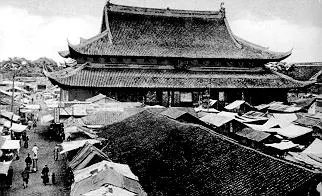
Around 1905
The Suzhou Library’s “Old Photographs” database dates this old view of Xuanmiao Temple to around 1905. From a higher vantage, the picture looks across the market within the temple grounds toward the Hall of the Three Pure Ones, with dense shed-stalls before the hall.
1905–1911
The University of Bristol’s Historical Photographs of China database places this old view of the Miluo Treasure Pavilion of Xuanmiao Temple in the “George Johnson Collection”, with the catalogue number GJ01-006, and estimates the date of the photograph as 1905 to 1911. The picture fully records this tower, later destroyed in the fire of 1912, together with the crowd and the fencing before it.
1910
Among the old photographs of Guanqian Street published by the Suzhou Municipal Local Chronicles Office, this photograph of the main mountain gate of Xuanmiao Temple was taken in the second year of Xuantong of the Qing (1910). Stall-sheds line both sides of the road before the mountain gate, and pedestrians are entering and leaving the temple grounds.
Before 1929
The fourth volume, “Architecture,” of A History of Early Chinese Art, published by Osvald Sirén in 1929, includes a photograph captioned “Xuanmiao Temple, Suzhou” and credited to Sirén. What the picture records is the multi-storied Miluo Treasure Pavilion, not the Hall of the Three Pure Ones.
Before 1939
The fourth series of Shina Bunka Shiseki (Historical Monuments of Chinese Culture), edited by Tokiwa Daijō and Sekino Tadashi, was published in 1939; in it two photographs are captioned “The Great Hall of Yuanmiao Temple” and “The Same, Interior.” The former looks up at the Hall of the Three Pure Ones from close within the market; the latter records at close range the timber frame and furnishings of the same great hall from inside.
Before 1940
The fourteenth series of Ajia Taikan (Grand Views of Asia), in the photograph set “Ancient Sites of Suzhou,” includes an old view of the Hall of the Three Pure Ones of Xuanmiao Temple. The lens passes through the market before the hall to face the great hall directly, with stalls, signboards, and the passing crowds filling the foreground.