Introduction
In the third year of the Zhangwu reign of Shu Han (223), Liu Bei died of illness in the Yong’an Palace. In the fifth month his coffin was carried back to Chengdu, and Liu Bei was given the posthumous title Emperor Zhaolie; in the eighth month he was buried in the Huiling Mausoleum. The Huiling Mausoleum thus became the earliest-dated relic within today’s Wuhou Shrine; this ground first took shape around an imperial tomb, and no shrine to Zhuge Liang yet existed.
In the twelfth year of the Jianxing reign of Shu Han (234), Zhuge Liang died of illness at Wuzhang Plain. The people of Shu often offered private sacrifices by the roadside on festival days, until in the spring of the sixth year of the Jingyao reign (263) the Later Sovereign Liu Shan finally decreed that a temple be erected at Mianyang (present-day Mian County, Shaanxi), near Zhuge Liang’s tomb. That official temple was far away in Hanzhong, not in Chengdu. In the summer of the same year, Shu Han changed its era name to Yanxing. In the first year of the Yanxing reign (263), the Wei general Deng Ai stormed Jiangyou and then defeated Zhuge Zhan at Mianzhu, and the Wei army pressed on toward Chengdu. At court some urged fleeing to Eastern Wu, others urged withdrawing to hold Nanzhong, while Qiao Zhou forcefully advocated surrendering to Wei, and Liu Shan ultimately accepted his counsel. Liu Chen, the Prince of Beidi, begged that sovereign and ministers, father and sons, fight a last battle with their backs to the city wall and live or die together with the altars of state, but his remonstrance was not accepted. On the day Liu Shan sent out the imperial seals[1], Liu Chen went to the “Temple of Zhaolie” and wept in sacrifice before his grandfather; he then killed his wife and children and took his own life for his state.
During the Cheng Han period of the Sixteen Kingdoms, the founding ruler Li Xiong erected a temple to Zhuge Liang within the Shaocheng, the lesser city of Chengdu, giving Chengdu one of its earliest temples to Kongming. In the third year of the Yonghe reign of the Eastern Jin (347), Huan Wen destroyed Cheng Han and the Shaocheng was leveled, yet this temple of Kongming was preserved. By the Jianyuan era of the Southern Qi in the Northern and Southern Dynasties (479–482), Emperor Gao, Xiao Daocheng, dreamed that a “Son of Heaven’s cortege”—the full ceremonial train of an emperor on progress—had appeared in Yizhou. Upon waking he issued an edict ordering Fu Tan, the provincial inspector of Yizhou, to build a Temple of the Former Sovereign east of the Huiling Mausoleum. The temple that Fu Tan completed was low and cramped. At about the same period of the Northern and Southern Dynasties, another shrine sacrificing to Zhuge Liang, the Wuhou Shrine, appeared near the mausoleum. From then on the Huiling Mausoleum, the Temple of the Former Sovereign, and the Wuhou Shrine began to gather in the same precinct, but Liu Bei and Zhuge Liang still each had a temple of his own.
In the first year of the Shangyuan reign of Emperor Suzong of Tang (760), Du Fu sought out the Wuhou Shrine in Chengdu and wrote “Where may I find the shrine of the Chancellor? Beyond the Brocade Official City, where the cypresses stand deep and dense”; some years later, while sojourning in Kuizhou, he recalled the place again in the line “The Former Sovereign and Marquis Wu share one hidden palace.” What the two lines show are precisely the Temple of the Former Sovereign and the Wuhou Shrine standing side by side among the same ancient cypresses. In the reign of Emperor Xuanzong of Tang, Li Hui, a former chief minister then guarding Xichuan, again put the mausoleum temple in order, established households to tend the tomb, and arranged sacrifices through the four seasons. After the Southern Song began, the pattern of separate sacrifices still had not changed: the Huiling Mausoleum lay to the west, the Temple of the Former Sovereign to the east, and the Wuhou Shrine stood somewhat to the south of the temple’s west side. In the twenty-ninth year of the Shaoxing reign (1159), the newly appointed Sichuan military commissioner[2] Wang Gangzhong came to offer sacrifices and, seeing that the halls, galleries, gates, and walls were mostly collapsed or broken and that some statues already stood exposed to the open air, at once ordered the local officials to repair them. Work began in the tenth month of that year and was completed in the third month of the thirtieth year of the Shaoxing reign (1160). The two shrines were rebuilt on their old sites and, together with the Huiling Mausoleum, enclosed within a protective wall; north of the Wuhou Shrine, lodgings were added where those offering sacrifices could rest. The buildings and their painted decoration were made new again, yet Liu Bei and Zhuge Liang still each occupied a temple of his own.
In the twenty-fourth year of the Hongwu reign of the Ming (1391), Zhu Chun, Prince Xian of Shu, came here and beheld toppled halls and ancient cypresses standing in desolation. He ordered soldiers to build an enclosing wall and set the shrines in order, and, on the grounds that “sovereign and minister ought to be one body,” removed the separate Wuhou Shrine west of the Temple of the Former Sovereign and moved the statue of Zhuge Liang into the eastern side of the Temple of Emperor Zhaolie of Han, with Guan Yu and Zhang Fei ranged on the western side; the local officials further enrolled Liu Chen, the Prince of Beidi, Zhuge Zhan, and Fu Qian among the attendant sacrifices[3]. The Tang-dynasty stele in the former Wuhou Shrine was likewise moved into the temple together with Zhuge Liang’s statue. From that point the centuries-long separation of the two shrines came to an end, and Liu Bei, Zhuge Liang, and the sovereign and ministers of Shu Han entered a single temple. Within the temple Liu Bei still held the principal seat, but the people of the region had never ceased to cherish Zhuge Liang’s achievements in governing Shu, and now that Marquis Wu’s statue and the ancient stele had both entered the Temple of Zhaolie, people still habitually called the whole mausoleum-temple complex the “Wuhou Shrine.” From then on, the formal seat of sacrifice and the popular name diverged.
In the warfare of the Ming–Qing transition, Chengdu was ravaged. The Huiling Mausoleum escaped destruction, but of the temples beside the tomb only broken walls remained. In the tenth and eleventh years of the Kangxi reign of the Qing (1671–1672), Cai Yurong, governor-general of Sichuan and Huguang, proposed the rebuilding, and Song Kefa, the provincial surveillance commissioner of Sichuan, directed the works, with many local officials contributing funds. In the rebuilt front hall Liu Bei occupies the center, with Guan Yu, Zhang Fei, and the civil and military ministers of Shu Han ranged in the two side galleries, like a court in audience; the rear hall enshrines Zhuge Liang with his sons and grandsons, like a single family. The order of the joint sacrifice of sovereign and minister was thus fixed in the two successive halls and has continued to this day. A visitor entering through the main gate first sees the plaque “Temple of Emperor Zhaolie of Han,” passes through the Hall of Liu Bei, then crosses a passage hall hung with the plaque “Wuhou Shrine,” and finally arrives at the Hall of Zhuge Liang. The main gate preserves the complex’s formal identity, while the passage hall keeps the name the people of Chengdu have used for centuries.
Historical Documents
《三国志》 (Records of the Three Kingdoms)
五月,梓宫自永安还成都,谥曰昭烈皇帝。秋八月,葬惠陵。
In the fifth month, the imperial coffin returned from Yong’an to Chengdu, and he was given the posthumous title Emperor Zhaolie. In autumn, in the eighth month, he was buried in the Huiling Mausoleum.
《华阳国志》 (Chronicles of Huayang)
夏四月,先主殂于永安宫,时年六十三。亮表后主曰:“大行皇帝迈仁树德,复育无疆。昊天不吊,今月二十四日奄忽升遐,臣妾号啕,如丧考妣。乃顾遗诏,事惟太宗,百僚发哀,三日除服,到葬复服。其郡国守、相、令、长、丞、尉三日除服。五月,梓宫至成都,谥曰昭烈皇帝。秋八月,葬惠陵。
In summer, in the fourth month, the Former Sovereign passed away in the Yong’an Palace at the age of sixty-three. Zhuge Liang memorialized the Later Sovereign: “The late emperor strode in benevolence and planted virtue, his fostering care boundless. Alas, Heaven has shown no pity: on the twenty-fourth day of this month he suddenly ascended on high, and your servants and handmaids wail and keen as though bereaved of father and mother. Looking back to his testamentary edict, the rites should follow those of Emperor Taizong: the hundred officials are to make lamentation and doff their mourning after three days, resuming it at the burial. The governors, chancellors, prefects, chiefs, assistants, and commandants of the commanderies and kingdoms are likewise to doff their mourning after three days.” In the fifth month the imperial coffin reached Chengdu, and he was given the posthumous title Emperor Zhaolie. In autumn, in the eighth month, he was buried in the Huiling Mausoleum.
《太平御览》 (Imperial Readings of the Taiping Era)
习凿齿晋春秋曰:后主将从谯周策,北地王谌怒曰:“若数穷力屈,祸败必及,便当父子君臣背城一战,同死社稷,以见先帝可也。”后主不纳,遂送玺绶。是日,谌哭于昭烈之庙,先杀妻子,然后自杀。
Xi Zuochi’s Jin Chunqiu says: When the Later Sovereign was about to follow Qiao Zhou’s plan, Liu Chen, the Prince of Beidi, said angrily: “If our lot is spent and our strength broken and ruin must come, then it behooves us, father and sons, sovereign and ministers, to fight one last battle with our backs to the city wall and die together for the altars of state, that we may face the late emperor.” The Later Sovereign would not accept this, and duly sent out the imperial seals. That day, Liu Chen wept in the Temple of Zhaolie, first killed his wife and children, and then killed himself.
Tang-dynasty 《诸葛武侯祠堂碑记》 (Stele Inscription for the Shrine of Zhuge, Marquis Wu)
度尝读汉史,详求往哲,或秉事君之节,无开国之才,得立身之道,无治人之术。四者备矣,兼而行之,则蜀丞相诸葛公亮其人也。公本系在简册,大名盖天地,不复以云。当汉祚衰陵,人心竞逐,取威定霸者,求贤如不及;藏器在身者,择主而后动。公是时也,躬耕南阳,自比管乐;我未从虎,时称卧龙。诗曰:潜虽伏矣,亦孔之昭。荆州平心,与昭烈神交,洎乎三顾而许以驱驰,一言而定其机势。于是翼扶刘氏,缵承旧服。结吴抗魏,拥蜀称汉,政刑达于荒外,道化行乎域中。谁谓阻深?殷为强国,谁谓轻脆。励为劲兵,则知地无常形,人无常性,自我而作,若金在镕。故九州之地,魏有其七,我无其一,由僻陋而启雄图,出封疆以延大敌。
I have read the histories of Han and inquired closely into the wise men of the past: some held fast to the integrity of serving their lord yet lacked the talent to found a state; others attained the way of establishing themselves yet lacked the art of governing men. One who possessed all four and practiced them together—such a man was Zhuge Liang, the Chancellor of Shu. The duke’s origins are recorded in the books and documents, and his great name covers heaven and earth, so I will not speak of them further. When the fortune of Han declined and the hearts of men raced in rivalry, those who sought to establish their might and settle their hegemony sought worthy men as though they could never reach them; those who kept their talents hidden about their persons chose their lord before they would act. At that time the duke ploughed in person in Nanyang, comparing himself to Guan Zhong and Yue Yi; though he had not yet followed the tiger, the age called him the Crouching Dragon. The Odes say: “Though he hides submerged, he is very luminous.” With a level heart in Jingzhou he was in spiritual communion with Zhaolie, and only after three visits did he promise to drive in his service, settling the pivot of affairs with a single word. Thereupon he lent wings to the house of Liu and carried on its ancient raiment: he allied with Wu to resist Wei, held Shu and proclaimed it Han, and his governance and punishments reached beyond the wilds while his moral transforming sway moved within the realm. Who says the barriers were deep and steep? He made of Yin a strong state; who says they were light and brittle? He tempered them into stout soldiers. Thus we know that land has no constant form and men no constant nature: it all arises from oneself, like metal in the melting. Thus of the nine provinces Wei held seven and we held not one, yet from the narrow and remote he opened a grand design, marching beyond his borders to engage a mighty foe.
财用足而不曰朘我以生,干戈动而不曰残人以逞。其底定南方也,不以力制,而取其心服;震慑诸夏也,不敢角其胜负,而止候其存亡。法加于人也,虽死而无怨;德及于人也,虽奕业而见思。此所谓精义入神,自诚而明者矣。若其人存,其政举,则四海可平,五服可倾。而陈寿之评,未极其能事,崔浩之说,又诘其成功。此皆以变诈之略,论节制之师,以进取之方,语化成之道,不其谬欤?夫委弃荆州,不能遂有三郡,此乃务增德以吞宇宙,不黩武以争寻常。及出斜谷,据武功,分兵屯田,谋久驻之计,与敌对垒,待可胜之期,杂乎居人,如适虚邑,彼则丧气,我方养威。若天假之年,则继大汉之祀,成先主之志不难矣。且权倾一国,威震八纮,上下无异辞,始终无愧色,苟非运膺五百,道冠生知,曷以臻于此乎?
His revenues were sufficient, yet he never said “I tax the people to live”; his arms moved, yet he never said “I maim men to have my way.” In pacifying the south he did not subdue by force but won the submission of hearts; in overawing the central lands he dared not contend for victory or defeat, but only awaited their survival or ruin. When his law fell upon a man, that man died without resentment; when his virtue reached a man, he was remembered for generations. This is what is called “the quintessence of right entering into the spirit, from sincerity coming enlightenment.” Had such a man lived and his governance been carried out, the four seas could have been pacified and the five zones of submission overturned. Yet Chen Shou’s appraisal did not reach the limit of his ability, and Cui Hao’s account even questioned his success. Both judged a well-ordered army by the stratagems of shift and deceit, and spoke of the way of transforming accomplishment in the terms of aggressive advance—is that not an error? As for abandoning Jingzhou and failing to hold the three commanderies, this was because he sought to increase his virtue to swallow up all under heaven, not to glut his arms contending for the ordinary. When he marched out through the Xie Valley, held Wugong, divided his troops to open military colonies, and planned for a long occupation, facing the enemy in his ramparts while awaiting the time when he could win, he mingled with the inhabitants as though passing through an empty city; the enemy lost heart while we nursed our might. Had Heaven granted him years, then to continue the sacrifices of great Han and complete the Former Sovereign’s design would not have been hard. Moreover, his power overweighed a whole state and his might shook the eight bounds, yet above and below there was no dissenting word, and from beginning to end no blush of shame: were it not that his destiny met the five-hundred-year cycle and his way crowned innate knowledge, how could he have attained to this?
故昭烈知人之明者,倚仗如鱼之有水;仲达奸人之雄者,嗟称曰天下奇才。度每迹其行事,度其远心,愿奋短袖,以排群议。而文字蚩鄙,志愿未果。元和二年冬十月,圣上以西南奥区,寇乱余孽,罢甿未息,污俗未清,辍我股肱,为之父母,乃诏相国临淮公由秉钧之重,承推毂之寄,戎轩乃降,藩服乃理,将明帝道,陬落绥怀,溥畅仁风,闾阎滋殖,府中无留事,宇下无弃才,人知向方,我有余地,则诸葛公在昔之治。与相国当今之政,异代而同法矣。度谬以庸薄,获参管记,随旌旄而爰止,望祠宇而修谒,有仪可像,以赫厥灵。虽徽烈不忘,而碑表未立。古者或拳拳一善,或师表一城,尚流斯文,以示来裔。况如在之叹,终古不绝,其可阙乎?乃刻贞石,庶此都之人,存必拜之感云尔。
Thus Zhaolie, in the clarity of knowing men, leaned upon him as a fish takes to water; and Zhongda, that hero among the crafty, sighed and called him a rare talent under heaven. I have often traced his deeds and pondered his far-reaching heart, wishing to roll up my short sleeves and brush aside the crowd’s opinions; but my writing is poor and mean, and my wish has gone unfulfilled. In the winter tenth month of the second year of the Yuanhe reign, Our Sage, considering that the southwest was a remote fastness where the remnants of rebel bandits were not yet stilled, the weary folk unrested, and the sullied customs uncleansed, transferred me, his limb and thigh, to be father and mother to its people; he then decreed that the Minister of State, the Duke of Linhuai, from the weight of holding the balance of state, receive the charge of the push of the chariot hub. The war chariots descended, the frontier was put in order; he made bright the emperor’s way, the corners of the land were soothed, the wind of benevolence flowed far and wide, the villages grew and multiplied, in the prefecture no business was left undone, beneath his roof no talent cast aside; men knew the direction to take, and we had room to spare. Thus the rule of the Duke Zhuge in days past and the governance of the Minister of State in the present are of different ages yet follow the same law. I, unworthily, with my mediocre and slight abilities, was permitted to take part in the keeping of records; following the banners I came to this place, and gazing upon the shrine I paid my respects: there is a semblance that may be imaged, to make glorious his spirit. Yet though his splendid deeds are not forgotten, no stele or marker had been raised. The ancients, for one earnest goodness or for being the model of a single city, still handed down writings to show to later generations; how much the more when the sigh “as if he were present” has never ceased through all the ages—how could it be omitted? So we carved the enduring stone, that the people of this capital may keep the feeling of one who must be worshipped.
铭曰:
The inscription reads:
昔在先主,思启疆宇,扰攘靡依,英雄无辅。爰得武侯,先定蜀土。道德城池,礼义干橹,煦物如春,化人如神,劳而不怨,用之有伦。柔服蛮落,铺敦渭滨。摄迹畏威,杂居怀仁。中原旰食,不测不克。以待可胜,允臻其极。天未悔过,公命不果。汉祚其亡,将星中堕,反旗鸣鼓,犹走司马。死而可作,当小天下。尚父佐周,阿衡佐商,兼齐管、晏,总汉陈、张,易代而生,易地而理,遭遇丰约,亦皆然矣。呜呼!奇谋奋发,美智夭遏,吁嗟平立,咸受谪罚。闻之痛之,或泣或绝。甘棠勿剪,骈邑斯夺。繇是而言,殊途共辙。本于忠恕,孰不感悦。苟非诚悫,徒云固结。古柏森森,遗庙沉沉,不殄禋祀,以迄于今,靡不骏奔,若有照临。
Of old, the Former Sovereign thought to open up the borders of the land; in turmoil and with none to rely on, the hero was without support. Then he found Marquis Wu, and first settled the land of Shu. His walls and moats were the way and its virtue, his shield and bulwark rite and right; he warmed all things like spring, transformed men like a spirit; he toiled without complaint and employed them in due order. Gently he made the Man tribes submit; massively he camped on the banks of the Wei. Those who traced his steps stood in awe of his might; those who dwelt among him cherished his benevolence. In the central plain they ate late at night for care, unable to fathom or overcome him. Awaiting the time when he could win, he truly attained the utmost. Heaven did not repent of its course, and the duke’s charge went unfulfilled: the fortune of Han perished, the general’s star fell in mid-course—yet with reversed banners and sounding drums he still made Sima flee. Could the dead rise again, he would make small all under heaven. The Grand Duke aided Zhou, Yi Yin aided Shang; he joined the Guan Zhong and Yan Ying of Qi and gathered the Chen Ping and Zhang Liang of Han—had they been born in a changed age or governed in a changed place, with fortunes ample or scant, all would have been thus. Alas! His rare counsels flared forth, his fine wisdom was cut short untimely; all who stood even and firm, sighing, received the punishment of loss. Hearing of it, pained by it, some wept and some swooned. Do not cut the sweet pear tree, yet the twinned city was snatched away. Speaking from this, by different roads they shared one track. Founded on loyalty and fellow-feeling, whom did they not move to joy? Without true sincerity, it would be called a mere stubborn bond. The ancient cypresses stand deep and dense, the temple left behind lies dark and still; the pure sacrifices have not been cut off, continuing down to today; none do not hasten to them, as if he still shone down upon them.
蜀国之风,蜀人之心。锦江清波,玉垒峻岭,入海际天,知公德音。元和四年记。
The airs of the land of Shu are the hearts of the people of Shu. The clear waves of the Brocade River, the steep ridges of Yulei, entering the sea and touching the sky, know the duke’s fair fame. Recorded in the fourth year of the Yuanhe reign.
《太平寰宇记》 (Universal Geography of the Taiping Era)
先主祠在府八里惠陵东西七十步。齐高帝梦益州有天子卤簿,诏刺史傅覃修立,而卑小,故相国李回在镇,更改置守陵户,四时祭祀。诸葛武侯祠在先主庙西。府城西有故宅。关羽祠、张飞祠俱在府西南七里惠陵左右。宋庐陵王立。
The Temple of the Former Sovereign is eight li from the prefectural city, seventy paces east and west of the Huiling Mausoleum. Emperor Gao of Qi dreamed that a Son of Heaven’s cortege appeared in Yizhou and decreed that the inspector Fu Tan build it; it was low and small, so when the late Minister of State Li Hui was in garrison here he further established households to tend the tomb, with sacrifices in the four seasons. The Shrine of Zhuge, Marquis Wu, lies west of the Temple of the Former Sovereign. West of the prefectural city there is a former residence. The temples of Guan Yu and Zhang Fei both stand seven li southwest of the prefectural city, flanking the Huiling Mausoleum. They were erected by the Prince of Luling of the Liu Song.
Ming-dynasty 《诸葛武侯祠堂碑记》 (Stele Inscription for the Shrine of Zhuge, Marquis Wu)
成都府城南三里许,邱阜岿然,是曰惠陵,昭烈弓剑实藏焉。有庙在其东,所从来远矣。大殿南向,昭烈弁冕临之,东夹室以祔后主,而西偏少南又有别庙,祀忠武侯。老柏参天,气象甚古,诗人尝为赋之。
Some three li south of the city of Chengdu Prefecture, a mound rises sheer: this is called the Huiling Mausoleum, where Zhaolie’s bow and sword are truly buried. There is a temple to its east, of very distant origin. The great hall faces south, and Zhaolie in ceremonial cap and crown presides over it; the eastern side chamber adjoins the Later Sovereign, while somewhat to the south of the western side there is another temple, sacrificing to Zhuge, Marquis Zhongwu. Ancient cypresses rise to touch the sky, and the atmosphere is most venerable; poets have written verses on it.
余闻之宋任渊氏云然。史载南齐高帝梦益州有天子卤簿,诏建先主庙,所谓北地王谌哭于昭烈之庙而死者,何耶?是南齐高帝重修而非建明矣。或者曰:庙故祠武侯,后人更今祠,而蜀人至今称武侯庙云。然则唐、宋文人各有咏昭烈、武侯二祠者,斯又何耶?志有之曰:武侯祠先在先主庙西,宋时屡加修葺,而元因之。皇朝洪武初,以昭烈庙实为陵寝所在,令有司春秋致祭。蜀献王之国,首谒是庙,谓君臣宜一体,乃位武侯于东,关、张于西,自为文祭之。盖至是武侯废祠,而乃以其碑碑庙中,观者不察,遂谓以武侯庙庙先主耳。乙□有司又祔以北地王谌、诸葛瞻及关口守将傅佥,重死节也。
I heard this from Ren Yuan of the Song. History records that Emperor Gao of the Southern Qi dreamed that a Son of Heaven’s cortege appeared in Yizhou and decreed the building of the Temple of the Former Sovereign; but then, the so-called “Prince of Beidi, Chen, wept in the Temple of Zhaolie and died there”—what of that? This makes clear that the Southern Qi emperor rebuilt rather than founded it. Someone says: the temple originally sacrificed to Marquis Wu, and later men changed it to the present temple, yet the people of Shu to this day call it the temple of Marquis Wu. But then, the men of letters of Tang and Song each wrote poems on the two shrines of Zhaolie and Marquis Wu—what of that? The gazetteer has it: the Wuhou Shrine was formerly west of the Temple of the Former Sovereign, was repeatedly repaired in the Song, and the Yuan continued this. Early in the Hongwu reign of our august dynasty, because the Temple of Zhaolie is in truth where the imperial tomb lies, the officials were ordered to offer sacrifice in spring and autumn. When the Prince Xian of Shu went to his fief, his first act was to pay respects at this temple; holding that sovereign and minister ought to be one body, he placed Marquis Wu in the east and Guan and Zhang in the west, and composed his own sacrificial text. It was from this point that Marquis Wu’s shrine was abolished and its stele was steled in the temple; onlookers did not examine this, and so they say that the temple of Marquis Wu was made the temple of the Former Sovereign. In the yi□ year the officials further adjoined Liu Chen, the Prince of Beidi, Zhuge Zhan, and Fu Qian, the defending general at the pass, honoring their death for integrity.
余初至而展祠,垣墙崩剥,𣏾桷陊圮,屋瓦半脱,苔藓鳞次,仰而喟曰:坏若是甚乎?有司曰:其□前巡抚集斋邱公、檗谷王公,盖议新之矣,而材弗属也。岁又大饥,是以弗棘。予曰:国之大事在祀与戎,矧又祀之大者乎?若斥发公羡,鸠材聚工,则虽役弗役也。知府马九德乃祗奉以从事。既讫事,余乃碑曰。
When I first arrived and visited the shrine, the walls were crumbling and peeling, the beams and rafters fallen and ruined, half the roof tiles gone, mosses spread in scales; I looked up and sighed: “Is the decay truly this severe?” The officials said: “Formerly the grand coordinators, Lord Qiu of Jizhai and Lord Wang of Bogu, had indeed discussed renewing it, but the materials did not come together. The year, moreover, brought a great famine, and so it was not pressed forward.” I said: “The great affairs of the state lie in sacrifice and war—how much the more in the greatest of sacrifices! If we draw upon the public surplus, gather timber, and assemble workmen, then though there be labor it will be as no labor.” The prefect Ma Jiude thereupon reverently undertook the work. When it was finished, I inscribed it on a stele.
《重修先主庙记》 (Record of the Repair of the Temple of the Former Sovereign)
智力之不胜义也久矣。昔自英雄豪杰,乘时崛起,有能仗义而行,伟然正大,指麾号令,天下从之。虽其不幸,不克大有所成就于当时,而风烈之余,犹足以耸动后世,历千百载,尊仰而怀思之,有不能自已者,非以义胜故欤?东汉之季,王室陵夷,曹氏怙奸贼之资以擅中原,孙氏席强大之势,以并江左,皆矜尚智力,求所非望,非有志于王室也。
That cleverness and force cannot overcome righteousness has long been so. Of old, among heroes and stalwarts who rose up with the times, there were those able to act upholding righteousness, grand and upright, whose gestures and commands all under heaven followed. Though they were unfortunate and could not achieve great success in their own time, the aftermath of their ardor was still enough to stir later ages, so that for a thousand or a hundred years men have honored, looked up to, and cherished them, unable to stop themselves—is this not because righteousness prevailed? In the last days of Eastern Han, the royal house fell into decline: the Cao clan, relying on the resources of traitorous usurpers, monopolized the central plain; the Sun clan, riding on a posture of power, annexed the lands south of the Yangzi. Both prided themselves on cleverness and force and sought what lay beyond their due; neither had the royal house at heart.
海内之士劫于威制,虽俯首听从,而心不与之。至后世,利害不相及,则排贬讥笑,未始少容。惟蜀先主昭烈帝,以宗胄之英,负非常之略,崎岖奔走,经理四方。最后伐刘璋,遂有蜀汉,盖将凭藉高祖兴王之地,建立本基,然后列兵东向,诛有罪而吊遗民,以绍复汉家大业,其理顺,其辞直,非若孙、曹氏之自为谋也。当是时,丞相忠武诸葛侯,实左右之,人品意象,高远英特,骎骎乎伊、吕之间,应变机权,本于道德,内修综核之政,外举节制之师,欲以攘除奸凶,混一区宇,不负其君付托之意,可谓社稷臣矣。彼其君臣仗义而行,正大如此,是以海内之士,心与而诚服之,举无异论。虽厄于运数,屈其远图,而后世有读其遗书,过其陵庙者,未尝不咨嗟流涕,尊仰而怀思之也。
The gentlemen of the realm, coerced by their might, bowed their heads and obeyed, but their hearts did not go along. In later generations, when profit and harm no longer touched them, men dismissed, belittled, mocked, and laughed at them without the least forbearance. Only the Former Sovereign of Shu, Emperor Zhaolie, with the flower of the imperial lineage and bearing a strategy beyond the ordinary, toiled and hurried over rough roads, managing the four quarters. At last he campaigned against Liu Zhang and so came to possess Shu Han, intending to rely on the ground where Emperor Gaozu had risen to kingship, establish his foundation there, and then marshal his troops eastward to punish the guilty and comfort the surviving people, so as to continue and restore the great enterprise of the house of Han: his principle was accordant, his words were upright, unlike the Sun and Cao houses who schemed for themselves. At that time the Chancellor, Zhuge, Marquis Zhongwu, in truth stood at his right and left: in person and bearing lofty, far-reaching, heroic, and outstanding, pressing on apace between Yi Yin and Lü Shang; his response to change and his weighing of expedients were rooted in the way and its virtue; within, he cultivated a governance of exact accounting; without, he raised a well-ordered army—wishing to sweep away the traitorous and violent and unite the whole realm into one, not betraying the charge his lord had entrusted to him: he may be called a minister of the altars of state. That sovereign and minister acted upholding righteousness, upright and great in this way, and so the gentlemen of the realm agreed with them in heart and submitted in sincerity, all without dissent. Though they were thwarted by fate and their far-reaching designs bent down, yet later men who read their surviving writings or pass by their tomb and temple have never failed to sigh and weep, honoring, looking up to, and cherishing them.
夫义之所在,俯仰无愧天地,且将直之,见信于人,亦其理之然哉。成都之南三里所,邱阜归然,曰惠陵者,实昭烈弓剑所藏之地,有庙在其东,所从来远矣。大殿南向,昭烈弁冕临之,东夹室以祔后主,而西偏少南又有别庙,忠武侯在焉。老柏参天,气象甚古,诗人尝为赋之。庙久不治,风雨摧剥,殿庑门墙,率皆颓圯破缺,像设仅存,至或露处。绍兴二十有八年秋九月,蜀当谋帅,上亲择廷臣文武兼资,可属方面者,得中书舍人王公,命以龙图阁待制制置四川使,出镇成都,临遣甚宠。粤明年夏四月,公始至,用故事谒诸祠,奠献至此,顾瞻太息曰:有大功德于蜀人,宜莫如昭烈、忠武。庙貌乃尔,亦独何心!亟命有司缮冶之,鸠工庀材,咸有程度,以是岁十月巳已,经始,落成于明年三月已丑,虽号为因旧起废,实再造而一新之。
Where righteousness lies, one may look up and down without shame before heaven and earth, and, moreover, men will make it straight and it will be believed by others: such is its principle. Some three li south of Chengdu, a mound rises round: called the Huiling Mausoleum, it is truly the place where Zhaolie’s bow and sword are buried; there is a temple to its east, of very distant origin. The great hall faces south, and Zhaolie in cap and crown presides over it; the eastern side chamber adjoins the Later Sovereign, while somewhat to the south of the western side there is another temple, where Zhuge, Marquis Zhongwu, is. Ancient cypresses rise to touch the sky, and the atmosphere is most venerable; poets have written verses on it. The temple had long gone untended; wind and rain battered and peeled it; halls, galleries, gates, and walls were all fallen and broken; the images barely survived, some even left exposed in the open. In autumn, the ninth month of the twenty-eighth year of the Shaoxing reign, when Shu was due to deliberate on a commander, the emperor himself chose among his courtiers one endowed with both civil and military gifts, fit to be charged with a region, and found Wang, the Secretariat Drafter, whom he appointed military commissioner of Sichuan with the title of Academician Awaiting Orders of the Dragon Diagram Hall, sending him out to garrison Chengdu with great favor at his departure. In summer, the fourth month of the following year, the lord first arrived; following precedent he paid respects at the various shrines, and when his libation reached this one, he looked about and sighed deeply: “For great merit and virtue toward the people of Shu, none should surpass Zhaolie and Zhongwu. That the temple’s face should be like this—what heart could allow it!” He urgently ordered the officials to repair and restore it: they assembled workmen and prepared materials, all with due measure and plan. Work began on the jisi day of the tenth month of that year and was completed on the jichou day of the third month of the following year; though called “restoring the old and raising the ruined,” it was in truth a second creation, made wholly new.
栋宇宏敞,丹雘鲜明,坚壮精密,足以经久。祠与惠陵,皆护以垣墉,限禁樵牧,筑室忠武祠北,明洁幽𮟏,有事于神者得以休焉,盖旧所无也。用公万一千六百七十有八,为钱无虑二百万。木章竹个,取于津步,商旅之征劳与费,民不知焉。既成,命渊记之。渊惧陋不克称,固辞,公不许,乃冒昧书其事。盖尝妄论王霸之说,以谓义近王,智力近霸。窃观昭烈、忠武之所为,非深于王道,未易明其心于千载上也。今公之所学,宏远高明,正论凛然,一以宗王为本。尝过公孙述庙,笑唾不顾,至刘蜀君臣严事之如此,意固有在,非特以钦崇秩祀,为牧守之所当先也。公名刚中,鄱阳人。开豁迈往,而克勤庶事,综练周密,治蜀之政,百废具举,不独新此庙之可书也。绍兴三十年记。
The buildings were grand and spacious, the vermilion and white plaster fresh and bright, solid, strong, fine, and close-fitted, enough to last long. The shrine and the Huiling Mausoleum were both protected by enclosing walls, and woodcutting and grazing were barred; north of the Zhongwu shrine a lodging was built, bright, clean, secluded, and tranquil, where those serving the spirits could rest—something the old site had not had. The expenditure came to eleven thousand six hundred and seventy-eight strings, amounting to no less than two million cash. Timber by the log and bamboo by the piece were taken from the ferry landings, sparing the merchants and travelers the levy, the toil, and the cost, and the people knew nothing of it. When it was done, he ordered me, Yuan, to record it. Fearing that my meanness could not match the task, I firmly declined, but the lord would not permit it, so I rudely wrote down the affair. I once ventured to discuss the theory of kingship and hegemony, holding that righteousness approaches kingship while cleverness and force approach hegemony. Observing what Zhaolie and Zhongwu did, one who is not deeply versed in the kingly way cannot easily make their hearts plain across a thousand years. Now the lord’s learning is vast, far-reaching, lofty, and bright, his upright discourse awe-inspiring, taking the honoring of kingship as its root in all things. Once passing by the temple of Gongsun Shu, he laughed, spat, and would not look at it; toward the sovereign and ministers of Liu’s Shu he is as reverent as this: there is surely a meaning in it, not merely that venerating the ordered sacrifices is what a shepherd and guardian should put first. The lord’s name is Gangzhong; he is from Poyang. Open and surpassing, yet diligent in the multitude of affairs, thorough and meticulous in practice, his governance of Shu raised up a hundred neglected things—this temple’s renewal is not the only thing worth recording. Recorded in the thirtieth year of the Shaoxing reign.
《重建诸葛忠武侯祠碑记》 (Stele Inscription of the Rebuilding of the Shrine of Zhuge, Marquis Zhongwu)
古之祀典有五:一曰法施民,二曰死勤事,三曰劳定国,四曰御大灾,五曰捍大患。有一于此,从而祀之,以云报也。昔者诸葛武侯之治蜀也,抚百姓,示仪轨,赏不遗远,罚不阿近,恩威并济,上下有节,故刑政虽峻,而人无怨,法施民也。受命托孤之际,泣效忠贞,继之以死。及其出师上表,又以鞠躬尽瘁,死而后已为言,竟以食少事烦,病卒军中,死勤事也。五月渡泸,深入不毛,用攻心之说,七纵七擒,终侯之世,夷不复反,劳定国也。蜀人曰:祀典有五,侯得其三焉。予谓侯之事先后主忠矣,其于人民,亦以威行其爱耳。世有忠主爱民之人,而不为此一方御大灾、捍大患者哉?盖侯之身虽告终于五丈原,而其心未尝一日不在炎刘社稷间也。是宜庙飨千世而勿替者与。
The ancients had five canons of sacrifice: the first, for those whose laws were bestowed upon the people; the second, for those who died in diligent service; the third, for those who by their toil settled the state; the fourth, for those who warded off great calamities; the fifth, for those who repelled great perils. Whichever one of these a man had, he was accordingly sacrificed to, in requital. Of old, when Zhuge, Marquis Wu, governed Shu, he comforted the hundred surnames and showed them the models and measures; his rewards did not overlook the distant, his punishments did not favor the near; kindness and might aided each other, and above and below there was due order. Thus, though his punishments and governance were strict, men bore no resentment: this is “laws bestowed upon the people.” At the moment he received the charge of the orphaned heir, he wept and offered up his loyalty and steadfastness, following it with death. And when he submitted his memorial on marching out with the army, he spoke again of “bending his back to the task until death, stopping only when life ends”—and indeed, eating little while burdened with affairs, he died of illness in the army: this is “dying in diligent service.” In the fifth month he crossed the Lu River and drove deep into the barren lands; employing the counsel of attacking the heart, he seven times freed and seven times captured his foe, and to the end of the marquis’s life the Yi did not rebel again: this is “by toil settling the state.” The people of Shu say: of the five canons of sacrifice, the marquis obtained three. I say that the marquis served the Former and Later Sovereigns with loyalty, and toward the people too he practiced his love through his might. In this world, when there is a man loyal to his lord and loving of the people, would he not for this one region ward off great calamities and repel great perils? For though the marquis’s body met its end at Wuzhang Plain, his heart was not for a single day absent from the altars of state of the fiery Han. It is fitting, then, that his temple should be feasted for a thousand generations without ceasing.
旧制,侯祠近昭烈墓,今仍之,益奉昭烈于正殿,侯居后,子若孙从之。殿两廊位关、张、北地王,次文武诸臣之有功者。其正大规模,遗像俨然,率皆凛凛有生气焉。呜呼!当其屯田渭滨,居民安堵,庶几三代之兵,望若时雨。向使天假以年,则国贼可靖,汉业可复,惜也,中营星陨,大志未伸。后世黜魏削吴,以蜀汉继炎统,固史家之正论,其亦慰侯之苦心也夫!皇清康熙十一年秋,庙成,岁时致祀,嘉侯之忠诚感被,阅世久而愈深也。
By the old plan, the marquis’s shrine stood near Zhaolie’s tomb; today this is kept, with Zhaolie further enshrined in the main hall and the marquis behind, his sons and grandsons following. In the two galleries of the hall are placed Guan and Zhang and the Prince of Beidi, and next the civil and military ministers who had merit. Its correctness and grandeur of scale, its surviving images so grave, all seem so awe-inspiring as to have the breath of life. Alas! When he opened military colonies on the banks of the Wei, the inhabitants dwelt undisturbed, and his was nearly the army of the Three Dynasties, awaited like seasonable rain. Had Heaven earlier granted him years, then the traitors to the state could have been quelled and the enterprise of Han restored—alas, the star fell upon the central camp and the great design went unstretched. That later ages have deposed Wei and demoted Wu and taken Shu Han as continuing the fiery line of Han is indeed the correct judgment of the historians—and may it not also console the marquis’s painstaking heart! In autumn of the eleventh year of the Kangxi reign of Our August Qing, the temple was completed, and sacrifices are offered at the year’s seasons, for the moving power of the marquis’s loyal sincerity grows ever deeper as the ages pass.
颂曰:先生抱道,高卧南阳。长吟梁父,与世相忘。亦有英雄,闻声思慕。志兴汉室,殷勤三顾。鱼之得水,骨肉君臣。感斯情好,可以忘身。侯之忠贞,死而后已。嗟侯之忠贞,死而后已。嗟侯此心,万世不死。
A eulogy reads: The master embraced the Way and lay high at rest in Nanyang, long intoning the Liangfu air, forgetful of the world. There was also a hero who, hearing his fame, longed for him; resolved to raise the house of Han, he earnestly paid three visits. A fish finding water: sovereign and minister closer than bone and flesh. Moved by this affection and regard, he could forget his very self. The marquis’s loyal steadfastness ceased only with death. Ah, the marquis’s loyal steadfastness ceased only with death; ah, this heart of the marquis will not die for ten thousand generations.
《诸葛忠武侯祠堂碑记》 (Stele Inscription for the Shrine of Zhuge, Marquis Zhongwu)
志幼读遗书,即为咨嗟想像者久矣。比来是土,修谒祠宇,益仰止焉。顾瞻像设,系从祀于昭烈、惠陵之殿后,如见其君臣一气,魂魄相依也。第,二祠之春秋禋祀,惜废弛。甲寅之后,遂仰请大廷,仍复盛典。其有榱椽梁柱之挠弱而不支,瓴甓垣墉之缺断而不承者,与诸大夫相为倡率,悉举而更新之,足以称邦人崇奉之意矣。间以政事之不逮者,上通嘉赖,于兹二载,百废渐兴,要匪侯之呵护群生,讵能若是?爰树珉于庭,以纪侯之精诚,万古如一日焉。
In my youth I read his surviving writings, and for long I sighed and imagined him. Having lately come to this land and paid my respects at the shrine, I look up to him all the more. Gazing upon the images, which are placed in attendant sacrifice behind the halls of Zhaolie and the Huiling Mausoleum, it is as though I saw sovereign and minister of one breath, their souls cleaving to one another. But the spring and autumn sacrifices of the two shrines had regrettably fallen into disuse; after the jiayin year I petitioned the great court, and the grand rites were restored. Wherever rafters, beams, and pillars were bent and weak beyond bearing, or tiles and walls broken and fallen beyond support, together with the various grandees I led and urged that all be taken up and renewed, enough to answer the intent of the people of the land in venerating him. Meanwhile, where my governance has fallen short, all above has gone well by his grace; in these two years the hundred neglected things have gradually risen—were it not the marquis’s sheltering care of the multitudes, how could this be so? So I set up a stone in the courtyard, to record that the marquis’s pure sincerity is for ten thousand ages as a single day.
《汉昭烈帝惠陵庙碑记》 (Stele Inscription for the Temple at the Huiling Mausoleum of Emperor Zhaolie of Han)
昭烈帝兴复汉业,拓基益州,大勋虽未集,蜀人思之。所葬惠陵,在成都城南,樵苏弗及。陵侧有庙,俗所称武侯祠者也。而昭烈设像,端冕于前殿,武侯退祔其后,盖实昭烈庙云。昭烈伐吴而殂,或疑帝陵在白帝城,然考纲目载,章武三年夏四月,帝崩于永安,丞相亮奉丧还成都,秋八月,葬惠陵。帝之陵在成都𥿑日,确然可据。前明时与历代帝王陵寝并祀。国朝康熙年间,抚军蔡公题奉俞允,春秋祀于庙,非漫然也。宋任渊记曰:成都南三里有惠陵,陵东有先主庙,其西偏少南别有庙,祀武默侯。今通志惠陵在华阳县南八里,成华犹之一邑,其里数偶有互异,不足深辨。旧志又言武侯祠在先主庙西,唐、宋、元因之。
Emperor Zhaolie sought to raise and restore the enterprise of Han and opened his foundation in Yizhou; though his great merit was not completed, the people of Shu think of him. The Huiling Mausoleum where he is buried lies south of the city of Chengdu, beyond the reach of woodcutters and foragers. Beside the tomb there is a temple, the one popularly called the Wuhou Shrine. Yet Zhaolie’s image is set up, upright in cap and crown, in the front hall, while Marquis Wu is withdrawn to be adjoined behind it: it is in truth the Temple of Zhaolie. Zhaolie died while campaigning against Wu, and some suspect the imperial tomb is at Baidi City; but examining the Gangmu, it records that in summer, the fourth month of the third year of the Zhangwu reign, the emperor passed away at Yong’an, that the Chancellor Liang escorted the funeral back to Chengdu, and that in autumn, the eighth month, he was buried in the Huiling Mausoleum. That the emperor’s tomb is in Chengdu from that day is certain and well founded. In the former Ming it was sacrificed to together with the tombs of the emperors and kings of successive dynasties. In the Kangxi years of our own dynasty, Governor Cai memorialized and received gracious assent that spring and autumn sacrifices be offered at the temple: this was not done idly. The record of Ren Yuan of the Song says: three li south of Chengdu there is the Huiling Mausoleum; east of the tomb is the Temple of the Former Sovereign; somewhat to the south of its west side there is another temple, sacrificing to Marquis Wu. Now the Comprehensive Gazetteer has the Huiling Mausoleum eight li south of Huayang County; Chengdu and Huayang are still as one county, and the occasional difference in the number of li is not worth deep dispute. The old gazetteer also says the Wuhou Shrine was west of the Temple of the Former Sovereign, and the Tang, Song, and Yuan continued this.
明蜀献王以君臣当一体,移武侯于昭烈庙之东庑,关、张西庑,而武侯祠遂废。嘉靖中,张抚军据以勒碑,而宋观察又以武侯非耑祠,义未安,乃奉武侯于后殿两庑,祀当时文武臣。两祀之兴废分合,此其大较矣。第宋观察碑云:祠在唐宋,专祀武侯。是以今地为武侯故祠,而昭烈移入者,与旧志不令,似非确论。少陵诗云:先主武侯同閟宫,言其近耳。而丞相祠堂,别有吟咏,明系两祠,故裴晋公碑文不兼昭烈。张公谓武四侯既移入昭烈庙,因以其碑碑庙中者,人无不爱古,以唐碑故移而护之,理或然与。汉制,宗庙之外有原庙,昭烈既定山陵,必立原庙,所谓北地王谌哭昭烈庙而死者,当在成都之宗庙,而张公援为于心此庙证,亦非也。蜀重武侯,多专祠,此祔昭烈者,统二于尊也。
The Ming prince Xian of Shu, holding that sovereign and minister should be one body, moved Marquis Wu into the eastern gallery of the Temple of Zhaolie, with Guan and Zhang in the western gallery, and the Wuhou Shrine was thereupon abolished. In the Jiajing reign, Governor Zhang inscribed this on a stele, and Surveillance Commissioner Song, holding that Marquis Wu had no dedicated shrine and the principle was not settled, then enshrined Marquis Wu in the rear hall, with the civil and military ministers of the time sacrificed to in the two galleries. Such, in broad outline, are the rises and falls, divisions and unions of the two sacrifices. But Commissioner Song’s stele says that in Tang and Song the shrine sacrificed solely to Marquis Wu: this takes the present site as Marquis Wu’s former shrine into which Zhaolie was later moved, which does not agree with the old gazetteer and seems not to be a settled conclusion. Shaoling’s poem says: “The Former Sovereign and Marquis Wu share one hidden palace”—this speaks of their nearness. And of the Chancellor’s shrine there are separate poems, making clear there were two shrines; thus Duke Pei of Jin’s stele text does not include Zhaolie. When Lord Zhang says that once Marquis Wu had been moved into the Temple of Zhaolie, his stele was accordingly steled in the temple—there is no one who does not love antiquity, and to move and protect it for the sake of a Tang stele, the reasoning is perhaps so. Under the Han system, beyond the ancestral temple there was a “second temple”; once Zhaolie had fixed his mountain tomb, a second temple must have been established, and the so-called “Prince of Beidi, Chen, wept in the Temple of Zhaolie and died” should have been at the ancestral temple in Chengdu—Lord Zhang citing it as evidence for this temple is also wrong. Shu honors Marquis Wu and has many dedicated shrines; that this one is adjoined to Zhaolie unites the two in honoring.
蜀人之口习武侯,而不复别以昭烈,余恐字久而失其实,因拈诸说以记之。公孙述、李特、孟知一祥辈,皆尝据蜀矣,生而夜郎王自大,殁则已焉。今官王长曰:有功德于民则祀之,是固未可强也夫。乾隆二十一年三月记。
The mouths of the people of Shu are accustomed to Marquis Wu and no longer distinguish Zhaolie; I fear that in time the name will lose the truth, and so I have set out the various accounts to record it. Gongsun Shu, Li Te, Meng Zhixiang and their like all once occupied Shu: in life they were kings of Yelang, grand in their own conceit, and at death they were finished. Now the officials and elders say: those who had merit and virtue toward the people are sacrificed to—truly this cannot be forced. Recorded in the third month of the twenty-first year of the Qianlong reign.
《钦定大清一统志》 (Imperially Commissioned Comprehensive Gazetteer of the Great Qing)
武侯庙。《寰宇记》:“在先主庙西。”《方舆胜览》:“在府城西北二里。武侯初亡,百姓遇朔节,各私祭于道中。李雄始为庙于少城内。桓温平蜀,夷少城独存孔明庙。”旧志:“一在百花潭上。”按:今与昭烈合祀一庙,详见上。府东北亦有祠。又有庙在新都县北弥牟镇。
The Temple of Marquis Wu. The Huanyu Ji: “West of the Temple of the Former Sovereign.” The Fangyu Shenglan: “Two li northwest of the prefectural city. When Marquis Wu first died, the people, on the new-moon festivals, each offered private sacrifices in the roadways. Li Xiong first made a temple for him within the Shaocheng. When Huan Wen pacified Shu and leveled the Shaocheng, only the temple of Kongming survived.” The old gazetteer: “One is above Baihua Pool.” Note: today he is sacrificed to together with Zhaolie in one temple, as detailed above. There is also a shrine northeast of the prefectural city. There is also a temple at Mimou Town, north of Xindu County.
Historical Photographs
Published in 1936
The thirty-first issue of Meishu Shenghuo (Art Life), published on October 1, 1936, included a two-page feature on the Wuhou Shrine. The original issue does not identify the photographers of the individual photographs.
Published in 1941
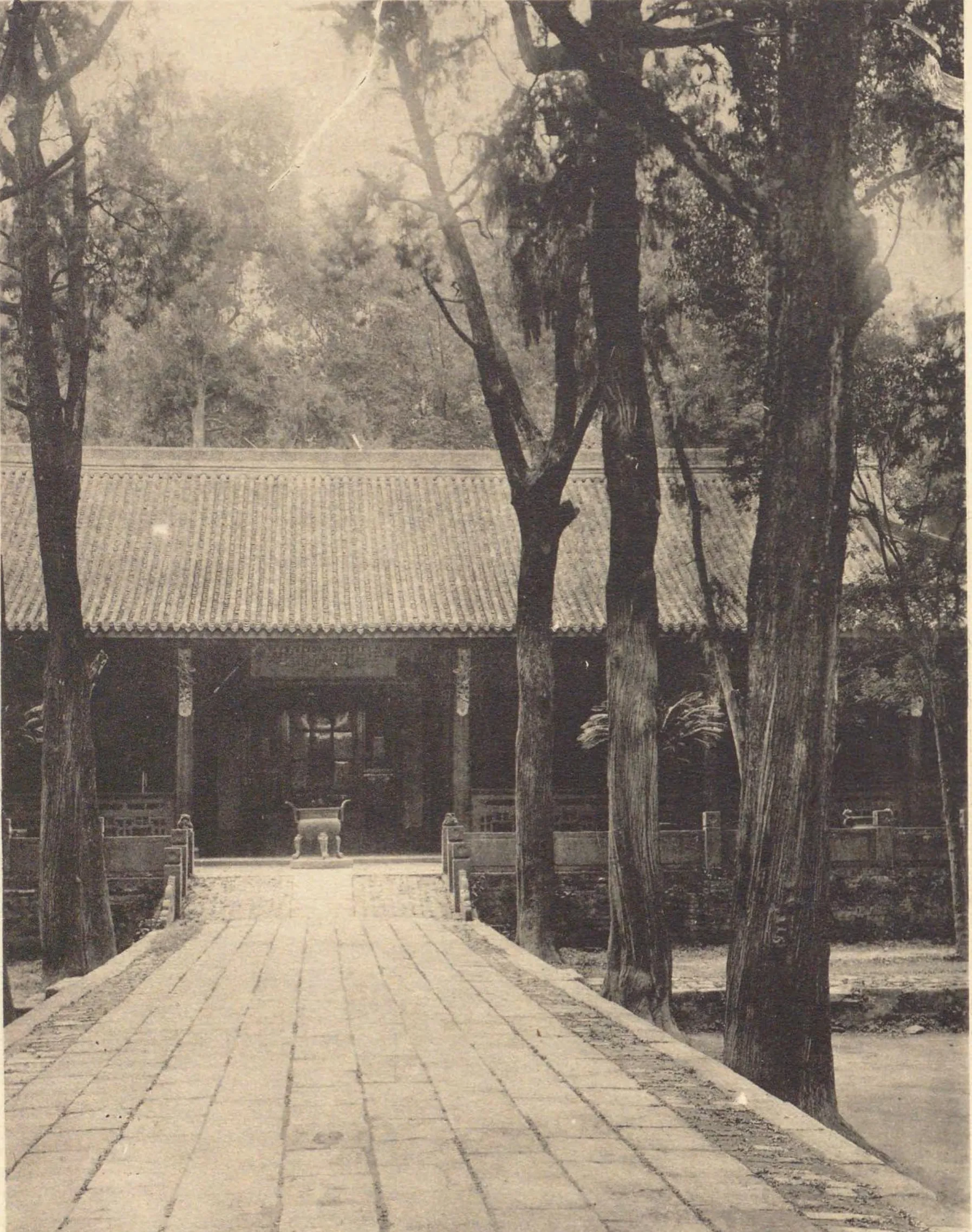
Volume 10 of Shina Bunka Shiseki (Historical Monuments of Chinese Culture), edited by Tokiwa Daijo and Sekino Tadashi, includes an old view of the paved path before the main hall of the Chengdu Wuhou Shrine. The original volume does not identify the photographer or the exact year the photograph was taken.
References
- Pan Shitong, comp., 《昭烈忠武陵庙志》 (Gazetteer of the Mausoleum-Temples of Zhaolie and Zhongwu), block-print edition of the tenth year of the Daoguang reign of the Qing (1830), held by the National Library of China, call number “Di 753.2/863”.
- Xie Hui and Mei Zhengzheng, “The Historical Evolution and Conservation of the Chengdu Wuhou Shrine”, China Cultural Heritage, 2016, no. 6, pp. 4–10.
- Chengdu Wuhou Shrine Museum: “Chengdu Wuhou Shrine” heritage database.