Introduction
West of the city of Guangyuan, the Jialing River flows past the foot of Mount Wulong. Huangze Temple stands against the cliff face of the west bank, while on the east bank lies Qianfoya, the Thousand-Buddha Cliff—the two grotto sites facing each other across the Jialing. In the late Northern Wei, craftsmen began opening caves and carving images in the rock face on the Huangze Temple side; the men who first directed the carving left no names. Cave-cutting and image-carving continued under the Western Wei and Northern Zhou; further caves were opened in the Sui, and by the early and high Tang the carving at Huangze Temple reached its peak.
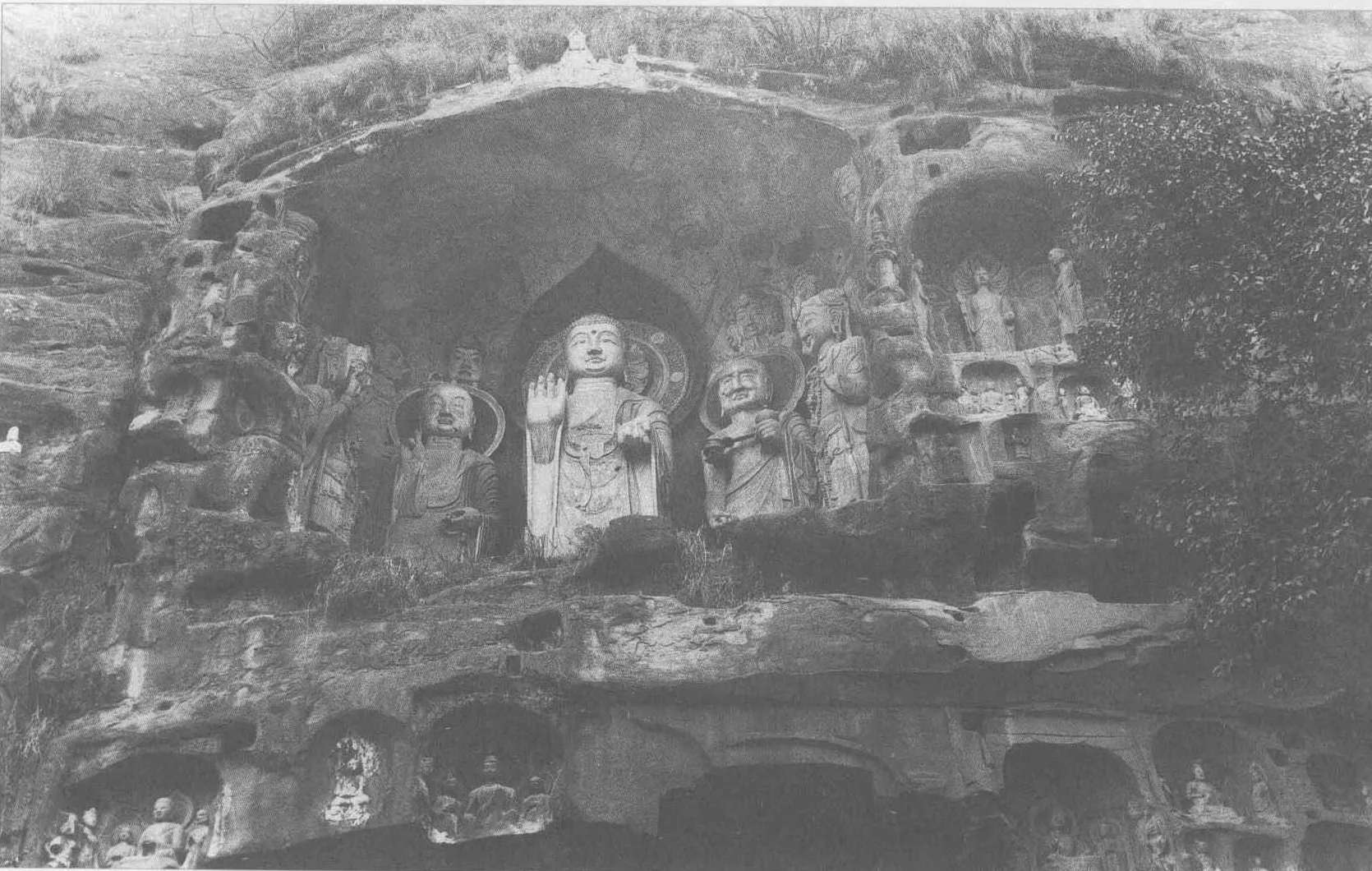
Around the beginning of the seventh century, the craftsmen completed what is now numbered Niche 28; by the second year of the Zhenguan era (628), Wu Shihuo—a founding meritorious official of the Tang who had served as governor-general of Lizhou—and his wife Lady Yang, the parents of Wu Zetian, may have built the West Niche Buddha Pavilion in front of the niche. Inside the niche, Amitabha Buddha[1] is the principal image, flanked on either side by the bodhisattvas Avalokiteshvara and Mahasthamaprapta. The Buddha Pavilion was not another grotto but a timber structure attached in front of the niche: the stone images were carved into the cliff, the pavilion was built outside the cliff, and the two parts together served worshippers.
By the second year of the Baoli era (826), the images in the niche had already been eroded by wind and rain. The name of the Lizhou prefect who directed the repair has been lost; the fragmentary stele preserves only his commandery of origin[2], “Beiping,” and his surname, “Cui.” This prefect donated money and ordered craftsmen to rebuild the Buddha Pavilion. The stele recording this restoration is three chi eight cun high and one chi three cun wide; its head is carved with a Buddha niche ringed by coiled dragons. Though the main text is badly damaged, the prefect’s donation of funds, his commissioning of workmen, and the course of the rebuilding can still be made out.
By the twenty-second year of the Guangzheng era of Later Shu (959) at the latest, Huangze Temple already contained a shrine dedicated to Wu Zetian. That year Li Fengqian, military commissioner[3] of the Zhaowu Army, rebuilt the old temple and erected the “Stele of the New Temple of Lady Wu, Empress Zetian of the Tang, at Huangze Temple in the Lizhou Governor-General’s Office of Great Shu.” When floods or droughts struck Lizhou, soldiers and civilians would still come to the temple to pray to Wu Zetian.
In the Northern Song, Huangze Temple already had a “Hall of the True Countenance of Empress Wu of the Tang,” which housed a true-countenance image of Wu Zetian. The site thus held both Buddhist images carved along the cliff and temple halls dedicated to Wu Zetian—the two served different purposes.
In the fifteenth year of the Jiaqing era (1810), Tao Shu, who had been ordered into Shu to preside over the provincial examination, passed through Guangyuan. He crossed the Jialing River and walked into Huangze Temple, where he saw an image of Wu Zetian in the dress of a bhikshuni; his travel diary also mentions a Dressing Tower within the temple.
In 1954, during the construction of the Baoji–Chengdu Railway, work crews dug this Later Shu stele out of a slope in front of the temple’s Lüzu Pavilion. The historian Guo Moruo later combined the Later Shu stele, the Tang poet Li Shangyin’s “Written at the Deep Pool of Lizhou,” and old local traditions to argue that Wu Zetian was born in Guangyuan. But the crucial characters in the stele bearing on the place of birth are already broken away, and Lady Yang’s conception after encountering a dragon is also a later legend—neither can establish that Wu Zetian was born in Guangyuan. In 1961, the Huangze Temple cliff sculptures were included in the first batch of Major Historical and Cultural Sites Protected at the National Level.
Historical Documents
Record of the Rebuilding of the West Niche Buddha Pavilion
再修西龛佛阁记
Record of the Rebuilding of the West Niche Buddha Pavilion.
益昌郡城江岸之□□□□十里有凿石古龛:有释迦如来像设并诸圣贤 / 为侍卫之仪□□□□□□□□则□□。圣唐贞观二载,郡□武都督杨夫□ / 灵异如响,建其□□□□□□□居诸而□□□兆圣仪容□□为风雨所侵。 / 我太守北平公崔于□□□□□□□□□□□□□舍净缗□□□□□□ / 胜因,遂令良工□□□□□□□水□□□□一方□□□□□荣。
On the riverbank by the seat of Yichang Commandery, […] ten li away, there is an ancient niche hewn from the rock: within it is set an image of Shakyamuni Tathagata together with the assembled sages, […] forming the ceremonial retinue of attendants, […]. In the second year of Zhenguan of the Sacred Tang, the commandery’s […] Governor-General Wu [and] Lady Yang […], the numinous powers answering like an echo, built this […]; as time went by, […] the signs of the sacred countenance […] were worn by wind and rain. Our prefect, Lord Cui of Beiping, […] donated pure funds […] this excellent cause, and thereupon ordered skilled craftsmen […] the waters […] so that the whole region […] in glory.
大唐宝历二年岁次□□□□□□日□。
In the Great Tang, second year of the Baoli era, the year being […], the day […].
右碑高三尺八寸,广一尺三寸,额镌佛龛,环以蟠龙。额下前两行有转运使崔字,不见其名。□戌上元,亦无由考为何年。后七行左行标题云:再修西龛佛阁,记中有贞观二载字,当是述创建佛阁之事。又云:我太守北平公崔,未审即转运使其人否?益昌郡本义成郡,天宝元年更名。补访碑录作皇泽寺转运使崔□造象。残碑上方有横列十字,非古刻也。碑文阙字,据三巴孴古志补注之。
The above stele is three chi eight cun high and one chi three cun wide; its head is engraved with a Buddha niche ringed by coiling dragons. In the first two lines beneath the head appear the words “transport commissioner Cui,” but his given name is not visible. The notation “[…]-xu, first month” likewise cannot be assigned to any year. In the last seven lines a heading written leftward reads: “Rebuilding the West Niche Buddha Pavilion.” The record contains the words “second year of Zhenguan,” which must recount the original building of the Buddha Pavilion. It also says: “Our prefect, Lord Cui of Beiping”; whether this is the same man as the transport commissioner is unclear. Yichang Commandery was originally Yicheng Commandery and was renamed in the first year of Tianbao. The Supplementary Record of Visits to Steles lists it as an image made by Transport Commissioner Cui […] of Huangze Temple. Across the upper part of the broken stele runs a horizontal line of ten characters, which is not an ancient carving. Missing characters in the stele text have been supplemented and annotated according to the Sanba Nigu Zhi.
Two Tang Image Steles of Huangze Temple
碑连额高三尺八寸,广一尺七寸,九行;大字二行,行十六字;小字七行,行三十字。大字径寸余,小字径八分,正书。
The stele including its head is three chi eight cun high and one chi seven cun wide, in nine lines: two lines of large characters, sixteen characters per line, and seven lines of small characters, thirty characters per line. The large characters are over one cun across, the small characters eight fen, all in standard script.
右碑在广元县西二里嘉陵江岸,倚岩建寺。相传唐武士彟镇蜀,生武后于此。后临朝,建此寺。碑已泐,不可读。
The above stele stands on the bank of the Jialing River two li west of Guangyuan county seat, where a temple is built against the rock. Tradition holds that when Wu Shihuo of the Tang held command of Shu, Empress Wu was born here; when she later presided over the court, she built this temple. The stele is already effaced and cannot be read.
Yuanfeng Jiuyu Zhi
古迹。皇泽寺,有唐武后真容殿。按士彟为利州都督,生后于此。望乡台、邓艾城。
Ancient sites. Huangze Temple, which contains a Hall of the True Countenance of Empress Wu of the Tang. Note: Shihuo served as governor-general of Lizhou, and the Empress was born here. Also the Gazing-toward-Home Terrace and the city of Deng Ai.
Written at the Deep Pool of Lizhou
神剑飞来不是销,碧潭珍重驻兰桡。自携明月移灯疾,欲就行云散锦遥。河伯轩窗通贝阙,水宫帷箔卷冰绡。他时燕脯无人寄,雨满空城蕙叶雕。
The divine sword that flew here was never melted away; by the emerald deep, in reverence, we rest our magnolia oars. Bearing our own bright moon, we shift the lamps in haste; wishing to follow the drifting clouds, we gaze at brocade scattered far. The River Earl’s latticed windows open onto palaces of shell; the water palace’s curtains roll up ice-cold silk. In days to come no one will send dried swallows; rain fills the empty city, and the iris leaves wither.
Yudi Jisheng
古迹天后梳洗楼,在州城西北渡江二里。一统志无城字。
Ancient site: the Tower Where Empress Tianhou Washed and Combed, two li across the river to the northwest of the prefectural city. The Yitong Zhi lacks the character for “city.”
太后故宅报恩寺在州城北一里,即唐□□□□,
The Bao’en Temple at the Empress Dowager’s former residence is one li north of the prefectural city; it was in the Tang […],
一统志作在利州北一里。报恩寺。
The Yitong Zhi gives: “One li north of Lizhou. Bao’en Temple.”
顺圣皇后庙,唐李义山有感孕金轮所诗,意即此地也。按义山诗注所作处。
The Temple of Empress Shunsheng: Li Yishan of the Tang wrote a poem at “the place where the Golden Wheel was conceived,” which should mean this very place. According to the location given in the note to Yishan’s poem.
Shuzhong Guangji
今之临清门川主庙,即唐皇泽寺也。九域志云:利州都督武士护生武后于此,因赐寺,刻其真容。李商隐利州江潭诗注:感孕金轮,乃武则天事也。诗云:神剑飞来不是销,碧潭珍重驻兰桡。自携明月移灯疾,欲就行云散锦遥。河伯轩窗通贝阙,水宫帷箔卷永稍。他时燕脯无人寄,雨满空城蕙叶雕。盖后母感漑龙而有孕也。
The present Chuanzhu Temple at the Linqing Gate is none other than the Tang Huangze Temple. The Jiuyu Zhi says: Wu Shihuo, governor-general of Lizhou, begot Empress Wu here, whereupon the temple was bestowed and her true countenance was carved. The note to Li Shangyin’s poem “The Deep Pool of Lizhou” reads “the place where the Golden Wheel was conceived”; this concerns Wu Zetian. The poem says: The divine sword that flew here was never melted away; by the emerald deep, in reverence, we rest our magnolia oars. Bearing our own bright moon, we shift the lamps in haste; wishing to follow the drifting clouds, we gaze at brocade scattered far. The River Earl’s latticed windows open onto palaces of shell; the water palace’s curtains roll up ice-cold silk. In days to come no one will send dried swallows; rain fills the empty city, and the iris leaves wither. For the Empress’s mother conceived after encountering a dragon in the waters.
Daoguang Gazetteer of Baoning Prefecture
皇泽寺在县西一里嘉陵江岸,倚岩建寺,峭壁如削。
Huangze Temple lies on the bank of the Jialing River one li west of the county seat; the temple is built against the rock, with sheer cliffs as though pared by a knife.
山行力苦疲,乍喜乘流适。鼓棹下嘉陵,豁然双峡拆。苍厓无寸肤,苔色千年积。尚留斧凿痕,知是架栈迹。仰视白云端,人马行络绎。奔濑送轻舫,回头忽已失。出峡见危峰,横江起律崒。杰阁踞其巅,势若排风翮。曾闻徐佐卿,化鹤此栖息。仙踪半眇茫,松响自萧槭。前头石壁来,古佛千万亿。龛传韦抗劖,记出苏颋笔。倏见利州城,突兀在江侧。空潭感行云,古寺访皇泽。急雨川上来,停桡系椓𣏾。稍霁复前行,乌奴山翠滴。团团岩树青,溅溅石泉白。江鸟与江花,一一入画格。舣舟登葭萌,援笔记所历。清景追亡逋,十已遗六七。
Traveling the mountains, my strength worn to exhaustion, I suddenly rejoice in the ease of riding the current. Plying the oars down the Jialing, all at once the twin gorges split apart. The grey cliffs have not an inch of soil; the hues of moss have gathered for a thousand years. Still bearing the marks of axe and chisel—I know these are the traces where plank roads were framed. Looking up to the tips of the white clouds, men and horses file past in an unbroken line. Racing rapids speed my light skiff on; I turn my head, and they are suddenly lost from sight. Out of the gorge I see towering peaks, rising sheer across the river. A splendid pavilion crouches upon its summit, its bearing like a wind-parting wing. I once heard that Xu Zuoqing, transformed into a crane, came here to roost. The immortal’s traces are half lost in dimness; the pines sough on by themselves. Ahead the stone walls draw near, with ancient Buddhas in thousands and myriads. The niches are said to have been cut by Wei Kang; the records issued from the brush of Su Ting. All at once the city of Lizhou appears, looming abrupt beside the river. At the empty deep I am moved by the drifting clouds; at the ancient temple I seek out Huangze. Driving rain comes down the river; I stop the oars and make fast to a wooden stake. When the sky has cleared a little I press on again; Mount Wunu’s verdure drips with green. Round and dense, the cliff trees are green; splashing, the springs among the rocks run white. The river birds and the river flowers, each one fits a painter’s composition. Mooring the boat, I go ashore at Jiameng, take up my brush and record what I have passed through. The clear scenes flee my pursuit; of ten parts, six or seven are already lost.
Shuyou Riji
五里宿广元县,古葭萌国,賨夷所居。魏以后为利州,舟航四达,西蜀要冲。唐武士彟为利州都督,生武后于此。皇泽寺是其故宅,中有像,作比邱尼。又有梳妆楼,西望山势波起,作金水形,为入栈来所罕见。
After five li I lodged for the night at Guangyuan county seat—the ancient state of Jiameng, where the Cong tribespeople dwelt. From the Wei onward it was Lizhou; boats reach it from every direction, and it is a strategic chokepoint of western Shu. In the Tang, Wu Shihuo served as governor-general of Lizhou, and Empress Wu was born here. Huangze Temple is her former residence; inside is an image made as a bhikshuni. There is also a Dressing Tower. Looking west, the mountain forms rise like waves, making a metal-and-water configuration—a sight rarely seen since I entered the plank roads.
Record of the Journey to the Capital in the Dinghai Year
闰月二十三日行,出城三里,渡桔柏津,即杜工部纪行诗之桔柏渡,今仍称桔柏渡,或称桔柏潭。但古有笮桥,五代时尚然,今则用舟在嘉陵、白水二江合处,下流里许。未至渡口,有坊题唐县令何易于腰笏挽舟处。既渡,上坡,又有坊,题唐明皇双鱼来舟处。五里榆钱树,十里张家湾,十里皀角铺尖。二十五里,过渡,抵广元城外宿。城外长街一条,为往来要道,过客多不入城。广元,古苴国,賨夷所居。华阳国志:周显王时,蜀王封其弟葭萌于汉中,号曰苴侯,命之邑曰葭萌。苴侯与巴王为好,巴、蜀雠也。蜀王怒,伐苴,苴侯奔巴,求救于秦。秦遣张仪伐蜀,灭之,并灭巴。是也。秦置葭萌县,汉因之。先主初入蜀,屯于葭萌,既而西袭成都,留霍峻守葭萌,刘璋将扶禁等帅兵由阆水上攻围峻,为峻所败,均即此。隋改绵谷为利州治,唐亦曰利州。武士彟为利州都督,生武后于此。今对江有皇泽寺,云是故宅也。山势开展,河下小船颇多,可上溯至略阳以北之白水江汛为止。蜀中有事西北者,其将以广元为转运之要津乎?是日晴,夜小雨。
On the twenty-third day of the intercalary month I set out. Three li beyond the city I crossed the Jiebai Ford—the Jiebai Crossing of Du Fu’s travel poems, still called Jiebai Crossing today, or sometimes Jiebai Pool. In antiquity there was a bamboo-cable bridge, and it was still so in the Five Dynasties; today boats are used at the confluence of the Jialing and the Baishui rivers, about a li downstream. Before reaching the crossing there is an archway inscribed “the place where the Tang county magistrate He Yiyu, his tablet tucked in his belt, hauled boats.” Once across, climbing the slope, there is another archway, inscribed “the place where the pair of fish came by boat to Emperor Minghuang of the Tang.” Five li to Elm-Pod Tree, ten li to Zhang Family Bend, ten li to a midday halt at Soap-Pod Post. Twenty-five li on, I crossed the river again and lodged outside the walls of Guangyuan. Outside the city runs one long street, a thoroughfare for travelers; most passersby do not enter the city. Guangyuan is the ancient state of Ju, where the Cong tribespeople dwelt. The Huayang Guo Zhi records: in the time of King Xian of Zhou, the king of Shu enfeoffed his younger brother Jiameng in Hanzhong with the title Marquis of Ju, and named his domain Jiameng. The Marquis of Ju was on friendly terms with the king of Ba, but Ba and Shu were enemies. The king of Shu, enraged, attacked Ju; the Marquis of Ju fled to Ba and sought help from Qin. Qin sent Zhang Yi to attack Shu, destroyed it, and destroyed Ba as well. This is that place. Qin established Jiameng County, and the Han continued it. When the Former Lord first entered Shu, he camped at Jiameng; then he struck west at Chengdu, leaving Huo Jun to hold Jiameng, and Liu Zhang’s generals Fu Jin and others led troops up the Lang River to besiege Jun, but were defeated by Jun—all of this happened here. The Sui changed Miangu into the seat of Lizhou, and the Tang likewise called it Lizhou. Wu Shihuo served as governor-general of Lizhou, and Empress Wu was born here. Today Huangze Temple stands across the river; it is said to be the former residence. The mountain forms open out broadly, and there are many small boats on the river, which can be followed upstream as far as the Baishui River post north of Lüeyang. If anything should happen in the northwest of Shu, will its generals make Guangyuan the key crossing for moving supplies? The day was clear; light rain fell at night.
Old Photographs
1906–1909
Ernst Boerschmann photographed Huangze Temple during his travels in Sichuan. The photographs were later published in 1926 in “Architecture and Landscape in China” (Baukunst und Landschaft in China): one captioned as the memorial temple of Empress Wu, the other as the cliff-face Buddhist images above the temple of Empress Wu.
1939–1940
During the Society for Research in Chinese Architecture’s Sichuan–Xikang survey, Liang Sicheng photographed the main niche of the Huangze Temple cliff sculptures. The photograph was later included in “Liang Sicheng’s Drawings and Notes on Architecture in the Southwest (Manuscript Edition),” written by Liang Sicheng and edited by Lin Zhu.
References
- Sichuan Provincial Institute of Cultural Relics and Archaeology, “The Cliff Sculptures of Huangze Temple”
- Han Sheng, “A New Inquiry into the Family Background and Birth Year of Wu Zetian,” Journal of Xiamen University (Arts and Social Sciences), 2002, no. 1
- Yang Xiao, “The Date, Iconographic Program, and Fore-Building of Niche 28 at Huangze Temple in Guangyuan—With a New Interpretation of the Tang Record of the Rebuilding of the West Niche Buddha Pavilion of the Second Year of Baoli,” Dunhuang Research, 2025, no. 5
- Guo Moruo, “Fourteen Items of Important Material,” appendix to Wu Zetian, in Complete Works of Guo Moruo, Literature Series, vol. 8, People’s Literature Publishing House, 1987.
- Sichuan Provincial Cultural Relics Administration, Chengdu Institute of Cultural Relics and Archaeology, Center for the Study of Chinese Archaeology at Peking University, and Guangyuan Municipal Office for the Preservation of Cultural Relics, eds., Complete Catalogue of the Contents of the Guangyuan Grottoes: Huangze Temple Volume, Bashu Publishing House, 2008.
- Wang Jiayou, “Huangze Temple in Guangyuan and Its Stone Carvings,” Reference Materials on Cultural Relics, 1956, no. 5
- Zhang Mingshan and Huang Zhanyue, “A Survey of Huangze Temple in Guangyuan County, Sichuan,” Archaeology, 1960, no. 7.
- Guangyuan Municipal Office for the Preservation of Cultural Relics and Buddhist Research Section of the Institute of World Religions, Chinese Academy of Social Sciences, “A Survey of the Huangze Temple Grottoes in Guangyuan,” Cultural Relics, 1990, no. 6.
- Guangyuan Municipal Office for the Preservation of Cultural Relics, Chengdu Institute of Cultural Relics and Archaeology, and School of Archaeology and Museology at Peking University, “Survey Report on the Huangze Temple Grottoes in Guangyuan,” Sichuan Cultural Relics, 2004, no. 1.
- Luo Zongyong and Wang Jianping, “Newly Discovered Tang-Dynasty Stone Cliff Sculptures at Huangze Temple in Guangyuan, Sichuan,” Cultural Relics, 2009, no. 8.
- Huangze Temple Museum, ed., Report on the Conservation and Restoration Project of the Cultural Relics of Huangze Temple in Guangyuan, Cultural Relics Publishing House, 2010.