Introduction
The history of Xuankong Temple is usually told beginning in the late Northern Wei. In the fifteenth year of the Taihe era (491), Emperor Xiaowen decreed that the Daoist altar inside the city of Pingcheng[1] be moved to “the shaded side of the Sanggan south of the capital, on the sunlit side of the Sacred Peak,” still bearing the name Chongxu Temple. The commonly heard claim that Xuankong Temple was founded in 491 rests precisely on linking this Chongxu Temple with it; yet the edict does not say whether Chongxu Temple was in fact the Xuankong Temple in Ciyao Gorge.
More than six hundred years later, on the second day after the Double Ninth festival in the sixteenth year of the Dading era of the Jin (1176), a traveler who left no name walked into Ciyao Gorge along the merchant post road. The road twisted and turned among the cliffs, and suddenly he saw buildings suspended in mid-air: above, they did not reach the summit; below, they did not rest on the valley floor; chambers were carved from the stone wall, and timber frames held up the halls and terraces. By then the temple already had its stone niches, wooden pavilions, and hanging chambers, but the traveler could not say in what age it had first been built.
Climbing up into Xuankong Temple, the traveler met the abbot Puci, forty-nine years old, and Xingman, seventy-two, both monks of the Shifo Cloister in Xuanning, Yunzhong. In the traveler’s account, life among the cliffs was austere: the monks wore hemp and fed on grasses and herbs, keeping their doors shut to visitors all year round. Looking down from the railing to the valley floor, the men and horses on the post road seemed as small as ants on the move. The traveler had only stopped along the way, but in the end he lingered in delight, forgetting to return; before leaving he wrote down that day and all he had seen at the temple as a stele inscription.
By the Ming, Zhou Bingmo and his companions climbed slowly and carefully along the plank road; the temple windows looked straight out at the ridge of Lianyue, and directly below lay the Iron Gate pass. Zhou Bingmo thought of the days when troops were once stationed here to guard the pass, and looked again at the old monk quietly practicing in the temple; as he mounted his carriage to leave, the chime of the mountain temple still came drifting across the bend of the stream.
In the sixth year of the Chongzhen era (1633), Xu Xiake too walked into Ciyao Gorge. He first noticed stone sockets cut into the cliffs on both sides, ranged one above another, and guessed that in times of high water timbers had once been inserted there to carry a roadway; the old plank road[2] had long since fallen into ruin, with only two great timbers left hanging on high. After three more turns the gorge grew ever narrower and the cliffs ever higher, and only then did the storied pavilions and winding terraces of Xuankong Temple emerge from halfway up the western cliff, like the layered towers of a mirage. Xu Xiake looked up until his spirit took flight, then summoned his courage and climbed the temple alone. Once inside, he found the halls and pavilions ranged high and low, the railed paths winding into one another; the monks’ quarters held meditation niches, bright windows, and warm couches, all neatly and quietly ordered within the narrow cliff face.
More than two centuries later, members of Xuankong Temple’s pavilions had begun to shake loose and fall into ruin. The gentry of Hunyuan feared the temple would decay further and had long wished to repair it, but the work was put off time and again because there was nowhere at the foot of the cliff to raise scaffolding. In the ninth year of the Xianfeng era (1859), the carpenter Liu Shanyu petitioned the authorities to undertake the repairs, but just as work was about to begin he died in an epidemic, and the restoration halted once more. Four years later the Hunyuan gentry called the craftsmen together again, and the carpenter Zhang Tingyan proposed doing without upright scaffolding: one rope loop bound at the waist, another trodden underfoot, the rope-ends tied to the rafter boards — the workman rose and sank beyond the cliff face with the position of the work, steadying the members that shook and making good what was broken or missing. Xuankong Temple had always hung in mid-air, and now the men repairing it hung in mid-air as well; in less than a year the work was done.
The buildings seen today consist mainly of halls and pavilions rebuilt in the Ming and Qing, still climbing the sheer cliff from south to north. Niches and chambers are set into the rock face, timber structures reach outward, and as one moves among the pavilions there is never level ground underfoot; looking back, the road on the valley floor still passes beneath this cluster of hanging chambers.
Historical Documents
Book of Wei
太和十五年秋,诏曰:“夫至道无形,虚象为主。自有汉以后,置立坛祠,先朝以其至顺可归,用立寺宇。昔京城之内,居舍尚希。今者里宅栉比,人神猥凑,非所以祗崇至法,清敬神道。可移于都南桑乾之阴,岳山之阳,永置其所。给户五十,以供齐祀之用,仍名为崇虚寺。可召诸州隐士,员满九十人。”
In autumn of the fifteenth year of Taihe, the edict said: “The utmost Way has no form; the image of emptiness is its master. Since the Han, altars and shrines have been set up, and the former dynasty, holding that it was supremely docile and worthy of allegiance, erected a temple for it. In former days dwellings within the capital were still few; now the houses of the wards stand close as the teeth of a comb, and men and spirits crowd together in confusion — this is no way to revere the utmost law and honor the divine way in purity. It may be moved to the shaded side of the Sanggan south of the capital, on the sunlit side of the Sacred Peak, and established there forever. Grant it fifty households to provide for the needs of the fasts and sacrifices; it shall still be named Chongxu Temple. Hermits from the provinces may be summoned, up to a full quota of ninety men.”
Record of Xuankong Temple, with Poem
碑高一尺六寸七分,广一尺九寸,二十四行,行字不一,字径七分,行书。今在浑源州。
The stele is one chi six cun and seven fen high and one chi nine cun wide, with twenty-four lines of varying numbers of characters, the characters seven fen across, in running script. It is now in Hunyuan Subprefecture.
大定拾陆年,重九后二日,天晴气爽,月朗风轻,日口口龺同𣸯邑之南六七里,石峡槁栈阁,若巴蜀之道,则经商大驿路也。风逥路转,仰自临壑之数峰,犹羙目不系,舍,信悬空之𪨷。古之遗迹,始自建兴扵何代,又不知栖隠者口也,明巍峩之万丈中焉凿石为龛,植木为榭,上不至扵山之巅,下不至扵陆地,悬空置屋,山山晻映,似愽壁之翆幈,流水潺湲泻清声。之淑玉,非丹青而图画者哉!嗟乎!一废一兴,迄今几千百年矣。余闭目想之,昔时游行乐所,了然可数,若比扵斯,未之有也。真物多𫠦韬之地也。居此者以息其心,俱忘物我。久口富贽扵浮云,甘受贫𥨪,不忧戚,弃骨肉,佀栖枝宿鸟,时口同居,凭槛视行人徃还,有如移蚁。不生七情,屏绝六𫻎,衣麻布食,可以草木实为吾有形。已知县患,体轻清而圎同太虚,遗骨骸而复㱕地大,遇患难而不屈,临死生而不惧,然后与天相终,是为常也。访二禅者,乃敦朴之人也,系云中宣寕县石佛院僧也。普慈四十有九,住持,不入俗门;行满七十二岁,荷真未甞有惮。相挈八𥝝,水乳难公顺味,犹周一日,真大善知炽也。始我乐而忘归,髙述其游焉,故为记耳。
In the sixteenth year of Dading, on the second day after the Double Ninth, the sky was clear and the air bracing, the moon bright and the breeze gentle. [Characters missing] together we went six or seven li south of the town, where in the rocky gorge a plank gallery rose, like the roads of Ba and Shu — for this was the great post road traveled by merchants. As the wind wound and the road turned, looking up at the several peaks above the ravine, the eye could not take in all their beauty; truly it is a marvel suspended in the void. Of this ancient relic, it is not known in what age it was first built, nor who the recluse was [who dwelt here]. Amid the towering heights of ten thousand zhang, stone was cut into niches and timbers planted to make pavilions; above, they do not reach the mountain’s summit; below, they do not touch the ground — chambers set in mid-air, peak answering peak in shade and light, like a kingfisher-green screen [upon the wall], while the flowing water murmurs, pouring forth its clear sound like fine jade — is this not a painting made without brush and pigment? Alas! One fall and one rise, and from then to now nearly a thousand years have passed. When I close my eyes and ponder, the pleasure-haunts where I once roamed can be counted clearly, yet none compares with this. It is truly a place where hidden things lie concealed. Those who dwell here quiet their hearts, forgetting both self and world. Long […], regarding wealth as drifting clouds, content to endure poverty without grief, abandoning kin, like birds that roost upon a branch, […] dwelling together; leaning on the railing they watch the travelers come and go, like ants on the move. They do not give rise to the seven emotions and shut out the six desires; clothed in hemp, they feed on the fruits of grasses and trees, knowing this body of ours is but a thing of form. Their forms grow light and pure, rounded like the Great Void itself; they leave behind their bones and return to the element of earth; meeting calamity they do not bend, facing life and death they do not fear — and so they end together with Heaven: this is the constant way. The two Chan monks I visited are honest and simple men, monks of the Shifo Cloister of Xuanning County in Yunzhong. Puci, forty-nine years of age, is the abbot and never enters worldly gates; Xingman, seventy-two years of age, bears the truth and has never known weariness. They led me [through the temple]; like milk and water we found it hard to part, and though it lasted but a day, they were truly great and good friends. At last, delighted, I forgot to return; I have recounted this journey, and thus made this record.
识破尘缘万事休,翛然归去罢追求。踈人垒壁凿石磴,厌俗悬崖置屋楼。朙月清风真徇用,皴松痩栢旻吾俦。经年掩戸绝賔客,独乐玄中玄更幽。
Seeing through worldly bonds, all affairs come to rest; carefree, one returns home and ceases all striving. Shunning men, one piles up walls and cuts steps into the stone; scorning the vulgar crowd, one sets chambers upon the hanging cliff. Bright moon and clear breeze are truly there for the taking; gnarled pines and lean cypresses are my companions. Year after year the door stays shut against all guests; alone I delight in the mystery within mystery, deeper still in seclusion.
在望村内头陁僧行口立石
Erected by the ascetic monk Xing[…], residing within Wangyan village.
望岩村施主王公庭马信马囗口马口口
Donors of Wangyan village: Wang Gongting, Ma Xin, Ma […], Ma […].
此悬空寺记并诗。悬空寺一统志在浑源州南磁窑峡内,石壁巉崖,悬空结构,楼阁相望,下临无地。寺创自后魏,此刻未见著录。
The above is the Record of Xuankong Temple, with Poem. According to the Comprehensive Gazetteer, Xuankong Temple lies within Ciyao Gorge south of Hunyuan Subprefecture; the stone walls and towering cliffs are structured in mid-air, its halls and pavilions face one another, and below there is no ground. The temple was founded in the Later Wei. This inscription has not previously been recorded.
Collected Works of the Suwen Studio
香地凭虚结构空。廊檐千叠翠阴中。莲花月漏堪分影,水国波光足悟空。不住心原生象界,有为法亦窍鸿蒙。登来自在天无际,面壁峰前好课功。
The fragrant ground rests upon emptiness, its fabric framed in void, corridors and eaves in a thousand folds amid the verdant shade. The lotus peak and the sifted moonlight are fit to share their shadows; the gleam of waves over the water suffices to awaken one to emptiness. An unabiding mind is born beyond the realm of images; even conditioned dharmas bore into the primal chaos. Climbing here, one is at ease where the sky has no bounds; facing the wall before the peak is a fine place for one’s meditative work.
Cunjia Poetry Drafts
一寺空虚里,危栏高几层。悬崖惟度鸟,无路去斋僧。云隐多罗树,天垂宝月灯。尘心何处觉,孤磬下崚嶒。
A temple amid the empty void, its perilous railings rising tier on tier. Across the hanging cliff only birds pass over; no road leads up to the monks at their meals. Clouds hide the tala trees; the sky lets down a jeweled moon-lamp. Where can the dusty heart be awakened? A solitary chime descends from the towering heights.
Poetry Collection of the Shimei Hall
梵宫遥望挂青山,栈路相将细细攀。窗外平临莲岳岭,尊前下视铁门关。当年斥堠屯兵苦,此日焚修老衲闲。徙倚登车思往事,数声清磬渡溪湾。
From afar the Brahma palace hangs upon the green mountain; along the plank road we climb together, step by careful step. Beyond the window we stand level with the ridge of Lianyue; before the wine cup we look down on the Iron Gate pass. In those years the lookout posts and garrison troops knew hardship; today the old monk burns incense and practices at leisure. Lingering, I board the carriage and think of bygone things, as several notes of a clear chime drift across the bend of the stream.
The Travel Diaries of Xu Xiake
循之抵山下,两壁削立,一涧中流,透罅而入,逼仄如无所向,曲折上下,俱成窈窕,伊阙双峙,武夷九曲,俱不足以拟之也。时清流未泛,行即溯涧,不知何年两崖俱凿石坎,大四五尺,深及丈,上下排列,想水溢时插木为阁道者,今废已久,仅存二木悬架高处,犹栋梁之巨擘也。三转,峡愈隘,崖愈高。西崖之半,层楼高悬,曲榭斜倚,望之如蜃吐重台者,悬空寺也。五台北壑亦有悬空寺,拟此未能具体。仰之神飞,鼓勇独登。入则楼阁高下,槛路屈曲,崖既矗削,为天下巨观,而寺之点缀,兼能尽胜。依岩结构,而不为岩石累者,仅此僧寮位置适序,凡客坐禅龛,明窗暖榻,寻丈之间,肃然中雅。既下,又行峡中者三四转,则洞门豁然,峦壑掩映,若别有一天者。
Following it, I reached the foot of the mountain, where the two walls rise as if pared flat, with a single stream flowing between; threading in through the cleft, so narrow that one seemed to have nowhere to go, winding up and down, all secluded and graceful — even the twin towers of Yique and the nine bends of Wuyi could not compare with it. At that time the clear stream was not yet in flood, and my path followed the ravine upward. In some unknown year, stone sockets had been cut into both cliffs, four or five chi across and up to a zhang deep, ranged one above another; these, I suppose, were where timbers had been inserted to make a gallery road when the water overflowed. It has long been abandoned; only two great timbers still hang suspended on high, still like the chief among beams and pillars. After three turns the gorge grew ever narrower and the cliffs ever higher. Halfway up the western cliff, storied pavilions hung on high and winding terraces leaned aslant; seen from below like the tiered towers belched out by a mirage-clam — this was Xuankong Temple. In the northern ravine of Wutai there is also a Xuankong Temple, but compared with this one it cannot match it in full. Looking up, my spirit took flight, and summoning my courage I climbed up alone. Once inside, the halls and pavilions rose high and low, the railed paths winding and curving. The cliff, towering and sheer, is a grand sight under heaven, and the temple set against it adds every touch of beauty. It is built against the rock yet not encumbered by the rock — and what is most remarkable is how aptly ordered the monks’ quarters are: guest seats, meditation niches, bright windows, and warm couches, all gravely and elegantly arranged within a few zhang of space. Having come down, I walked on through the gorge for another three or four turns; then the cave-mouth opened wide, peaks and ravines half hidden, half revealed, as if there were another heaven beyond.
Gazetteer of Yunzhong Commandery
悬空寺州南十里磁窑口,崖悬穴三百余丈,后魏建。
Xuankong Temple is at the Ciyao Pass ten li south of the subprefectural seat, where the cliff hangs with caves over three hundred zhang high; it was built in the Later Wei.
[Yongzheng] Gazetteer of Shanxi
悬空寺,在州南恒山下磁窑峡,悬崖三百余丈,崖峭立如削,倚壁凿窍,结构层楼,危梯仄磴,上倚遥空,飞阁相通,下临无地,恒山第一景也。后魏时建。
Xuankong Temple lies in Ciyao Gorge beneath Mount Heng south of the subprefectural seat, on a hanging cliff over three hundred zhang high. The cliff stands steep as if pared; hollows are cut against the wall, and storied pavilions are framed upon them. Perilous ladders and narrow steps lean up against the distant sky; flying galleries join one another, and below there is no ground — the finest sight of Mount Heng. It was built in the time of the Later Wei.
Gazetteer of Yuelu in Changsha Prefecture
忆己未秋游恒岳,自浑源州南入,可二十里至山足。其间有所谓悬空寺者,峭壁百丈,寺县其中,观之令人惊心骇目。时秋将半,白草黄沙,塞雁哀鸣,边城景色,莾苍弥望。路委折,不甚陡峻,骑行可至山腰,过此则拾级而登。土人指十鳌相告,因与同游诸子分韵赋诗。及至顶谒岳帝,日正中天,秋阳暴烈,俯视山下,则已黑云宻布,大雨忽作,雷声殷殷,反在足下。噫嘻,岂不一大观也哉!
I recall an autumn journey to the Sacred Peak of Heng in the jiwei year. Entering from south of Hunyuan Subprefecture, it is some twenty li to the foot of the mountain. On the way there is what is called Xuankong Temple: sheer cliffs of a hundred zhang, with the temple suspended among them — the sight of it startles the heart and dazzles the eye. It was then nearly mid-autumn: white grasses and yellow sands, the frontier geese crying mournfully, the scenery of the border towns stretching vast and wild as far as the eye could see. The road wound but was not too steep; one could ride to the mountainside, and beyond that ascend by the steps. The local people pointed out the Ten Ao peaks to us, and I divided rhymes and composed verse with my companions. When we reached the summit and paid homage to the Emperor of the Sacred Peak, the sun stood at mid-heaven, the autumn sun fierce; looking down, the foot of the mountain was already blanketed in dark clouds, great rain suddenly fell, and the rumbling thunder was instead beneath our feet. Ah — is this not a grand sight indeed!
Imperially Commissioned Comprehensive Gazetteer of the Great Qing
悬空寺。在浑源州南磁窑峡口。石壁巉岩,悬空结构,飞阁相望,下临无地。寺创自后魏,盛于元时,近增三殿,称奇观焉。
Xuankong Temple lies at the mouth of Ciyao Gorge south of Hunyuan Subprefecture. The stone walls tower steeply, structured in mid-air; the flying galleries face one another, and below there is no ground. The temple was founded in the Later Wei and flourished in the Yuan; recently three halls have been added, and it is called a rare spectacle.
Gazetteer of Mount Heng
遥闻十里钟,在山忽在水。盘折叩山门,老僧闲如此。戏严缀虚空,石阁轻如纸。携手说飞登,白云檐外止。
From afar I hear a bell ten li away, now on the mountain, now upon the water. Winding and turning, I knock at the mountain gate; the old monk is as idle as this. Half sport and half majesty, the temple is studded into the empty sky; the stone pavilion seems light as paper. Hand in hand we speak of flying up to climb it; the white clouds come to rest beyond the eaves.
刬石成香地,凭虚结构工。梵宫依碧𪩘,栈阁俯丹枫。涛壮磁窃雨,僧寒谷口风。跻攀真不易,遥望意无穷。
Scraping the stone, a fragrant ground is made; resting on the void, the structure’s craft is complete. The Brahma palace leans against the azure peak; the plank pavilions look down on crimson maples. The torrents swell in the gorge’s rain; the monks grow cold in the wind at the valley’s mouth. Climbing up is truly not easy; gazing from afar, one’s thoughts are endless.
Diary of a Former Journey
复望悬空寺,又为之神色飞越。盖其横粘千仞壁上,凌空妙凑,仰可见底。寺状则旁耸而中凹,乍合为三,乍离而成九,莫不架殿戴阁,傍阁撑台,面面风棂,仿佛浮图之鼎峙。中间飞桥交绾,雕槛斜穿,人行其间,只觉风飏云流,互相容与,为之伫立想象者久之,盖诧神工匪由人造矣。须臾,因崖南一线,沿之以升,其中或如来、弥勒同龛,或老子、纯阳异室。虽方丈之地,而禅房蒲室、奥馆凉台,缭曲往复,幻化不测,只觉千门万户,俨入建章宫阙,奇矣哉!
Gazing once more at Xuankong Temple, my spirits soared again. For it is pasted sideways upon a cliff of a thousand ren, wondrously fitted into the empty sky, and looking up one can see its very underside. The temple’s form rises at the sides and hollows in the middle; now it joins into three, now it parts into nine — halls mounted and pavilions borne, terraces propped beside pavilions, wind-lattices on every face, like pagodas standing as a tripod. In between, flying bridges intertwine and carved railings pierce aslant; walking among them one feels only the wind blowing and the clouds flowing, moving leisurely together, and I stood long in wonder, marveling that such divine workmanship was not made by human hands. Presently, following a threadlike path along the southern edge of the cliff, I climbed up along it. Within, some niches house the Tathagata and Maitreya together, while Laozi and Chunyang keep separate rooms. Though the ground is but a zhang square, meditation cells and rush-mat rooms, hidden chambers and cool terraces wind back and forth, shifting beyond prediction — one feels only a thousand gates and ten thousand doors, as if entering the palace towers of Jianzhang. Marvelous indeed!
Historical Photographs
1937
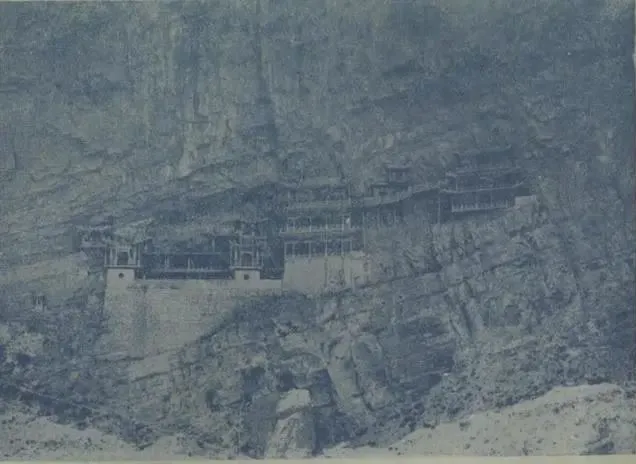
Fu Zengxiang wrote up his journey to the Northern Sacred Peak of April 22–30, 1936, as the Travel Notes on the Northern Sacred Peak, published in the ninth volume of Yilin Monthly: Special Travel Issue in 1937. The old view of Xuankong Temple carried in the same volume preserves the overall outline of the cliffside building complex as seen from the valley floor. For the image source, see the repost page of the Mount Heng Scenic Area Management Center.
References
- Jin Wei, “A Study of the Jin-Dynasty Stele Inscription of Xuankong Temple”, Journal of Shanxi Datong University (Social Science Edition), 2021, no. 2.
- Hunyuan County People’s Government, “Xuankong Temple”, October 24, 2024.
- Mount Heng Scenic Area Management Center, “Shanxi through the Archives of Ancient Architecture: Xuankong Temple of Mount Heng”.
- Mount Heng Scenic Area Management Center, “Three Visits by Famous Figures of the Past to Xuankong Temple”.
- Wenhui Bao, “Restoring Xuankong Temple: Dancing at the Cliff’s Edge, to Stand Another Thousand Years”, May 25, 2016.
- Li Yuming and Wang Ya’an, eds.-in-chief, and Chen Xuefeng, vol. ed., Complete Stone Inscriptions of Sanjin: Hunyuan County, Datong, Supplementary Volume, Sanjin Publishing House, 2015.