Introduction
In the eleventh month of 618, Li Shimin, then Prince of Qin, defeated Xue Rengao at Qianshuiyuan. After ascending the throne as Emperor Taizong of Tang, he ordered temples to be built wherever his forces had fought since their uprising, to seek blessings for the dead[1]. Zhaoren Temple rose on the Qianshuiyuan battlefield and was completed in the first month of Zhenguan 4. It stands in Changwu, Shaanxi, then Yilu County in Binzhou.
The court commissioned Zhu Zishe to compose its inscription, setting the achievements of the campaigns in stone. Much of the text, over three thousand characters long, praises Taizong. It also explains who was to benefit from the temple: Tang soldiers killed in battle, and the dead who had fought against them. Tall gateways and halls went up, monks moved in, and the battlefield became a place of Buddhist prayer for the fallen.
In 1064, Ouyang Xiu read the inscription and challenged the purpose of the foundation. He acknowledged Taizong’s achievement in ending the wars, but believed that prayers for the soldiers served as a way for the emperor to atone for killing. Tang of Shang and King Wu of Zhou, he argued, had also killed when overthrowing tyrants. Yet Heaven continued to favor them because they had acted for the public good and delivered the people from harm. If Taizong’s campaigns were equally worthy, why should he need Buddhist temples to redeem himself? Ouyang set out his criticism in a colophon[2], while praising the fine calligraphy, and included it in his record of collected inscriptions.
On the seventh day of the eleventh month of 1082, a local man named Zhang Chun wrote Ouyang’s colophon on the back of the stele. Its front praised Taizong; its back questioned his motives. Rubbings[3] of the reverse carried that criticism to later readers. The Ming scholar An Shifeng first read Ouyang’s essay, then obtained a rubbing of the back, but remained unconvinced by his judgment. Continuing his search, An paid a high price for four damaged rubbings from a family’s old collection.
After reading the inscription, An turned the criticism back on Ouyang. The text plainly stated, he argued, that the temple was primarily intended to benefit fallen Tang soldiers, while also including the enemy dead. Ouyang’s eagerness to reject Buddhism had led him to overlook the court’s mourning for its men. An also worried that mocking a ruler’s unease over killing might encourage a taste for bloodshed. In Pleasant Matters from the Forest of Ink, he defended Taizong’s foundation as an act of compassion for the dead and reluctance to kill.
In 1784, the epigrapher Wang Chang commanded troops stationed at Changwu. During a break from his duties, he visited the temple to see the stele. It was intact, sheltered in a pavilion on a stone platform beyond the reach of cattle rubbing their horns or herdboys striking sparks from the stone. Later, while compiling his Collected Inscriptions on Metal and Stone, Wang read it alongside the Dengci Temple inscription, also dedicated to the war dead. Both, he observed, lavished praise on Taizong, while less than a tenth of their wording mourned the soldiers. He therefore agreed that the steles commemorated imperial achievements.
More than thirty years after Wang’s visit, the protective pavilion had deteriorated and the stele’s base was failing, leaving it in danger of toppling. Passing through on an official journey to Lanzhou, the Qing official Fei Jun paid for materials and entrusted the repairs to the local official Xu Fuchang. The work took about twenty days. On his return, Fei found the pavilion secure, the base reinforced and a railing added around it. The stele, with praise of Taizong on its front and Ouyang’s criticism on its back, remained sheltered in the repaired pavilion.
Historical Documents
Illustrated Gazetteer of the Prefectures and Counties of the Yuanhe Era
宜禄县,本汉浅水县地,属上郡。后魏为东阴盘县地,废帝以县南临宜禄川,因改名,隶泾州。暨周、隋又为白土县。贞观二年,分新平县又置宜禄县,后魏旧名也。浅水原,即今县理所。初,金城人薛举称兵,攻破郡县。武德元年,举寇泾州,屯兵于安定县之折摭城。太宗亲征,相守六十余日。会举死,其子仁杲统其众,并羌胡十余万数来挑战。上遣总管庞玉自此原南出贼之右,因高而陈。上率大兵自原北出其不意,斩首万余级,贼大溃。仁杲惧而请降,俘其精兵万余人,男女五万口,故城犹在今县北五里。阴盘城在县西北二十五里。昭仁寺在县西十步浅水原上。王师讨平仁杲,诏于此置寺。碑,谏议大夫朱子奢之词也。长武城,在县西五十里。隋开皇中筑,在泾河南岸。武德元年废。大历初,郭子仪置兵以备西戎。
Yilu County was originally part of Qianshui County under the Han, belonging to Shang Commandery. Under the Later Wei it belonged to Dongyinpan County. Emperor Fei renamed it because the Yilu River lay to its south, placing it under Jingzhou. Under the Zhou and Sui it became Baitu County. In Zhenguan 2, part of Xinping County was divided off to establish Yilu County again, restoring the Later Wei name. Qianshuiyuan is the present county seat. At first Xue Ju of Jincheng raised troops and captured commanderies and counties. In Wude 1 he invaded Jingzhou and camped at Zhezhi Fortress in Anding County. Taizong campaigned in person, and the armies faced one another for over sixty days. Xue Ju then died, and his son Rengao took command. Together with Qiang and Hu troops, his army numbered over a hundred thousand and repeatedly challenged the Tang. The emperor sent Commander Pang Yu from the plateau’s southern side against the enemy’s right, forming up on high ground. He himself led the main army from the north in a surprise attack, taking over ten thousand heads and routing the enemy. Rengao surrendered in fear; over ten thousand elite soldiers and fifty thousand men and women were taken captive. The old fortress remains five li north of the present county seat. Yinpan Fortress is twenty-five li northwest. Zhaoren Temple lies ten paces west of the county seat, on Qianshuiyuan. After the imperial army defeated Rengao, an edict established the temple here. Its inscription was written by the remonstrance official Zhu Zishe. Changwu Fortress lies fifty li west of the county seat. It was built south of the Jing River in the Kaihuang era of the Sui, abandoned in Wude 1, and garrisoned by Guo Ziyi early in the Dali era to guard against western enemies.
Sea of Jade
唐贞观纪功业碑铭。旧纪:“贞观三年十二月癸丑,诏建义已来交兵之处,各立一寺,命虞世南、李百药、褚亮、颜师古、岑文本、许敬宗、朱子奢等为之碑铭,以纪功业。”会要:“贞观二年十二月一日,诏破刘武周于汾州,立洪济寺;破宋老生于吕州,立普济寺;破薛举于邠州,立昭仁寺;破宋金刚于晋州,立慈云寺;破王世充于邙山,立昭觉寺;破窦建德于汜水,立等慈寺;破刘黑闼于洺州,立昭福寺。”并贞观四年正月建造毕。
Tang inscriptions commemorating achievements in the Zhenguan era. The Old Annals state: “On the guichou day of the twelfth month of Zhenguan 3, an edict ordered a temple at every place where fighting had occurred since the righteous uprising. Yu Shinan, Li Baiyao, Chu Liang, Yan Shigu, Cen Wenben, Xu Jingzong, Zhu Zishe and others were commanded to compose inscriptions recording the achievements.” The Institutional Compendium states: “On the first day of the twelfth month of Zhenguan 2, an edict established Hongji Temple at Fenzhou, where Liu Wuzhou was defeated; Puji Temple at Lüzhou, where Song Laosheng was defeated; Zhaoren Temple at Binzhou, where Xue Ju was defeated; Ciyun Temple at Jinzhou, where Song Jingang was defeated; Zhaojue Temple at Mangshan, where Wang Shichong was defeated; Dengci Temple at Sishui, where Dou Jiande was defeated; and Zhaofu Temple at Mingzhou, where Liu Heita was defeated.” All were completed in the first month of Zhenguan 4.
Colophons to the Collected Records of Antiquity
右昭仁寺碑,在豳州,唐太宗与薛举战处也。唐自起义,与群雄战处,后皆建佛寺,云为阵亡士荐福。汤、武之败桀、纣,杀人固亦多矣,而商、周享国各数百年,其荷天之祐者,以其心存大公,为民除害也。唐之建寺,外虽托为战亡之士,其实自赎杀人之咎尔。其拨乱开基,有足壮者,及区区于此,不亦陋哉!碑文朱子奢撰,而不著书人名氏,字画甚工,此余所录也。治平甲辰秋分后一日书。
This stele of Zhaoren Temple is in Binzhou, where Tang Taizong fought Xue Ju. After the Tang uprising, Buddhist temples were built at all the places where its armies had fought rival leaders, supposedly to seek blessings for soldiers killed in battle. Tang and Wu certainly killed many when defeating Jie and Zhou, yet the Shang and Zhou each ruled for hundreds of years. Heaven favored them because they acted with complete impartiality and removed evils from the people. Although the Tang temple foundations outwardly invoked the war dead, they were really an attempt to redeem the guilt of killing. There was much to admire in ending disorder and founding the dynasty; was it not petty to trouble over this? Zhu Zishe composed the inscription, but the calligrapher is unnamed. The lettering is excellent, which is why I recorded it. Written the day after the autumn equinox in the jiachen year of Zhiping.
Stone Granary Anthology of Poetry through the Ages
危栏凭绝壑,欲奈此时何。但有夕阳处,就中秋色多。与谁同徙倚,空自发吟哦。便觉成羁旅,归心逐雁过。
A high railing hangs above a sheer ravine—what am I to do at such a moment? Wherever the evening sun falls, autumn gathers most richly. With whom can I linger here? Alone I begin to chant. At once I feel myself a traveler far from home; my longing follows the passing geese.
Stele of Zhaoren Temple in Binzhou
守谏议大夫、骑都尉臣朱子奢奉敕撰。
Composed by imperial command by your servant Zhu Zishe, acting Grand Master of Remonstrance and Commandant of Cavalry.
大哉乾元,寒暑违而成岁;赫矣上圣,禅代乖而为道。斯则淳源既往,弧矢开戡翦之利;天下为公,揖让盛皇王之业。是知圣无自我,不背时以成务;仁惟济物,乃当流而义行。岂好异哉,盖因世而已矣。若乃执契提象,继天理物,张八极,叶五纬,坐玄扈,游翠受昭华而锡天佩,观荥河而巡温洛。补石于娲皇之世,奠山于文命之初。殊质文于车服,改正朔于寅丑。顺天地而财成,奄宇县而光宅。斯固神宗与汜水一致,文祖将㙁野同归者也。
Great is the primal force of Heaven: opposing cold and heat make the year. Glorious are the highest sages: differing modes of succession accord with the Way. When the age of simple purity passed, bows and arrows served conquest; when the world was held for the common good, courteous abdication magnified royal achievement. Thus the sage has no private self and accomplishes his work without resisting the times; benevolence saves living beings, acting justly as circumstances require. This is no love of novelty, but a response to the age. Bearing authority and celestial models, rulers succeed Heaven in ordering all things, extend rule to the eight limits and harmonize the five planets. The text evokes Xuanhu, the reception of luminous jade, heavenly ornaments, the Ying River and the Luo. From Nüwa repairing Heaven with stones to Wenming settling the mountains, simplicity and ornament varied in carriages and robes, and calendars changed their opening month. Following and completing the work of Heaven and Earth, they ruled and illuminated the realm. In this, the divine ancestor and the events at Fanshui, the cultured ancestor and the field of Mu, lead to the same end.
随政悖道,区夏歼溃。星亡日斗,天瘥地反。驭朽无秋驾之术,履薄罕春冰之惧。竭人力于醉饱,轻神器于弈棋。玉杯非藜藿之用,金柱乃骄淫之靡。旌跸遍天下,驰道穷华裔。暴师韩濊,宿兵辽碣。贪石田之地,忘金镜之宝。骏𫘧之乘,骛燕山而不息;鼋鼍之梁,泛苍波其无已。五岳维尘,三川咸震。大盗负其扃𫔎,长鲸冲其漏网。介胄不能匡其祸,衣冠无以靖其乱。伊尹去而夏亡,辛甲奔而殷灭。人怨神怒,众叛亲离。触瑟无汉臣之忠,梦骖成秦宫之酷。于是九畿幅裂,窃名假号,四方圜视,蜂飞猬结。赤眉起刘樊之众,白梃奋陈吴之兵,徇赵北而图王,反淮南而称帝。钩爪锯牙,递相吞灭。茫茫禹迹,沟壑无归,苍苍彼天,何其罔极!
The Sui government departed from the Way, and China collapsed. Stars vanished, suns contended, Heaven sent affliction and Earth overturned. They drove rotten reins without the skill to restrain them, crossed thin ice without fear of its breaking, exhausted the people to satisfy feasting and treated the sacred throne as a chess piece. Jade cups were no vessels for humble fare; golden pillars fed pride and extravagance. Imperial processions covered the empire, their roads reaching Chinese and foreign lands. Armies were exposed in Korea and stationed around Liaodong and Jieshi. Barren territory was coveted while the precious mirror of good government was forgotten. Fine horses raced endlessly toward Yanshan; bridges of turtles and alligators stretched without end across the waves. Dust veiled the Five Peaks; the Three Rivers trembled. Great thieves carried off the gates and locks, and giant whales burst the net. Neither soldiers nor officials could avert calamity or quell disorder. As Xia fell after Yi Yin’s departure, and Shang after Xin Jia fled, the people resented and the spirits raged; followers rebelled and kin deserted. The allusions to the zither and the dream of the team of horses set lost Han loyalty against Qin cruelty. The imperial domains split apart. Usurpers assumed titles, watching one another, swarming like bees and clustering like hedgehogs. Red Eyebrows recalled the forces of Liu and Fan; wooden clubs, the armies of Chen and Wu. Some sought kingship north of Zhao; others proclaimed themselves emperor south of the Huai. With hooked claws and sawlike teeth they devoured one another. Across the lands of Yu, the dead lay in ditches without a home. Vast Heaven—why was there no end to this?
若乃崇替相袭,天地恒其道;灵贶所归,三五更其运。是以秦人弛御,丰沛膺赤帝之符;夏道云衰,景亳得白狼之瑞。殷忧启圣,必将有主,扑原静海,上玄有属。我皇帝受之。皇帝兆出震之灵,禀枢电之精,开日月之明,审正气之贞。潜德而隐,凝玄姑射之侧;感而遂通,应迹庙堂之上。乘龙之梦,夙符于神道;断鳌之心,早发于灵鉴。蕴风云于藏用,纳宇宙于胸怀。濡足授手,救焚是急。于是御太乙,挹勾陈,驱天驷,回地轴。乾行岳止,雷惊麟震。得兵钤于玄教,吞戎韬于黄石。龙飞晋水,凤翥河干。命苍以泛流,麾鸟旗以长迈。以仁为本,扶义而西,传檄百城,转斗千里。战无交兵之虏,攻无汤池之固。望凤墟而一息,登灞上而回首。观衅而动,俟天休命。壶浆溢陌,厥篚盈涂,鬼神叶赞,华夷载伫。𫄬秦婴于枳道,拜殷士于商旌台之珠,毕散于邦国;诸侯之玊,不留于服御。眷言兆庶,企景来苏。
Rise and decline follow one another: Heaven and Earth keep their enduring course, while auspicious favor passes between successive sovereigns. Thus when Qin lost its hold, Feng and Pei received the Red Emperor’s token; when Xia declined, Jing and Bo received the white wolf’s omen. Deep distress brings forth a sage; there must be a ruler to settle land and sea, chosen by highest Heaven. Our emperor received that charge. Born under auspicious thunder and celestial lightning, he possessed the brightness of sun and moon and the integrity of vital energy. His virtue lay hidden in profound seclusion, then answered the call of the court. A dream of riding a dragon early matched divine signs; the resolve to sever the giant turtle’s legs arose in his spiritual insight. He stored wind and cloud within his powers and held the universe in his breast. He would wet his feet and extend his hand, hastening to rescue those in the flames. He commanded Taiyi, drew on Gouchen, drove the heavenly team and turned Earth’s axis. His movement was Heaven’s, his stillness a mountain’s; he startled like thunder and stirred like the qilin. He mastered sacred military teachings and the strategies of the Yellow Stone elder. The dragon rose beside the Jin River, the phoenix soared by the riverbank. Boats took the current and bird-emblazoned banners advanced. With benevolence as his foundation, he upheld justice and marched west, sending proclamations to a hundred cities and fighting across a thousand li. No enemy could stand in battle, no fortified moat withstand attack. He paused toward the phoenix’s ruins and looked back from Bashang, moving when opportunity opened and awaiting Heaven’s favorable command. People filled the roads with drink and baskets of provisions; spirits lent support and Chinese and foreign peoples waited. The text invokes the surrender of Qin’s Ziying and the submission of Shang’s men. Pearls and jade were distributed throughout the realm rather than kept for personal use. He cared for the multitudes, who eagerly awaited deliverance.
薛举往因天隙,偷安陇坻,藉九州之险,成五幡之暴。推锋东向,结垒西夏,同恶如市,转相煽合,带州连郡,豺虺为群。无窦融之先觉,有隗嚣之迷谬。游魂放命,豕突豳梁。虽大风之作梗青丘,有苖之称乱丹浦,均强比逆,异代同年。岂不以道丧鹑居,让王义隐,时惟龙战,争帝理开者乎?是以轩辕五十一伐,殷后二十七征,暴寿华之泽,戮凶绝辔之野,非文德之可绥,乃雄略之攸震。天子躬御武节,亲总元戎,洒沉灾而括地象,正斗极而清天步,倚长剑以肃威,伫中区以傍瞩。运投水转规之智,蓄礼乐慈爱之兵。韬百战百胜之谋,总天关天梁之术。驱驾韩白,鞭击雷电。命招摇以启行,诏参伐以前扫。殉义之士,听鼓鼙而窃誓;蹈恩之众,望旌笳而张胆。呼吸则河海沸荡,指麾则昆岱掎拔。圣上顺天道好生之德,体周王掩瘠之仁,将欲克乱在权,善师非战,兵交使在,弘其自革。而茅旌不建,舆榇莫从,告舍既违,行迷遂往。吠尧之犬,终成桀用;刺由之客,俱为跖徒。鸟啄兽穷,来犯锋刃,比角为城池之固,召雨恣屈强之力。非折箠之可笞,岂亭长之攸制?于时摄提在岁,黄钟纪月,义勇同奋,贲育争先。下神兵于九天,决睿图于万里。逆顺斯悬,轰然大溃。僵尸蔽莽,委甲成山。拥秦泾而不流,投过涧而自满。焚巢扫窟,野无遗正倾旻于西北,纽缺地于东南,卷氛祲于辰象,反光华于日月。九伐已施,载櫜于武库;五兵罢用,偃伯于灵台。分蒨旆于应毕,誓山河于将率。
Xue Ju had earlier exploited Heaven’s breach to establish himself beyond the Long Mountains. Relying on strong terrain, he raised violent forces, advanced east and fortified the western lands. Evildoers flocked to him, inciting one another, linking prefectures and commanderies like packs of wolves and vipers. He lacked Dou Rong’s foresight and shared Wei Xiao’s delusion. His doomed forces defied commands and rushed into Bin and Liang like boars. Like the Great Wind ravaging Qingqiu or the Miao rebellion at Danpu, his strength and rebellion matched ancient evils. When the Way fails and abdication loses its meaning, dragons contend and rivals seek empire. Hence Xuanyuan’s fifty-one campaigns and the Shang ruler’s twenty-seven expeditions, the defeat of the violent at Shouhua and of the wicked at Juepei: such men cannot be soothed by civil virtue, but must be shaken by military power. The Son of Heaven personally took command, swept away disaster, restored celestial order, held his long sword in majesty and surveyed the realm. His wisdom worked as fluidly as water and a turning circle; his army embodied ritual, music, kindness and love. He held plans for a hundred victories and mastered the arts symbolized by the heavenly gates and beams. He surpassed Han Xin and Bai Qi, driving thunder and lightning, ordering the stars Zhaoyao and Shenfa to clear the way. Men ready to die for justice swore oaths at the drums; those grateful for imperial favor gained courage at banners and pipes. At his breath seas boiled; at his gesture Kunlun and Mount Tai could be uprooted. Following Heaven’s love of life and the Zhou king’s compassion in burying the dead, he wished to end disorder with discretion and prevail without battle. Envoys remained between the armies, giving the enemy room to reform. But they raised no surrender banner and brought no coffin in submission. Rejecting release, they persisted in error, like dogs barking at Yao in Jie’s service, or assassins serving the robber Zhi. Desperate as trapped beasts, they attacked his blades, trusting their massed forces as walls and their defiance as rain-summoning strength. A broken switch or a petty local officer could not subdue them. In the year marked by Sheti and the month of Huangzhong, all the righteous and brave rose together, competing like Meng Ben and Xia Yu. Divine troops descended from the nine heavens; imperial strategy reached ten thousand li. The division between rebellion and obedience was decisive, and the enemy collapsed. Corpses covered the wilds, discarded armor piled like mountains, bodies choked the Qin and Jing waters and filled the gullies. Their nests and lairs were burned and swept away [the transmitted text is defective here]. The displaced heavens and earth were restored, ominous vapors cleared from the stars, and sunlight and moonlight returned. Campaigns ended; weapons were sheathed in the arsenal and war ceased. Banners and fiefs were granted to the commanders, with oaths enduring as mountains and rivers.
帝图咸举,邦政斯澄。革污俗于维新,正王风于旧物。鼓之以道德,怀之以仁义。春雨以润之,秋阳以暴之。解罔深汤帝之慈,焚书下汉王之诏。布以新政,刑用轻典。四海之内,靡然向风;八荒之表,奔走无𭣧。却塞蹛林之北,开郡铜柱之南。苑葱山而池盐泽,逾盘水而跨热阪。郡生环海,自入提封;方朔炎洲,同归王会。岂止菌鹤短独、西鹣东鲽之贡而已哉!若夫至人忘已,义期拯物,黄屋非汾水之荣,玄圭岂具茨之贵?圣道运而不积,神功为而莫宰。虽复大横固祉,长发启祥,犹且置玺陈谦,避河为让,道外天下,情遗尊极。而岩廊余事,人神之望难拒;符命傥来,历数之期安避?仰追上玄之心,俯顺域中之请。然后履乘石,握神珠,开黄玉之图,临紫辰之位,冠百王而称首,与三代而同风。巍巍乎,荡荡乎,粤不可名也。于是衢室辟扉,宾门启路,延揽英彦,鉴昧幽仄。用人不偏于世族,得贤无弃于农琐。故非熊非螭,致光景之佐;为舟为楫,获营求之士。等五臣之亮采,同六相之𬣙谟。崇台非一木之枝,珍裘乃千金之丽。济济多士,皇家以宁。重以制礼作乐,移风也;胜残去杀,刑措也。藏金舜岭,菲膳尧宫。雉裘非先王之服,宝马岂鸾旗之用?运玄览以照物,推赤心以期下。万方罪已,轸推沟之虑;百姓为心,顺天从之欲。若乃上嗣重光之美,元良万国;棣华璇萼之宗,本支百世。咸幼陶慈训,言提自昔。奉审喻于宸极,得乐善于轩殿。非藉保传之勤,宁因师友之力。逾启诵而高视,越郇韩而上征。既而休气和年,祥风荐祉。威凤为宝,麟趾游郊。若烟非烟,浮晓空而下映;似月非月,丽宵天而成象。祯不绝书,灵无遁迹,猗与伟与,事高图史。至于登舆下辇,省方巡岳,应感必彰,形言弥著,道盛金奏,美盈玉简,叶睿思于泉涌,谐神功于日用,陋柏梁之词,掩南风之曲,圣作物睹,永贻千载者焉。
The imperial plan was fulfilled and government made clear. Corrupt customs were renewed and royal ways restored. The people were moved by virtue and cherished through benevolence and justice, moistened like spring rain and warmed like autumn sun. The emperor’s mercy recalled Tang opening the hunting net; his amnesty, the Han king burning incriminating writings. New government was proclaimed and lighter penalties applied. All within the seas turned toward him; beyond the eight wastes people hurried to submit. Frontiers extended north of Dailin and commanderies south of the bronze pillars. The Onion Mountains became a park and the Salt Lake a pond; rule crossed the Pan waters and the hot slopes. Distant island realms entered the boundaries and northern and southern lands joined royal assemblies. Their tribute went far beyond rare cranes and paired birds and fish. The perfected ruler forgets himself and seeks only to save others: the imperial carriage did not tempt the sage by the Fen River, nor did the dark jade tablet make rank precious at Juci. The sage’s Way works without hoarding; divine achievement claims no ownership. Despite auspicious omens, he set aside the seal in modesty and offered to withdraw, regarding rule as external and supreme rank with detachment. Yet he could not refuse the hopes of people and spirits, nor evade Heaven’s appointed succession. Following Heaven above and the realm below, he mounted the royal stone, held the sacred pearl, unfolded the yellow-jade plan and took the purple celestial throne. First among a hundred kings, he matched the Three Dynasties: lofty and vast beyond description. He opened his audience halls, welcomed worthy men and sought talent in obscurity. He neither favored great families nor rejected men from humble farming households. Thus he found helpers like the sage’s auspicious prey and counselors like the boat and oars that carry a ruler, matching the five ministers’ achievements and six advisers’ plans. A high terrace needs more than one timber; a precious fur robe draws on many costly pelts. The many worthy men secured the dynasty. Ritual and music transformed customs; violence and killing ceased and punishments fell unused. He shunned wealth and ate sparingly, following Shun and Yao: pheasant robes and prized horses were no necessary ornaments of kingship. With deep discernment and sincerity, he blamed himself for the realm’s faults, worried as though he had pushed people into a ditch, and made their wishes his own in obedience to Heaven. The heir continued the imperial brilliance, and the princely branches promised a hundred generations. Trained in kindness from childhood and instructed personally by the throne, they loved goodness without depending solely on tutors and friends. They surpassed Qi and Song, Xun and Han. Auspicious energies blessed the years: phoenixes appeared and qilin roamed the outskirts; mistlike portents filled the morning sky and moonlike forms shone at night. Signs were recorded without cease, their marvels surpassing earlier histories. On journeys and inspections, the emperor’s responses and words manifested his virtue. His writings filled music and jade tablets, flowing like a spring and matching divine accomplishment in daily life, outshining the poems of Bailiang and the Song of the South Wind, to be handed down for a thousand years.
抑又闻之,羲、农遐邈,轩、顼悠 绝,传信于故老,非取接于闻见。百世可知,斯言殆息,七代更立,求之岂易?今之视昔,遥然未睹。将何以分素青于三后,辨天地于九皇,遂能历选列辟,详观群帝,得茂实于千古,验英声于万叶。斯道何哉?将由孔丘登岱,纪金绳者七十;管仲对齐,陈玉检者十二。亦有汉廓帝图,魏开王业,树丰碑于泗水,𬤥贞石于繁昌。莫不垂鸿名,腾显号,播休风于六舞,歌盛德于九韶,与天壤而无穷,悬贞明而可久。刊勒之美,不其懋与!
I have also heard that Fuxi and Shennong are remote, Xuanyuan and Zhuanxu far removed. We trust the elders’ reports, not our own sight or hearing. Even the saying that a hundred generations can be known seems hard to sustain; how much harder to recover seven successive ages. Looking back, we cannot see them. How then distinguish the achievements of the ancient sovereigns, examine successive rulers and verify enduring merit and renown? Confucius, ascending Mount Tai, recorded seventy rulers with golden cords; Guan Zhong, answering the lord of Qi, listed twelve with jade-sealed records. When Han expanded its empire and Wei began its royal enterprise, great steles were raised by the Si River and enduring stones at Fanchang. All transmitted exalted names, spread worthy customs through the six dances and sang great virtue in the ninefold Shao music, to last with Heaven and Earth and shine enduringly. How great is the value of inscription!
然则事止寰中,道外,未辨西方之圣,莫知东被之法。求真之理,我则未闻。虽御辩崆峒,非 涅盘之岸;乘云谷口,宁游波若之门?莫不同陟耶山,俱沉业浪,生死无际,苦集相因。讵照重昏之日,谁翦稠林之树?比夫真如实相,解脱妙津,道王三千,功弥百亿,何异吹剑首于雷门,策蚊睫于鹏运者哉!是知伊兰无实,有为终假,漂溺四流,邅回九结,践畏涂而卒岁, 捷径其长往。大梦无晓,可为叹息。粤若能仁,深弘慈奖,虽寂泊为道,无来无去,乘机诱发,垣玺必追。住一子地,开方便门,翔八正道,示如来藏。飘香风于有顶,洒甘露于无边。慧炬明而幽夜朗,法桥搆而冯河息。但为仁由已,履道自衷,表立影从,因果非外。今我所以仰胜缘于十号,纪武功于七德,真俗二谛,兼而两之。
Yet these achievements remain within the world [the transmitted wording has a gap], without discerning the sage of the West or the teaching spread eastward. The principle of seeking ultimate truth is still unheard. Even the discourse at Kongtong does not reach nirvana’s shore; riding clouds at the valley mouth does not enter the gate of wisdom. All climb the mountain of error and sink in the waves of karma, boundless birth and death, suffering following its causes. Who lights a sun in this darkness or cuts through its thicket? Beside true suchness, ultimate reality and the wondrous ford of liberation, whose Way rules the thousandfold worlds and whose merit fills countless realms, worldly achievements are like blowing on a sword hilt against the Thunder Gate, or riding a mosquito’s eyelash beside the flight of the great peng. The foul eranda tree bears no good fruit; conditioned things remain unreal. Beings drift in four torrents and circle among nine bonds, spending their years on dangerous paths [a gap interrupts the next phrase]. Their great dream never ends: how lamentable! The Benevolent One extends deep compassion. Though his Way is stillness, neither coming nor going, he responds to occasions and guides beings [the transmitted phrase here is uncertain]. Dwelling where all are regarded as one child, he opens skillful means, follows the Noble Eightfold Path and reveals the tathagata-store. Fragrant winds reach the summit of existence and sweet dew falls without limit. Wisdom’s torch lights the night; the bridge of Dharma ends perilous crossings. Benevolence comes from oneself and the Way from the heart: set up the post and its shadow follows; cause and effect are not external. We therefore seek the Buddha’s excellent conditions while recording the seven virtues of military achievement, embracing both ultimate and conventional truth.
皇上昔居因地,早弘誓力,应迹忍土,负荷群生。属忧火燎原,稽天方割,飙林无自静之木,震海岂澄源之水。东戡西翦,南征北怨,旄钺所次,酣战兹邦。君轻散千金之赏,士重酬九死之命。莫不竞凌锋镝,争赴水火。虽制胜之道,允归上略,而兵凶战危,时或殒丧。褰裳不顾,结缨荒野。忠为令德,没有余雄。同艰难于昔晨,异欢泰于兹日。有怀亮烈,用切旒扆。仍于战地,爰搆神居。变秽土于宝城,开莲花于火宅。高𤇺罢昭,慈灯载朗;鸢旌辍警,胜幡斯立。拔无明于棘林,𨗳焦热于渴井。尽诸有结,永除苦际。虽复去顺效逆,同归各徒,中涓颍从,寔惟义重。而上忍所被,旃檀与利刀兼忘;大慈所覃,怨贼将义夫齐指。俱润法雨,同乘大辕,回向菩提,无上平等。
Before attaining his present station, the emperor had already made great vows. Appearing in this world of endurance, he bore the burden of living beings. When sorrow blazed across the plains and floods rose to Heaven, no tree stood still in the storm and no water remained clear in the shaken sea. He pacified east and west; while he marched south, those in the north longed for his coming. His standards and axes reached this place, where fierce battle followed. The ruler freely bestowed vast rewards; his men repaid them at the risk of death, competing to face blades and plunge into fire and water. Victory rightly belonged to supreme strategy, but warfare is perilous, and some fell. They rushed on heedless, dying in the wilds with their honor intact. Their loyalty was exemplary and their courage survived them. Those who had shared past hardship could not share today’s peace. The sovereign grieved deeply for their steadfastness and built a sacred dwelling on the battlefield. Defiled ground became a jeweled city; lotus flowers opened in the burning house. War beacons gave way to lamps of compassion, warning banners to sacred streamers. Ignorance was uprooted from thorny thickets; the scorched were led to water. May all bonds of existence and all suffering end. Even those who left obedience for rebellion had followed their own leaders; loyalty has weight, as the examples of Zhongjuan and Ying’s followers show. Supreme forbearance distinguishes neither sandalwood nor cutting blade, and great compassion treats enemy and loyal warrior alike. All receive the rain of Dharma, ride the great vehicle and turn toward enlightenment in unsurpassed equality.
尔乃仰图景宿,东井躔其分野;下料物土,西河限其封域。雕戈是锡,尸臣启邦之所;豳馆斯开,公刘建都之地。梁山南枕,甘泉东指。面雕云之郁蓊,想玉树之青葱。沃野千里,平原超忽。先王之桑梓,西州之都会。于是诏司空,相原隰。四衢如砥,八道傍通。考极星之曜,测土圭之景。选耜梓于南郢,征琬琰于西昆。匠石奋斤,公输审墨。高门洞启,层甍有亢。藻井瞰烟霞之路,步檐拖虹霓之色。徘徊珠柱,陆离璇题。春牖前临,秋窗左辟。月殿含影,金波上而相照;日宫吐曜,羲和沉而犹朗。何止四柱成台,高多罗之树;五王立寺,临伽尸之水。信足上图驾御,傍拟醍醐,望鹫山而非远,想鸡林而可即。法徒萃止,应供来游,咸珠戒无缺,威仪莫犯。杖锡四禅之林,摄𪗋三朗之路。有宝所焉,有名僧焉。至矣哉,伽蓝之为盛也!虽复高天已烬,大海成田,我皇基与净刹,终永永而常传。
Above, the site lies within the celestial region of the Eastern Well; below, its lands are bounded by the Western River. It is the country where a lord received an engraved halberd and established his domain, where Gong Liu founded his capital at Bin. Mount Liang lies to the south and Ganquan to the east. Auspicious clouds gather before it and jade trees seem verdant. Fertile fields extend a thousand li across the broad plain: the ancestral homeland of former kings and a western metropolis. The emperor ordered the minister of works to survey high and low ground. Four thoroughfares lay smooth, eight roads connected. The pole star’s light was observed and the gnomon’s shadow measured. Timber was selected from southern Ying, fine jade sought from western Kunlun. Craftsmen wielded axes like Master Shi and tested ink lines like Gongshu. Tall gates opened wide and layered roofs rose high. Painted coffered ceilings overlooked the clouds; covered walks trailed rainbow colors. Jeweled columns and ornamented lintels gleamed. Windows faced spring and opened toward autumn. Moonlit halls held reflections; radiant palaces shone even after the sun god had set. They surpassed the four-pillared terrace and tall palm, and the five kings’ temple by the river of Kashi. They could rival the Buddha’s own sanctuary and highest teaching; Vulture Peak seemed near and the sacred grove within reach. Monks gathered and worthy mendicants came, keeping their precepts intact and their conduct correct. With staffs they entered the forest of the four meditations and followed the path of illumination [one transmitted term is uncertain]. Here were treasures and renowned monks: how flourishing this monastery! Even when the heavens burn and the sea becomes fields, our dynasty’s foundations and this pure sanctuary shall endure forever.
其词曰:三界云扰,六趣波扬。苦流方割,忧火炎岗。俱迷津济,莫导舟航。长夜无晓,非徒未央。于昭十号,四生是愍。道王大千,智周上忍。慧刀已裂,化城斯引。教有殊涂,乘无异轸。甘露朝洒,慈云夕布。品物以亨,群迷式悟。捷迳坦道,耶山启路。不有善权,谁澄恶趣。炎行弛德,废道毁常。玊弩惊焰,金宿腾芒。俯震瀛壑,仰紊乾纲。九野鲸奋,八极鸱张。乱离瘼矣,孰济生灵。黄星表曜,赤伏开祯。大君应历,粤御神兵。乃圣乃武,如雷如霆。于铄王旅,除凶靖暴。关右长驱,唐郊大号。壤裂逋丑,家离浞傲。刷野屠祅,空山剿盗。见危殒辔,怀忠死绥。惊燐宵远,穷魂夜飞。我有慈被,深仁莫违。建斯净域,永树归依。归依伊何,俱消五䌸。净域伊何,同升妙觉。架汉开宇,凭霞竦阁。朱丽琼丹,地严金雘。鹫山非远,鸡林可求。七宝低树,八解疏流。瑞莲开晓,天花不秋。戒定攸息,应供来游。凡厥慈众,俱弘上善。稠林以辟,爱枝爰翦。九结冰泮,四禅自。 彼岸可归,法轮恒转。金刚不坏,璇保惟长。慧室长湛,皇基载昌。僧祗可筭,恒沙易量。悠哉天历,永配无疆。
The verse says: The three realms are troubled, the six destinies surge. Suffering floods the land; sorrow burns the hills. All lose the crossing, with no boat to guide them; the long night has no dawn. Bright is the Buddha of ten titles, compassionate toward the four kinds of birth. His Way governs the great thousandfold world, his wisdom reaches supreme forbearance. Wisdom’s blade cuts bonds; the conjured city guides the weary. Teachings differ, but their vehicles lead together. Sweet dew falls at dawn, compassionate clouds spread at dusk. All beings flourish; the deluded awaken. A level road opens through the mountain of error: without skillful means, who could cleanse the evil destinies? The Sui abandoned virtue, destroyed the Way and violated enduring norms. Celestial signs flared; the seas shook below and Heaven’s order broke above. Rebels raged across the wilds and stretched to every limit. In such distress, who would save the living? Yellow stars shone and red prophetic signs revealed good fortune. The great ruler answered destiny and led divine troops, wise and martial as thunder. Glorious royal armies removed the wicked and stilled the violent, sweeping west of the passes and raising their cry in Tang’s fields. Fugitives were scattered and cruel houses broken, demons swept from the plains and bandits from the hills. Men met danger and fell, faithful unto death. Ghostly lights flickered far into the night and lonely souls flew in darkness. Our compassion covers them; deep benevolence will not fail them. We establish this pure precinct, an everlasting refuge. What is refuge? Release for all from the five bonds. What is the pure precinct? Shared ascent to wondrous awakening. Halls span the Milky Way; towers rise against the clouds. Vermilion and jewel colors shine; the ground is adorned with gold and pigments. Vulture Peak is not far; the sacred grove can be reached. Seven jewels hang upon the trees; streams flow through eight liberations. Auspicious lotuses open at dawn; heavenly flowers know no autumn. Precepts and meditation find a home; worthy mendicants come. All compassionate beings promote the highest good. Thickets are cleared and branches of attachment cut; nine bonds melt like ice [the next phrase on the four meditations is incomplete]. The farther shore can be reached; the wheel of Dharma turns forever. Adamant cannot be destroyed; jeweled protection endures. Wisdom’s chamber remains tranquil and the dynasty flourishes. Countless eons may be counted, the Ganges’ sands measured; long may Heaven’s mandate last, joined forever with the boundless.
右昭仁寺碑,唐守谏议大夫骑都尉朱子奢𬤥。欧阳公爱其字画甚工,惜无书人氏名。金石录尝载其目,亦不言为何人书也。惟通志金石略以为虞永兴书。永兴书之传世者,有孔子庙堂碑,然与此不类,而金石略乃谓出于虞公,当必有所据。昭仁寺在邠州西八十里,昔唐太宗与薛举战争之处。正德癸酉,予以使事道邠,得搨其本,字画完好,若初刻者,真可宝也。朱公,予乡先生,唐史有传,其文字人间罕存,可见者仅有此耳。
This Zhaoren Temple inscription was composed by the Tang official Zhu Zishe, acting Grand Master of Remonstrance and Commandant of Cavalry. Ouyang admired its excellent lettering and regretted the absence of the calligrapher’s name. The Catalogue of Inscriptions on Metal and Stone lists it without identifying the hand. Only the Treatise on Metal and Stone in the Comprehensive Records assigns it to Yu Yongxing. Among his surviving works is the Confucius Temple Stele, yet this looks different. The attribution must nevertheless have had some basis. Zhaoren Temple stands eighty li west of Binzhou, where Tang Taizong once fought Xue Ju. In the guiyou year of Zhengde, I passed through Bin on an official mission and obtained a rubbing. The characters were complete and fresh as though newly cut: a true treasure. Master Zhu was a distinguished man of my own region and has a biography in the Tang history. His writings rarely survive; this is virtually the only one to be seen.
Collected Works of the Unofficial Historian of Xingyang
右昭仁寺碑,在今豳州宜禄镇,唐师及薛举战地也。碑为阵亡士荐福而作,世以为虞永兴公书。宋元丰、绍圣诸君子题识刻于碑阴,若欧阳公取其字法之精,而不定为何人所书,其余但纪观碑岁月,谓为世南少年书者,河南张威甫也。以予观之,此碑视庙堂碑笔锋为露,而运意略同,至于辞语亦有相类者,亦一时士大夫习气然耶。越章立可自陜右入觐,用以为贶,既装潢成什,摭其指意,系长歌于后云:
This Zhaoren Temple stele stands at present-day Yilu Town in Binzhou, where Tang troops fought Xue Ju. It was erected to seek blessings for fallen soldiers, and is commonly attributed to Lord Yu Yongxing. Colophons by gentlemen of the Song Yuanfeng and Shaosheng eras are carved on its back. Ouyang admired the skill of its lettering but did not decide who wrote it; the others merely recorded the dates of their visits. Zhang Weifu of Henan called it a youthful work of Shinan. To my eye, its strokes are more exposed than those of the Confucius Temple Stele, though the conception is similar. Some phrasing also resembles it: perhaps this reflects the habits of scholars of that time. Zhang Like of Yue brought it as a gift when coming from Shaanxi to court. After mounting it as an album, I gathered its meaning into the long poem below.
隋家天子普六茹,五儿一气夸胤祚。噬脐追悔废立乖,忍死空惭独孤误。大业改号朝新君,北南乐土无惊尘。锦帆楼船驾河汴,琼花看遍江都春。春梦繁华眼前别,纵意淫奢宁改辙。乱离四海金铁鸣,杀人如麻川流血。咸阳不见翠华归,独夫剚刃谁其悲。寰宇皇皇望真主,秋风晋水神龙飞。秦王上将天日表,草昧群雄如电扫。锁枷械钮俘累累,献凯归来京阙晓。蕞哉小丑据豳岐,奉将天讨森熊貔。两军一战胜负决,倒戈弃甲愁疮痍。阵前骈首就诛戮,百里僵尸京观筑。惊燐明灭艳青红,长夜冥冥听鬼哭。贞观年来歌太平,恩波直欲流泉扃。丹碧楼台五云起,金身宝座联珠缨。吁嗟死者焉可作,冥福全资大皇觉。茫茫苦海渡慈航,净土西天归极乐。贝叶翻经白马驮,神人现相严㧑诃。法师上奏帝颜悦,倾心事佛真如何。龟趺螭首穹碑树,谏议文章重回护。书丹仿佛虞永兴,独怪当时名弗署。银钩铁画睹斯文,摩空鳌背愁斜曛。片言诛意凛斧钺,遐思渺渺凌秋云。自古明王严放伐,汤武吊民宁嗜杀。往事悠悠且莫论,要与书家论波磔。
The Sui emperor bore the name Puliuru; five sons of one stock boasted of their succession. Too late came regret for the wrongful deposition and appointment; dying, he could only rue Dugu’s mistake. Daye began beneath a new ruler, and north and south seemed peaceful. Brocade-sailed tower ships traveled the Bian, viewing all the blossoms of Jiangdu’s spring. The splendid dream vanished before his eyes, yet he would not turn from indulgence and luxury. Weapons rang across the war-torn seas; men were cut down like hemp, rivers ran with blood. The imperial banners never returned to Xianyang. Who mourned when the solitary tyrant was stabbed? The world anxiously awaited its true lord; in autumn winds a divine dragon rose by the Jin. The Prince of Qin, supreme commander, bore a sunlike countenance and swept away the rival warlords like lightning. Captives came in chains and shackles; victory was presented at dawn before the palace. A petty rebel held Bin and Qi; mighty troops carried Heaven’s punishment against him. One battle settled victory and defeat; weapons reversed and armor fell amid grievous wounds. Heads bowed together for slaughter at the front, corpses for a hundred li heaped into victory mounds. Ghostly lights flashed blue and red; in endless darkness the dead were heard crying. Under Zhenguan, peace was sung, and imperial grace sought to flow even into the grave. Vermilion and blue towers rose through five-colored clouds; golden images sat on jeweled thrones hung with pearl tassels. Alas, who could bring the dead to life? Their blessings depended wholly on the Buddha. Compassion’s boat crossed the boundless bitter sea toward the western Pure Land. Palm-leaf scriptures came borne by the white horse; divine figures appeared in solemn majesty. Monks memorialized the throne and pleased the emperor: what was this wholehearted service to Buddhism? A lofty stele with turtle base and dragon head arose, the remonstrance official’s prose carefully defending the undertaking. The hand resembled Yu Yongxing’s; strange that no name was signed. Silver hooks and iron strokes reveal the text; above the turtle’s back, the fading sunlight leans. A brief judgment of motives strikes like an axe, and distant thoughts rise through autumn clouds. From antiquity, wise kings treated punitive campaigns gravely: Tang and Wu comforted the people, surely they did not delight in killing. Let those distant events rest; I would discuss the strokes with calligraphers.
Inscribed Splendors in Stone and Ink
碑在长武县,朱子奢撰,无书者姓氏。余观其笔法,大类庙堂,庙堂丰逸,此稍瘦劲。庙堂五代重勒,此伯施真迹也。欧公亦不言谁书,郑樵直以为伯施,都玄敬谓必有据,而曹明仲曰欧阳通书。通书道因诸碑,殊与此不类。按旧唐书:贞观三年,诏建义以来交兵处,为殒身戎阵者,各立一寺,令虞世南、朱子奢等为之碑,此破薛举处也。又通本传,少孤,母徐氏教以父书,仪凤中始知名。贞观三年至仪凤元年,四十八年。道因碑书在龙朔三年,去贞观三年亦三十五年,则此非通书明甚。而虞与朱同事,其为虞书无疑。曹明仲又以虞恭公碑在宜禄巡检司。虞恭公,温彦博也,陪葬昭陵,碑正在醴泉。宜禄巡检司,即今长武县,明仲盖误以昭仁为恭公耳。且恭公碑亦是信本书,非通也。明仲之误如此,据其言者,可谓无目矣。
The stele is in Changwu County. Zhu Zishe composed it; the calligrapher is unnamed. Its brushwork strongly resembles the Confucius Temple Stele: that is full and flowing, this somewhat leaner and firmer. The former was recut in the Five Dynasties; this is Boshi’s authentic hand. Ouyang did not identify the writer either. Zheng Qiao directly assigned it to Boshi, and Du Xuanjing thought he must have evidence, but Cao Mingzhong called it Ouyang Tong’s work. Tong’s Daoyin Stele and other inscriptions look quite different. The Old History of Tang records that in Zhenguan 3 temples were ordered at former battlefields for those killed in action, with Yu Shinan, Zhu Zishe and others composing their inscriptions. This was the site of Xue Ju’s defeat. Tong’s biography also says that he lost his father young, that his mother Lady Xu taught him his father’s calligraphy, and that he first became famous during Yifeng. Forty-eight years separate Zhenguan 3 from Yifeng 1. The Daoyin Stele was written in Longshuo 3, itself thirty-five years after Zhenguan 3. Clearly this cannot be Tong’s. Since Yu and Zhu worked together, Yu’s authorship is beyond doubt. Cao also placed the Stele of the Duke of Yu at the Yilu inspection office. The Duke of Yu was Wen Yanbo, buried beside Zhaoling; his stele is at Liquan. The Yilu inspection office is present-day Changwu. Cao evidently mistook Zhaoren for the duke’s stele. Moreover, that stele was written by Xinben, not Tong. Anyone relying on errors like Cao’s might as well have no eyes.
Notes on Passing the Summer of Gengzi
昭仁寺碑为朱子奢文,不著书者名。郑樵金石略以为虞世南。细阅之,笔致娟秀尔雅,非永兴不能也。旧唐书载贞观三年诏建义以来交兵处,为陨身戎阵者各立一寺,令虞世南、朱子奢等为之碑。此碑立于豳州,乃破薛举处也。文既为朱,则字为虞,更足据耳。
The Zhaoren Temple inscription was composed by Zhu Zishe, without naming the calligrapher. Zheng Qiao’s Treatise on Metal and Stone assigns it to Yu Shinan. Close examination reveals such graceful, refined brushwork that only Yongxing could have written it. The Old History of Tang records that in Zhenguan 3 temples were ordered at all the battlefields of the uprising for those killed in action, and Yu Shinan, Zhu Zishe and others were commissioned to compose inscriptions. This stele was erected in Binzhou, where Xue Ju was defeated. Since Zhu wrote the text, the calligraphy being Yu’s is all the more credible.
Records of Metal and Stone Inscriptions in Yongzhou
昭仁寺碑正书,今在长武县城东隅。碑首篆书大唐豳州昭仁寺之碑九字,题曰豳州昭仁寺碑文,守谏议大夫、骑都尉臣朱子奢奉敕撰。碑文三千余字,完好如新,残缺者十余字耳。集古录云:字画甚工,信不虚也。按旧唐书:贞观三年,诏建义交兵之处,各立一寺,此其一也。而碑中无年月。金石文字记云:贞观四年十一月。
The Zhaoren Temple Stele is in regular script and now stands in the eastern corner of Changwu’s county seat. Its head bears nine seal-script characters meaning “Stele of Zhaoren Temple in Binzhou of the Great Tang.” The text is headed “Inscription of Zhaoren Temple in Binzhou” and credits your servant Zhu Zishe, acting Grand Master of Remonstrance and Commandant of Cavalry, writing by imperial command. Over three thousand characters survive, fresh as new, with only a little over ten damaged or missing. The Collected Records of Antiquity rightly calls the lettering excellent. According to the Old History of Tang, in Zhenguan 3 a temple was ordered at each battlefield of the uprising; this is one of them. The inscription itself has no date. Notes on Inscriptions on Metal and Stone gives the eleventh month of Zhenguan 4.
Pingjin Notes on Reading Steles
右豳州昭仁寺碑在长武县。碑与郑州等慈寺碑同时敕建。元和郡县志:昭仁寺在宜禄县西十步浅水原上。王师讨平薛仁杲,诏于此置寺。碑,谏议大夫朱子奢之词也,即此。旧唐书高祖本纪:武德元年六月,薛举寇泾州。八月壬午,薛举死,其子仁杲复称帝,命秦王为元帅以讨之。十一月己酉,秦王大破薛仁杲于浅水原,降之,陇右平。碑云:于时摄提在岁,黄钟纪月,又云仍于战地,爰搆神居,碑所言皆与史合。
This stele of Zhaoren Temple in Binzhou stands in Changwu County. It was commissioned at the same time as the Dengci Temple stele in Zhengzhou. The Yuanhe Gazetteer says: “Zhaoren Temple stands ten paces west of Yilu County, on Qianshuiyuan. After the imperial army defeated Xue Rengao, a temple was ordered here. Its inscription was composed by the remonstrance official Zhu Zishe.” This is that stele. The Annals of Gaozu in the Old History of Tang record: “In the sixth month of Wude 1, Xue Ju invaded Jingzhou. On the renwu day of the eighth month, Xue Ju died. His son Rengao again proclaimed himself emperor, and the Prince of Qin was appointed commander-in-chief to suppress him. On the jiyou day of the eleventh month, the prince decisively defeated Rengao at Qianshuiyuan and received his surrender; Longyou was pacified.” The inscription says, “In the year marked by Sheti and the month of Huangzhong,” and “on the battlefield he built a sacred dwelling.” Its statements agree with the history.
Collected Inscriptions on Metal and Stone
又,昶于乾隆甲辰四月,值宁夏回人之叛,率兵防御于长武者五阅月,军事暇即往观之,通体完好。盖因寺中斫石材丈余,方正巩固,乃立亭其上,置碑于中,牧童敲火,牛厉角皆不能及,所以全无损坏。凡守土好古之君子,所当仿而行之也。
In the fourth month of the jiachen year of Qianlong, during the rebellion of the Hui people of Ningxia, I, Chang, led troops defending Changwu for five months. In time free from military duties I went to see the stele; it was wholly intact. The temple had cut a stone platform over a zhang in size, square and firm, built a pavilion upon it and placed the stele within. Neither herdboys striking sparks nor cattle sharpening their horns could reach it, so it suffered no damage. Local officials who cherish antiquities should follow this example.
Illustrated Gazetteer of Historic Sites in Guanzhong
昭仁寺。一统志:在长武县治东。元和郡县志:寺在宜禄县西十步浅水原上。太宗平薛仁杲,诏于此置寺。碑文谏议大夫朱子奢之辞也。
Zhaoren Temple. The Comprehensive Gazetteer places it east of Changwu’s county offices. The Yuanhe Gazetteer says: “The temple stands ten paces west of Yilu County, on Qianshuiyuan. After Taizong defeated Xue Rengao, he ordered a temple here. Its inscription was composed by the remonstrance official Zhu Zishe.”
Historical Images
1927 (publication)
In 1927, the Japanese calligrapher Hidai Tenrai edited and printed The Zhaoren Temple Stele, published by the Shogakuin Support Association. It reproduces a complete rubbing of the Tang inscription cut and mounted as album leaves. That year, the third commentary volume of Buddhist Monuments of China by Tokiwa Daijō and Sekino Tadashi also reproduced and discussed the stele. The leaf below shows its regular-script lettering and the weathered stone surface.
1932 (publication)
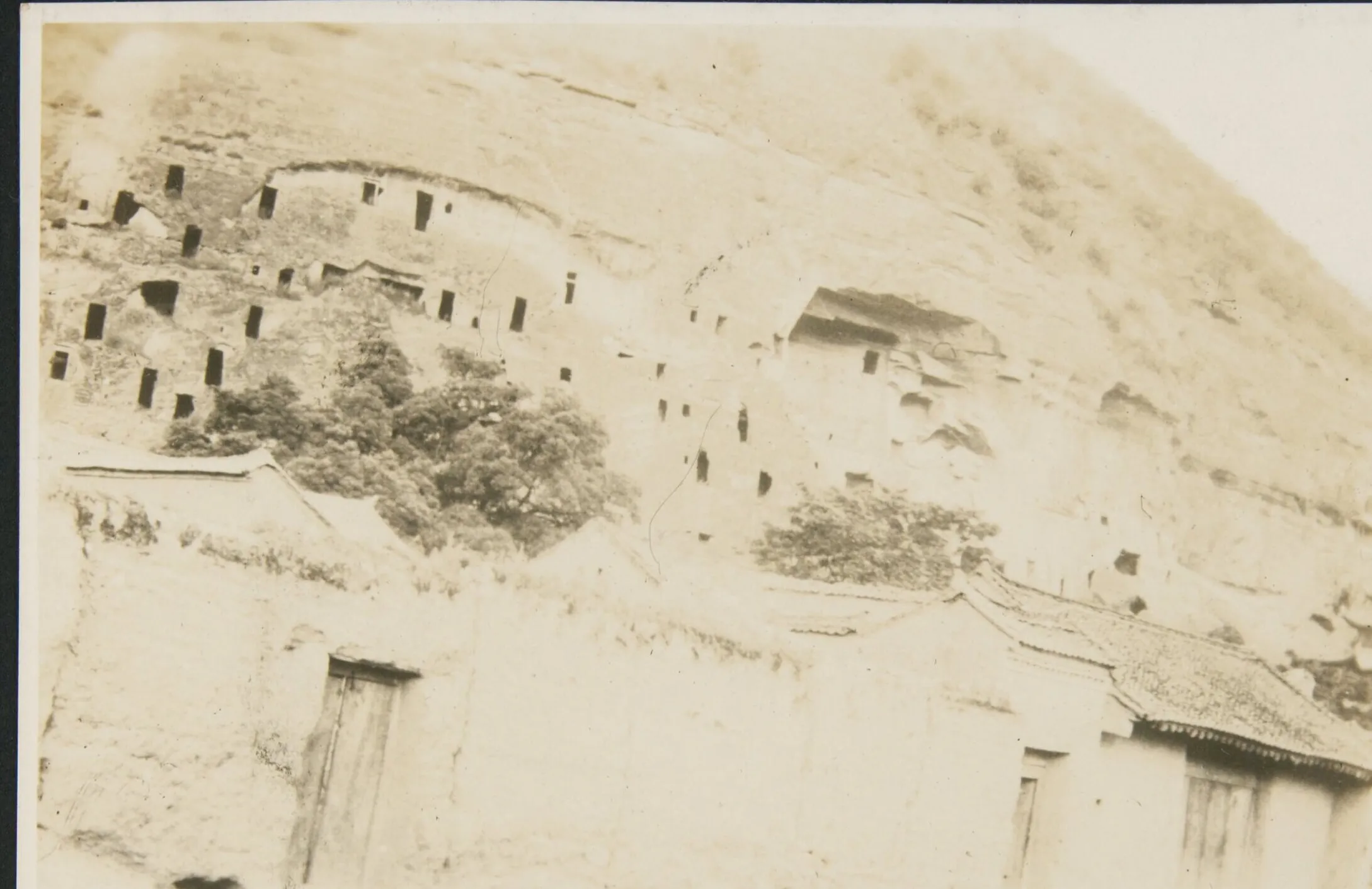
In 1932, an expedition organized by the Japanese publisher of Panorama of Asia followed the Longhai railway and the Xi’an–Lanzhou road from Henan into Shaanxi and Gansu. Volume 9 records the journey. The party traveled through Xi’an and Yongshou into Changwu, then continued west through Yaodian postal station, thirty li from the county seat, to Jingzhou in Gansu. Willows associated with the Qing official Zuo Zongtang’s planting campaigns still lined the route. These two photographs were taken in Changwu County: a cave-dwelling village at the edge of a loess plateau and a monastery set into a cliff. They record the county’s loess ravines and cave settlements.
1940 (publication)
In June 1940, Hozokan published volume 9 of Cultural Monuments of China, compiled by Tokiwa Daijō and Sekino Tadashi. It includes a full rubbing of the Tang stele preserved at Zhaoren Temple in Changwu, whose inscription, the Stele of Zhaoren Temple in Binzhou of the Great Tang, was composed by Zhu Zishe.