Introduction
Zixiao Palace was first built during the Xuanhe era of the Northern Song (1119–1125). In the first year of Chunxi of the Southern Song (1174), the palace complex was struck by fire. Thereafter Zixiao Palace lay abandoned for a time, and for fifteen or sixteen consecutive years no trace of human presence was seen there.
In the twelfth year of Zhiyuan of the Yuan (1275), Zixiao Palace reopened its mountain gate. Only the main hall remained within the palace, still fit for visitors to behold. Two years later, the Taoist Li Shouchong first cleared away the brambles in front of the hall. In the fifteenth year of Zhiyuan (1278), Xiao Shoutong, a Taoist nun from Khitan, went on to build a hall behind the palace. She later traveled abroad to raise alms[1], receiving offerings from all quarters.
In the first year of Zhizhi of the Yuan (1328), Ge Daojin, a senior Taoist of the palace, provided the funds and hired stonemasons to restore the Shangshan Pool and the Black Dragon Pool. His disciples Wang Daoqing and Zhang Daoyuan also contributed money to build one well each at the Junzhou branch palace and at Yanzhuang. The two wells supplied the palace’s Taoists with daily water and also made it convenient for passing travelers to draw water. In the sixth month of the same year, Chen Daoming and Xie Daoqing, the Taoist officials in charge of palace affairs, erected a stele for these works. The inscription explains the name of the Shangshan Pool with the phrase “water benefits all things and does not contend,” and sums up the intent of repairing the pools and digging the wells as “aiding the world and benefiting the people.”
At the end of the Yuan, warfare once again destroyed the palaces at Zixiao, Nanyan, and elsewhere, leaving the old site of Zixiao Palace nothing but brambles and rubble. Emperor Chengzu of Ming (the Yongle Emperor) believed that both his father the Hongwu Emperor’s pacification of the realm and his own victory in the Jingnan Campaign[2] had received the hidden protection of the Great Emperor Zhenwu[3]. To repay this protection, he ordered the palaces of Mount Wudang rebuilt; the completed palaces were also used to pray for blessings for the imperial family and all the people of the realm. In the tenth year of Yongle (1412), court officials, acting on orders, began construction at the old Zixiao palace. The works included the main hall dedicated to the Dark Emperor, the Patriarchs’ Hall, and the Hall of the Sage Parents dedicated to the Dark Emperor’s parents; the mountain gate, the covered corridors, and the left and right stele pavilions housing the imperial edict steles; and spaces such as the sacred treasury, the sacred kitchen, the abbot’s quarters, the refectory, the alms-bowl hall, the wandering monks’ hall, the meditation hall, kitchens, storehouses, and a poolside pavilion—one hundred and six bays in all. In the sixteenth year of Yongle (1418), this group of palace projects on Mount Wudang was completed, and Emperor Chengzu bestowed on Zixiao Palace the new name “Taixuan Zixiao Palace.”
After the palaces were completed, the court appointed three Taoist officials—Hu Guya, Mei Yuexuan, and Li Xuanyu—as supervisors[4], and Xu Fugao as abbot, granting them a sixth-rank official seal, with the four men managing the palace’s affairs. In the fifteenth year of Chenghua (1479), to continue the previous reigns’ sacrifices to Zhenwu and to pray for the imperial family, the state, and the people, Emperor Xianzong of Ming ordered craftsmen to cast seven gilt-bronze divine images: one image of Zhenwu, four attendant images, and one image each of the gods of water and fire. Eleven further ritual implements—including incense burners, vases and basins, bells and chimes—were made and delivered to Zixiao Palace by the eunuch Chen Xi for installation and veneration.
In the early Tongzhi years of the Qing (around 1862), Yang Laiwang, a native of Baihe County in Shaanxi, came to Mount Wudang and took the Quanzhen Longmen-lineage[5] Taoist He Yangchun as his master; he was later elected abbot of Zixiao Palace. Faced with the ruined palaces in the mountains, he took his disciples Wang Fumiao, Miao Fuqing, Cheng Hexing, and others, together with his grand-disciple Xu Benshan, around to raise restoration funds, an effort that lasted more than ten years in all. The Shifang Hall of Zixiao Palace was thereby restored; the Eastern Taoist Courtyard had five halls and twenty-two residential rooms repaired, the Western Taoist Courtyard five halls and forty-two residential rooms, and around the Dragon-Tiger Hall a further seventy residential rooms were restored. Besides leading the restoration work, Yang Laiwang also took in disciples and preached at Zixiao Palace and elsewhere, numbering more than fifty disciples under him.
In the twenty-seventh year of Guangxu (1901), Zixiao Palace established a shifang conglin[6], a public monastic community open to all, and began to accept itinerant Taoists from every region for temporary lodging. Xu Benshan, together with palace Taoists such as Zeng Liqian and Liu Liqing, successively raised funds to add the Wansheng Tower, the Merit Shrine, the Lingguan Hall, and more than twenty rooms on the east and west sides. Xu Benshan later also renovated the Eastern and Western Taoist Courtyards and the Hall of the Parents of Zixiao Palace.
In the spring of 1931, the Red Third Army[7] left the Honghu Soviet area and shifted toward northwestern Hubei; on the twentieth day of the fourth lunar month, He Long led his troops into Mount Wudang. Xu Benshan led the palace’s Taoists to greet them outside the East Heaven Gate of Zixiao Palace, vacated the rooms of the Hall of the Parents for He Long to live and work in, and converted the Western Palace Taoist Courtyard into a temporary rear hospital. Xu Benshan assigned four Taoists—Shui Heyi, Luo Jiaopei, Wu Jiaoyun, and Wang Jiaohua—to assist with nursing, while the other Taoists gathered medicinal herbs, brought out the palace’s stockpiled supplies, and prepared meals for the wounded. That autumn, after the Red Third Army moved on, some wounded soldiers remained in the Western Palace Taoist Courtyard; Xu Benshan continued to arrange for Taoists to care for them, and once the wounded had improved, sent them in batches to Fang County to rejoin their units. After 1938, the headquarters of the Fifth War Zone responsible for the resistance war in northern Hubei was first stationed at Laohekou and later moved into Zhoufu Nunnery, a Taoist temple on Mount Wudang; many of the mountain’s Taoist temples were used as troop quarters, schools, hospitals, and warehouses. The writer Zang Kejia, while working in Jun County, came to Zixiao Palace and saw with his own eyes a slogan reading “Welcome to the Commander-in-Chief” posted on the palace gate.
In March 2025, the Mount Wudang World Cultural Heritage Management Center launched a conservation and restoration project for the Zixiao Great Hall. Cultural heritage experts opened the four-tiered glazed finial[8] at the center of the hall’s roof and counted out 343 coins from successive dynasties inside, including 125 silver dollars and 218 copper coins. The experts preliminarily identified the earliest copper coin as a Chongning Tongbao minted during the Chongning era of the Northern Song. The staff subsequently sorted the coins and placed them into sealed storage.
Historical Documents
Wudang Fudi Zongzhen Ji
紫霄宫
Zixiao Palace
紫霄者,玄天之别名也。宫在大顶之北,展旗峰之东,威烈庙之西,太子岩之南。前对三公万仞玉笋倚天之峰,后坐远嶂七岩皂纛横星之势,松杉挺特,花木芬芳,殿宇崇高,堂庑拱接,帝容尊肃,神灵威严,一仿五龙之制度。然地势豁敞,未易相侔。神仙炼性修心之所,国家祈福之庭。
Zixiao (Purple Empyrean) is another name for Xuantian. The palace lies north of the Great Summit, east of Zhanqi Peak, west of the Weilie Temple, and south of the Crown Prince’s Cliff. Before it face the Three Dukes peaks, jade bamboo shoots ten thousand ren high leaning against the sky; behind it rest the distant ranges, seven cliffs like black banners strewn across the stars. Pines and firs stand tall and singular, flowers and trees are fragrant, the halls are lofty, the halls and corridors arch toward one another, the imperial countenance is revered and solemn, the divine spirits awesome in majesty—all modeled on the system of Wulong. Yet the terrain here is broad and open, and not easily matched. It is a place where divine immortals refine their nature and cultivate the mind, a court where the state prays for blessings.
宋宣和中创建,其敕额文据,甲午劫火,主者挈之南游。庚申之前,迁州于此,人民皆卜居焉。继后,宣慰孙嗣举众内附,十五六年,窅无人迹。至元乙亥,山门重开,正殿仅存,犹可瞻仰。岁在丁丑,道士李守冲辟荆于前;戊寅岁中,契丹女官萧守通建殿于后,行缘受供,一如五龙。
It was founded in the Xuanhe era of the Song; its imperially bestowed name plaque and documents—when the catastrophic fire of the jiawu year struck, the keeper took them with him on his journey south. Before the gengshen year, the prefecture was moved here, and the people all divined sites and settled. Later, the Pacification Commissioner Sun Si led the populace in submitting to the new dynasty, and for fifteen or sixteen years the place lay desolate, without human trace. In the yihai year of Zhiyuan, the mountain gate reopened; only the main hall survived, still fit to be gazed upon. In the dingchou year, the Taoist Li Shouchong cleared the brambles in front; in the wuyin year, Xiao Shoutong, a Khitan female Taoist official, built a hall behind it, traveling to raise alms and receive offerings, just as at Wulong.
Record of the Shangshan Pool
上善池记
Record of the Shangshan Pool
大万寿紫霄元圣宫,按经云:天下之至柔,莫过于水。水善利万物而不争,犹川谷之与江海。古之善为士者,濬石为池,以上善之名矣。本宫尊宿革道谨,居善地,心善渊,谨抽衣资,命匠石砌斯池及黑龙池,咸皆落成,革故新之,乃至大顺。先伊徒王道清、张道源施财于均州行宫并堰庄二处,各造砌水井,为道众日用,以便往来。以斯刻石,扬其善功,记其岁月。后来者,能知古始,惟济世利人,何千万年云尔。致和元年岁在戊辰六月日,冲正守真明素法师、大万寿紫霄元圣宫提点宫事陈道明,真应纯素凝和法师、大万寿紫霄元圣宫提点谢道清立石。
The Great Wanshou Zixiao Yuansheng Palace. According to the scripture: of all that is most yielding under heaven, nothing surpasses water. Water benefits all things and does not contend, as the streams and valleys are to the rivers and seas. Among the ancients, one skilled in the ways of the scholar dredged stone to make a pool, giving it the name of Supreme Goodness. Our palace’s venerable elder Ge Daojin, dwelling in a place of goodness, his mind a goodly abyss, respectfully drew from his own robe funds and ordered stonemasons to lay this pool and the Black Dragon Pool; both were completed, the old renewed, all coming to great accord. Earlier, his disciples Wang Daoqing and Zhang Daoyuan donated funds at the Junzhou branch palace and at Yanzhuang, building and lining a well at each of the two sites, for the daily use of the Taoist community and the convenience of those passing back and forth. This is carved in stone to proclaim their good works and record the season. May those who come later be able to know the ancient beginnings: aiding the world and benefiting the people—for how many tens of millions of years to come. On a day of the sixth month of the wuchen year, the first year of Zhizhi, the stone was erected by Chen Daoming, Dharma Master Chongzheng Shouzhen Mingsu and Supervisor of Palace Affairs of the Great Wanshou Zixiao Yuansheng Palace, and Xie Daoqing, Dharma Master Zhenying Chunsu Ninghe and Supervisor of the Great Wanshou Zixiao Yuansheng Palace.
Ming Stele Inscription for the Taoist Palaces of Dayue Taihe Mountain
国朝永乐十六年御制碑
Imperially Composed Stele of the Sixteenth Year of Yongle of the Present Dynasty
盖闻大而无迹之谓圣,充周无穷;妙不可测之谓神。是故行乎天地,统乎阴阳,出有入无,恍惚翕张,骖日驭月,鼓风驾霆,倏而为雨,忽而为云,御灾捍患,驱沴致祥,调运四时,橐籥万汇,陶铸群品,以成化工者,若北极玄天上帝真武之神是已。按道书:神本先天始炁五灵玄老,太阴天一之化,生而神灵,聪以知远,明以察微,潜心念道,志契太虚。乃入武当山,修真内炼,心一志凝,遂感玉清元君,授以无极上道,功满道备,乘龙天飞,归根复位,显名亿劫,与天地悠久,日月齐并。
It is said that greatness without trace is called sagehood, filling all without limit; subtlety beyond fathoming is called divinity. Thus he moves through heaven and earth and commands yin and yang, emerging from being and entering non-being, now dim, now unfolding; he yokes the sun and drives the moon, drums the winds and rides the thunder; in an instant he becomes rain, in a flash becomes cloud; he wards off calamities and repels misfortune, drives out pestilence and brings auspice; he regulates the turning of the four seasons, works the bellows of the myriad things, and molds all creatures to accomplish the work of transformation—such is the god Zhenwu, the Supreme Emperor of the Dark Heaven of the North Pole. According to the Taoist books: the god is in origin the Numinous Elder of the Five Numinosities of the Primordial Qi of Former Heaven, a transformation of Taiyin Tianyi. Born divine and numinous, his hearing knowing the distant, his sight discerning the minute, he immersed his mind in the thought of the Dao, his will attuned to the Great Void. He then entered Mount Wudang, cultivating perfection with inner refinement, his mind single, his will concentrated, whereupon he moved the Primordial Sovereign of Jade Clarity, who transmitted to him the Supreme Way of the Limitless. His merit complete and the Way attained, he rode a dragon and flew to heaven, returned to the root and resumed his seat, his name illustrious for a hundred million kalpas, enduring with heaven and earth and standing alongside the sun and moon.
武当旧名太和,谓非玄武不足以当之,故名曰武当。蟠踞八百余里,高列七十二峰,三十六岩之奇峭,二十四涧之幽邃。峰之最高曰天柱,境之最胜曰紫霄、南岩。上出游氛,下临绝壑,跨洞天之清虚,凌福地之深窅。紫霄、南岩皆有宫。又自南岩北下三十里,有五龙宫;又四十里抵山趾,有真庆宫,俱为祀神祝厘之所。元末悉毁于兵燹,荆榛瓦砾,废而不举。
Wudang’s old name was Taihe; it was said that none but Xuanwu was worthy of it, and so it was named Wudang. It coils and crouches over more than eight hundred li, rising high in seventy-two peaks, with the wondrous steepness of thirty-six cliffs and the secluded depths of twenty-four ravines. The highest of the peaks is called Tianzhu; the finest of its precincts are Zixiao and Nanyan. Above they rise beyond the drifting mists; below they overlook sheer chasms; they stride across the clear emptiness of the grotto-heavens and tower over the deep obscurity of the blessed lands. Both Zixiao and Nanyan had palaces. Further, thirty li north down from Nanyan stands the Wulong Palace; and another forty li on, at the mountain’s foot, stands the Zhenqing Palace—all places for worshipping the gods and praying for blessings. At the end of the Yuan, all were destroyed in the flames of war, left as brambles and rubble, ruined and unrestored.
天启我国家隆盛之基。朕皇考太祖高皇帝以一旅定天下,神阴翊显佑,灵明赫奕。肆朕起义兵,靖内难,神辅相左右,风行霆击,其迹甚著。暨即位之初,茂锡景贶,益加炫耀。至若榔梅再实,岁功屡成,嘉生骈臻,灼有异征。朕夙夜祗念,罔以报神之休。仰惟皇考、皇妣,劬劳恩深,昊天罔极,亦罔以尽其报。惟武当,神之攸栖。肃命臣工,即五龙之东数十里,得胜地焉,创建玄天玉虚宫;于紫霄、南岩、五龙,创建太玄紫霄宫、大圣南岩宫、兴圣五龙宫。又即天柱之顶,冶铜为殿,饰以黄金,范神之像,享祀无极。神宫仙馆,焕然维新。经营之始,至于告成之日,神屡显像,祥光烛霄,山峰腾辉,草木增色,灵气聚散,变化万状,众目咸睹,跽拜唶唶。榔梅垂实,加前数倍。九地启秘,金杵跃出,阴阳储精,玄质流润,灵异纷纭,莫能殚纪。神之响应,有如此者。
Heaven opened the foundation of our state’s flourishing. My imperial father, Emperor Taizu the High Emperor, settled the realm with a single force; the god secretly aided and manifestly protected him, his numinous brilliance resplendent. When I raised my righteous army to pacify the internal troubles, the god assisted me at my side, moving like wind and striking like thunder—his traces were most evident. And at the beginning of my accession, he generously bestowed great gifts, ever more gloriously displayed, as when the langmei trees bore fruit again and the year’s harvests repeatedly succeeded, auspicious growths arriving in pairs, with clear and unusual signs. Morning and night I have reverently pondered, yet had no way to repay the god’s beneficence. Looking up to my imperial father and imperial mother, whose toil and kindness were deep as the boundless sky, I likewise had no way to repay them in full. Only Wudang is where the god dwells. I solemnly commanded my ministers and workmen: some tens of li east of Wulong, a superb site was found, and there the Xuantian Yuxu Palace was founded; at Zixiao, Nanyan, and Wulong were founded the Taixuan Zixiao Palace, the Dasheng Nanyan Palace, and the Xingsheng Wulong Palace. Also atop the Tianzhu peak, bronze was smelted to make a hall, adorned with gold, casting the image of the god, to be worshipped without end. The divine palaces and immortal lodges were brilliantly renewed. From the beginning of the undertaking to the day of completion, the god repeatedly showed his image; auspicious lights illumined the sky, the mountain peaks shone with brilliance, the grasses and trees took on new color, numinous vapors gathered and dispersed in a myriad transformations—all eyes saw them, and the people knelt in worship, murmuring in awe. The langmei hung with fruit, several times more than before. The nine depths disclosed their secrets, and a golden pestle leapt forth; yin and yang stored their essences, and the dark substance flowed with moisture—the numinous marvels were too manifold to record in full. Such was the god’s responsive answer.
遂命道士为提点,主领各宫,饬严祀事,昭答神贶,上资荐扬皇考太祖高皇帝、皇妣孝慈高皇后在天之灵,下为天下臣庶祈迓繁祉。虽然,神之浮游混沌,变化无方,此感彼应,无往不然。非此无以达朕之诚与夫天下虔敬之心也。况山川冲和之气,融结于斯,与神相为表里。神之陟降往来,飘飖挥霍,顾瞻旧游,岂不徘徊于斯乎?则是宫观之建,有不可无。谨为文刻石山中,以彰神功,永永无穷焉。
I then appointed Taoists as supervisors to head each palace, to keep the sacrificial rites strict and solemn, in manifest answer to the god’s gifts—above, to aid and exalt the spirits in heaven of my imperial father Emperor Taizu the High Emperor and my imperial mother Empress Xiaoci the High Empress; below, to pray and invoke manifold blessings for all the subjects and people of the realm. Even so, the god drifts through the primal chaos, transforming without fixed direction, responding there to what is felt here, and everywhere it is so. Without this there would be no way to convey my sincerity and the reverent hearts of all under heaven. Moreover, the harmonious qi of the mountains and streams is fused and gathered in this place, standing to the god as exterior to interior. When the god ascends and descends, coming and going, drifting and sweeping past, and looks back upon the places he once roamed, would he not linger here? Thus the building of these palaces is something that cannot be dispensed with. I have respectfully composed this text and carved it in stone in the mountains, to make the god’s merit illustrious, forever and without end.
Emperor Xianzong’s Record of the Divine Images of Zixiao Palace
宪宗皇帝紫霄宫神像记
Emperor Xianzong’s Record of the Divine Images of Zixiao Palace
朕闻自开天以来,即有此山;自元始以来,即有此神。神乃北极玄天上帝真武是也,山乃大岳太和是也。神非兹山,无以为栖真之所;山非兹神,无以侈灵胜之名。是故历代构造殿宇,钦崇之不衰。我太祖高皇帝平定海宇,惟神默相,灵明赫奕,尝于南京建庙奉祀之矣。太宗文皇帝肃靖内难,惟神阴佑,厥迹诞著,特于兹山大造宫祠;及于北京,复建行宫奉祀之矣。英考睿皇帝光复大位,惟神屡现奇应,亦既命官,函香奠币,致敬尤笃。朕继绍大统,十有五年,仰思先志,敢不祗承?矧家国乂安,夷夏怀服,无为之治,于斯为盛,岂不赖于神之翊赞而能尔邪?昭答之典,在所必行。肆命工为像,往安于太玄紫霄宫。圣像一,从官像四,皆范铜为之,而镀以金;水火神二,亦铜体金饰,而各类其像。供器、香炉、瓶盂、钟磬,总十一事,既坚既完,载鲜载洁。特遣太监陈喜,送诣宫所奉安,永享四方之香火,永壮世人之观瞻。夫神分身降世,变化无穷,恍惚翕张,出无入有,御灾捍患,济物度人,数出祯祥,祚我家国。继自今,愿丕扬神道,斡运化机,俾上而圣母福寿无穷,于以昭朕之孝;下而储嗣繁衍未艾,于以昭朕之仁;宫闱清吉,于以昭朕治内之严;臣僚效忠,于以昭朕使臣之礼;黔黎于变,于以昭朕之化;夷狄来王,于以昭朕之威。以迄四时行,百谷登,群生遂,化工成,庶乎神有感必应,而朕虔奉之诚,亦不虚矣。虽然,朕之所望庇于神者,岂止一时如是而已哉?谨为文刻碑,以彰神功于不朽云。
I have heard that since the opening of heaven this mountain has existed, and that since the Primordial Beginning this god has existed. The god is none other than Zhenwu, the Supreme Emperor of the Dark Heaven of the North Pole; the mountain is none other than Dayue Taihe. Without this mountain the god would have no place to lodge his perfection; without this god the mountain would have no means to magnify the fame of its numinous wonders. Therefore, dynasty after dynasty has built halls here, revering them without cease. My ancestor Emperor Taizu the High Emperor, in pacifying all within the seas, was secretly aided by the god alone, whose numinous brilliance shone resplendent, and he once built a temple in Nanjing to worship him. Emperor Taizong the Cultured Emperor, in solemnly pacifying the internal troubles, was hiddenly protected by the god alone, whose traces were grandly manifest, and he specially built great palace-shrines on this mountain; and in Beijing he further built a branch palace to worship him. My heroic father Emperor Yingzong the Wise Emperor, in gloriously restoring the great throne, was repeatedly shown marvelous responses by the god, and he too ordered officials to present incense in sealed caskets and offer silk, his reverence especially earnest. I have succeeded to the great heritage for fifteen years; looking up in thought to the aims of my forebears, how dare I not reverently inherit them? Moreover, the state and its households are well governed, the Yi and the Xia cherish submission, and the rule of non-action here reaches its height—how could this be so without relying on the god’s assistance and support? The rites of manifest repayment must be carried out. I therefore ordered craftsmen to make images and sent them to be installed in the Taixuan Zixiao Palace. One sacred image and four images of attendant officials, all cast in bronze and plated with gold; two gods of water and fire, likewise of bronze bodies with golden ornament, each in the likeness of its kind. Of ritual implements—incense burners, vases and basins, bells and chimes—eleven items in all, both solid and complete, both lustrous and clean. I specially dispatched the eunuch Chen Xi to convey them to the palace for reverent installation, to enjoy the incense and fire of the four quarters forever, and forever to magnify the spectacle before the eyes of the world. Now the god sends down his divided bodies into the world, transforming without end, now dim, now unfolding, emerging from nothing and entering being, warding off calamities and repelling misfortune, succoring creatures and delivering men, repeatedly sending down auspicious omens, blessing our house and state. From this day forth, may he greatly exalt the divine way and revolve the mechanism of transformation, so that above, the Holy Mother’s fortune and longevity may be inexhaustible—thereby manifesting my filial piety; below, may the heirs multiply without ceasing—thereby manifesting my benevolence; may the palace chambers be pure and auspicious—thereby manifesting the strictness of my rule within; may the ministers render loyal service—thereby manifesting my propriety in employing them; may the black-haired people be transformed—thereby manifesting my civilizing influence; may the Yi and Di come to court—thereby manifesting my majesty. And so may the four seasons proceed, the hundred grains ripen, all creatures flourish, and the work of transformation be accomplished, so that the god, feeling, ever responds, and my own sincerity in devout worship is likewise not in vain. Even so, how could what I hope for of the god’s protection be only for one moment such as this? I have respectfully composed this text and carved it on a stele, to make the god’s merit illustrious for all time.
Dayue Taihe Shan Zhi (Gazetteer of Dayue Taihe Mountain)
太玄紫霄宫
Taixuan Zixiao Palace
即旧之紫霄元圣宫,正在展旗峰之阳。前有三公峰、五老峰、宝珠峰、福地峰、赐剑、禹迹桥、万松亭,后有太子岩,即玄帝紫霄圆道之处。西有七星岩,东有炼丹岩,中有真一泉、上善池。其地高低叠障,怪石奇峰。山之外,直与云霄相接。若羽士居于石室丹房则三九夏清凉,真仙人之窟宅也。永乐十年,国朝大兴,敕建玄帝大殿、山门、廊庑、左右圣旨碑亭、神库、神厨、祖师殿、圣父母殿、方丈、斋堂、钵堂、云堂、圜堂、厨室、仓库、池亭一百六个间,赐名曰太玄紫霄宫。钦除江西建昌府道纪胡古崖、池州府道纪梅月轩、湖广安陆州道正李玄玉为提点,南昌府奉新县道士徐复高为住持,赐六品印,统领宫事。
This is the former Zixiao Yuansheng Palace, situated directly on the sunny side of Zhanqi Peak. Before it are Sangong Peak, Wulao Peak, Baozhu Peak, Fudi Peak, Cijian, Yuji Bridge, and Wansong Pavilion; behind it is the Crown Prince’s Cliff, the place where the Dark Emperor of Zixiao completed the Way. To the west is Qixing Cliff, to the east Liandan Cliff, and in between are the Zhenyi Spring and the Shangshan Pool. The land rises and falls in layered barriers of strange rocks and wondrous peaks, and beyond the mountains it joins directly with the clouds and sky. If feathered adepts dwell in its stone chambers and elixir rooms, even the height of summer stays cool—truly a grotto-dwelling of immortals. In the tenth year of Yongle, the present dynasty greatly flourished, and by imperial order were built the Great Hall of the Dark Emperor, the mountain gate, the covered corridors, the left and right imperial-edict stele pavilions, the sacred treasury, the sacred kitchen, the Patriarchs’ Hall, the Hall of the Sage Parents, the abbot’s quarters, the refectory, the alms-bowl hall, the wandering monks’ hall, the meditation hall, kitchens, storehouses, and a poolside pavilion—one hundred and six bays in all—and the name bestowed was Taixuan Zixiao Palace. By imperial appointment, Hu Guya, Taoist Registrar of Jianchang Prefecture in Jiangxi, Mei Yuexuan, Taoist Registrar of Chizhou Prefecture, and Li Xuanyu, Taoist Superintendent of Anlu Subprefecture in Huguang, were made supervisors, and the Taoist Xu Fugao of Fengxin County in Nanchang Prefecture was made abbot; they were granted a sixth-rank seal and put in overall charge of the palace’s affairs.
Veritable Records of Ming Taizong
武当山宫观成,赐名曰太岳太和山。山有七十二峰,三十六岩,二十四涧,峰之最高者曰天柱,境之最胜者曰紫霄。南岩,上轶游气,下临绝壑。紫霄、南岩旧皆有宫,南岩之北有五龙宫,俱为祀神祝厘之所。元季兵毁,至是悉新建宫五龙之东十余里,名玄天玉虚宫,紫宵曰太玄紫霄宫,南岩曰大圣南岩宫,五龙曰兴圣五龙宫。又即天柱峰顶冶铜为殿,饰以黄金,范真武像于中。选道士二百人供洒扫,给田二百七十七顷,并耕户以赡之。仍选道士任自垣等九人为提点,秩正六品,分主宫观,严祀事。上资太祖高皇帝、孝慈高皇后之福,下为臣庶祈弭灾沴。凡为殿观、门庑、享堂、厨库千五百余楹,上亲制碑文以纪之。
The palaces of Mount Wudang were completed, and the name bestowed was Taiyue Taihe Mountain. The mountain has seventy-two peaks, thirty-six cliffs, and twenty-four ravines; the highest of the peaks is called Tianzhu, and the finest of its precincts is Zixiao. Nanyan rises above the drifting vapors and overlooks sheer chasms. Zixiao and Nanyan formerly both had palaces, and north of Nanyan is the Wulong Palace—all places for worshipping the gods and praying for blessings. Destroyed by war at the end of the Yuan, they have now all been newly built: the palace some ten li east of Wulong is named Xuantian Yuxu Palace; the one at Zixiao is named Taixuan Zixiao Palace; the one at Nanyan is named Dasheng Nanyan Palace; and the one at Wulong is named Xingsheng Wulong Palace. Also atop the Tianzhu peak, bronze was smelted to make a hall, adorned with gold, with an image of Zhenwu cast within. Two hundred Taoists were selected to perform sweeping and cleaning, and two hundred and seventy-seven qing of fields were granted, together with farming households to support them. In addition, nine Taoists including Ren Ziyuan were chosen as supervisors, of the regular sixth rank, to take charge of the palaces separately and keep the sacrificial rites strict. Above, this aided the blessings of Emperor Taizu the High Emperor and Empress Xiaoci the High Empress; below, it prayed on behalf of the subjects and people for the averting of calamities and pestilence. The halls, gates and corridors, offering halls, kitchens and storehouses totaled more than fifteen hundred bays, and the emperor personally composed the stele inscription to record it.
Record of the Revelation of the Sagely Origins of the Supreme Emperor of the Dark Heaven
记云:大唐贞观间,岁值苦旱。朝廷下诏有司,祷于天下名山大川。是时,武当军节度使姚简,奉命躬诣武当紫霄宫,齐醮致祷。建坛之夕,有五儒士,丰貌殊异,敬来谒简。延坐久之,从容语简曰:予五君,非凡之儒,乃五气龙君也。准玄帝敕命,守护此山,非一日矣。为子正直寡欲,祈祷精严,故来相访。少顷,云气迷目,甘雨霈然,遂失五君所在矣。
The record says: In the Zhenguan era of the Great Tang, the year suffered a bitter drought. The court issued an edict to the offices concerned to pray at the famous mountains and great rivers of the realm. At that time, Yao Jian, Military Commissioner of Wudang, by order went in person to Zixiao Palace on Wudang to hold a fast and offer prayers. On the evening the altar was set up, five scholars, of extraordinary bearing and appearance, respectfully came to call on Jian. After they had been invited to sit for a long while, they unhurriedly said to Jian: “We five lords are no ordinary scholars—we are the Dragon Lords of the Five Qi. By the decree of the Dark Emperor we have guarded this mountain for more than a day. Because you are upright and spare of desire, and your prayers are pure and rigorous, we have come to visit you.” In a little while, cloudy vapors blurred the eyes and sweet rain fell in torrents; then the five lords could no longer be found.
Miscellaneous Notes on Wudang
紫霄宫乃武当山最大的宫殿,有东宫西宫前殿后殿,规模极为宏大,庄严美观,真不愧为“金宇瑶宫”。大殿前有碑亭数个,高约三丈,内有约二丈高之大石碑,上刻永乐皇帝亲撰文字,碑置于一大石龟之背上,龟身长约丈余,高约六尺,刻工十分精细。正殿内有一条杉椽,约一尺见方,长约二丈,放于两约三尺之二木架上。用手摸这端,则那端可闻嗡嗡之声,一时传为神奇,凡来拜必摸之,所以两端凹入甚深。据道人说:当日兴筑紫霄大殿时,此根由四川飞来,可惜运到三分□,已用了其□,大概故庙置于此,以资纪念。殿内明代铜器及其他遗物甚多,足供考古家之玩赏。
Zixiao Palace is the largest palace on Mount Wudang, with an eastern palace and western palace, front halls and rear halls, on an extremely grand scale, solemn and beautiful—truly worthy of the name “golden roof and jasper palace.” Before the great hall stand several stele pavilions, about three zhang high, containing great stone steles about two zhang high, inscribed with texts composed by the Yongle Emperor himself; each stele rests on the back of a great stone tortoise, whose body is over a zhang long and about six chi high, the carving exceedingly fine. Inside the main hall lies a fir rafter, about one chi square and about two zhang long, resting on two wooden stands about three chi tall. If you touch one end with your hand, a humming sound can be heard at the other end—for a time this was famed as a marvel, and every visitor who came to worship was sure to touch it, so both ends are worn deeply concave. According to the Taoists: when the Zixiao Great Hall was being built, this beam flew here from Sichuan; unfortunately, when it had been transported three parts of the way □, its □ had already been used—so presumably the old temple placed it here as a memento. The hall contains many Ming-dynasty bronze vessels and other relics, ample for the enjoyment of archaeologists.
紫霄有道士二百多人。有几个虽着道装,但并未正式出家,都是在此隐居的。其间有无家可归的年老商人,有些是逃避服役的年青农夫。他们完全是自食其力,有的兼司炊爨,有的专司耕种的,也有专作杂役的。分工严密,所以生活亦井井有条。
Zixiao has more than two hundred Taoists. A few of them, though wearing Taoist dress, have not formally left household life; they are all living in seclusion here. Among them are elderly merchants with no home to return to, and some young farmers evading service. They are entirely self-supporting: some double as cooks, some specialize in farming, and some do odd jobs. The division of labor is strict, so life is likewise in perfect order.
Historical Photographs
1934
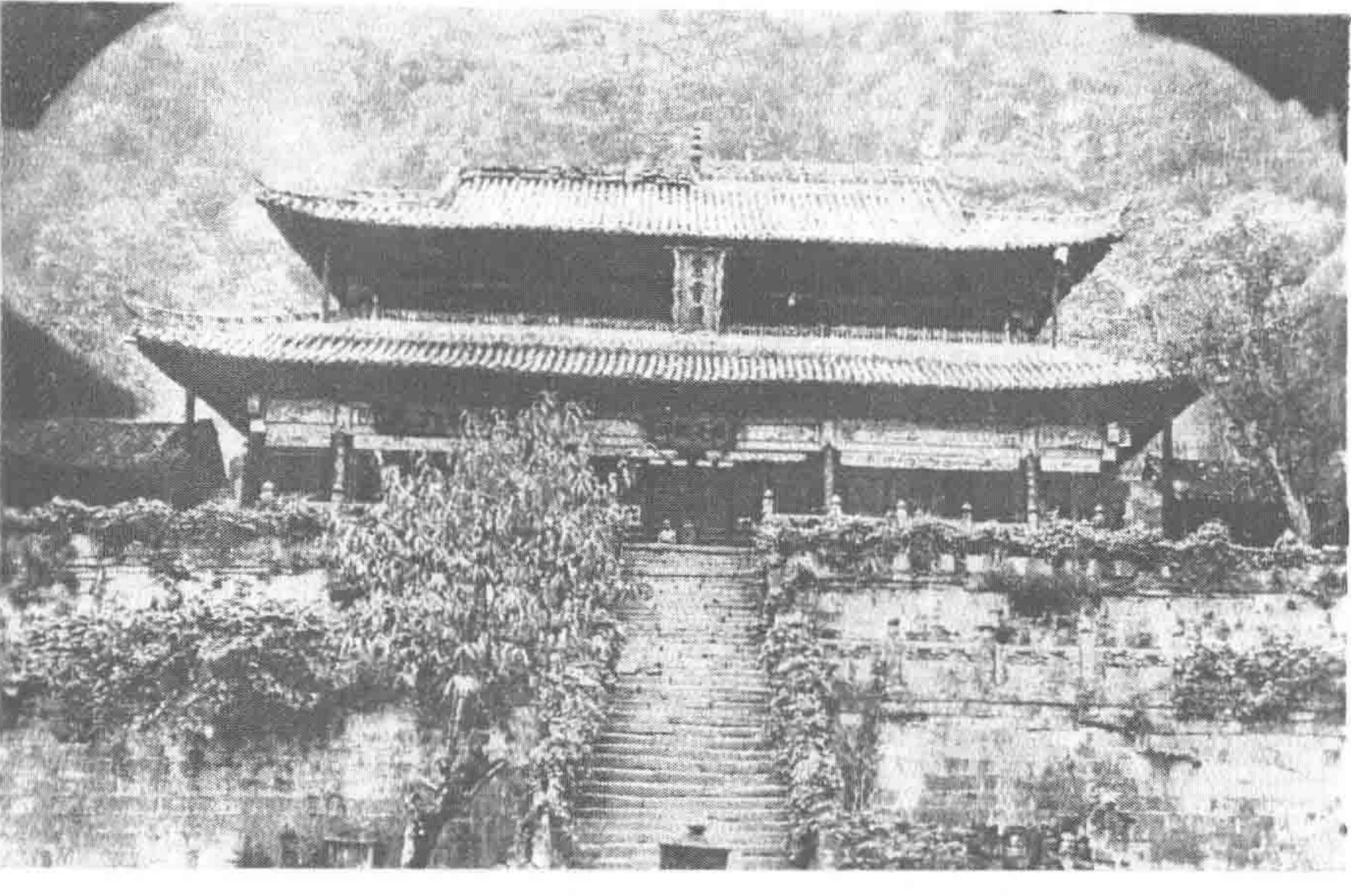
This frontal view of the Zixiao Hall appears in Li Dake’s travel record of Mount Wudang from the turn of spring and summer 1934, later published in “Travel Notes on Mount Wudang” in The China Traveler, vol. 10, no. 10, October 1936. The scan of the original issue can be found at The China Traveler, 1936, vol. 10, no. 10.
References
- Bibliographic record for Xuxiu Dayue Taihe Shan Zhi in eight juan, 1923 lithographic edition (twelfth year of the Republic)
- “Xu Benshan, Head Taoist of Wudang,” originally published in China Taoism
- Qi County People’s Government: “Xu Benshan”
- Mount Wudang Taoist Association: “Wudang Taoism During the War of Resistance (VII)”
- Hubei Provincial Department of Culture and Tourism: “The Finial of the Zixiao Great Hall on Mount Wudang Opened”
- Guangming Daily: “Conservation and Restoration Project for the Zixiao Great Hall on Mount Wudang Launched”