Introduction
In the ninth year of the Kaibao era of the Northern Song (976), Zhu Dong, prefect of Tanzhou, built an academy below the Baohuang Cave on Yuelu Mountain, setting up a lecture hall of five bays and study lodges of fifty-two bays to house scholars coming from the four quarters; Sun Mai, registrar of Luchuan, once composed a record of it. In the second year of the Xianping era (999), the prefect Li Yunze enlarged it, opening a lecture hall in the middle and raising a library tower above it, and the man of letters Wang Yucheng composed a record of this expansion; in the fourth year of Xianping, Li Yunze further petitioned the court to bestow from the holdings of the Directorate of Education[1] the phonetic glosses and exegetical commentaries of the various classics, together with the Records of the Historian, the Yupian, and the Tangyun, and this was granted. In the eighth year of the Dazhong Xiangfu era (1015), Emperor Zhenzong of the Song received the academy’s headmaster[2] Zhou Shi in a side hall and appointed him registrar of the Directorate of Education; Zhou Shi declined and would not accept, returning to the mountain to continue teaching his disciples, whereupon the court bestowed a name-board reading “Yuelu Academy” after the old name and additionally bestowed books from the palace collection. In the records of Northern Song men, the academy already had a Hall of Confucius and an Imperial Library Pavilion, with a clear spring flowing past below the hall. At that time the court had not yet everywhere established official schools in the prefectures and counties, and an academy of this kind, founded by worthy scholar-officials as a school of the local community, thereby became the center of education for a whole region; together with Songyang, Suiyang, and White Deer Grotto it was named one of the Four Great Academies. Of these four academies, the other three were all founded by the people; only Yuelu was founded by the local chief official.
In the early Shaoxing era of the Southern Song, the academy burned in the flames of war, no more than a tenth of its buildings surviving, and it lay long in ruin thereafter. More than thirty years later, in the first year of the Qiandao era (1165), Liu Gong, military pacification commissioner of Jinghu South Circuit, rebuilt the academy; the work was managed by the prefectural school instructor Shao Ying and completed in less than half a year, with fifty bays of buildings largely restoring the old plan, and the scholar Zhang Shi was invited to direct its teaching. In the third year of Qiandao, Zhu Xi came from Fujian to Tanzhou to visit Zhang Shi and stayed two months; the two held joint lectures and discoursed on learning within the academy, which later generations called the “Zhu–Zhang Joint Lectures.” Zhu Xi also wrote in his own hand the four large characters “loyalty, filial piety, integrity, and temperance,” which were long afterward copied and engraved on the academy’s hall walls. Zhang Shi composed a record of this rebuilding, declaring that the academy was not conducted for the sake of examination success and emolument, but “to bring men of talent to completion, so as to transmit this Way and succor this people.” In the fifteenth year of the Chunxi era (1188), Pan Shi, prefect of Tanzhou, added further study lodges, and the scholar Chen Fuliang was again invited to compose a record. In the Shaoxi era, Zhu Xi took up office as prefect of Tanzhou; within two months of his arrival he issued directives to set the academy in order, separately establishing ten supernumerary student places to accommodate scholars traveling to study from the four quarters, supplying each day one sheng and four ge of rice and sixty wen of cash, and exempting them from the placement examination for admission.
In the second year of the Deyou era of the Southern Song (1276), Yuan troops stormed the city of Tanzhou; students of the academy also climbed the walls with the defenders to resist, many of them dying, and the academy was destroyed once more. Ten years later, in the twenty-third year of the Zhiyuan era (1286), Liu Bida, a man of the commandery, rebuilt it; in the first year of the Yanyou era (1314), Liu Anren, assistant judge of Tanzhou Circuit, renovated it again, and the ritual hall, the four study lodges, the shrines of the various worthies, the lecture hall, the Zunjing Pavilion, the Jigaoming Pavilion, and the rest were all restored as of old. At the end of the Yuan the academy was destroyed in war for a third time, and thereafter lay long in ruin.
In the fifth year of the Chenghua era of the Ming (1469), Qian Shu, prefect of Changsha, rebuilt the academy, but it soon fell into disuse again, and the site was long occupied by monks and powerful families. In the Hongzhi era, the vice prefect Chen Gang donated his salary to restore it, building the central gate, the left and right galleries, the lecture hall, and the Chongdao Shrine for the worship of Zhu Xi and Zhang Shi; the succeeding prefect Wang Tao, upon taking office, gathered the teachers and students to perform the shicai offering ceremony[3], and the academy thereby resumed its teaching; the assistant prefect Yang Maoyuan subsequently built the Zunjing Pavilion to store books. Li Dongyang of the Hanlin Academy composed a record of this rebuilding, in which he mentioned that when he returned to Changsha in his early years to visit the ancestral graves and climbed Yuelu Mountain, what he saw was still only a broken stele and ruined foundations amid the scrub. In the second year of the Zhengde era (1507), the administration vice commissioner Wu Shizhong rebuilt the ritual hall as a Dacheng Hall and moved it to the left of the academy, forming the layout of temple on the left and school on the right; he also excavated a pan pool[4] and added a Lingxing Gate. The following year, the scholar Wang Yangming, on his journey into exile at Longchang in Guizhou, passed through Changsha and went to the academy to pay his respects at the shrine of Zhu Xi and Zhang Shi.
In the Jiajing era, the prefects Wang Bingliang and Sun Cun successively directed expansions, newly inscribing the names of the study lodges, opening three gates outside the hall, building the Hexi Terrace at the foot of the mountain, and adding more than 1,400 mu of school fields; the assistant prefect Yu Kui also erected on the west bank of the Xiang River a stone memorial archway carved with the four characters “Yuelu Academy,” so that the ferry crossing there took the name Pailoukou (“Archway Crossing”). In the tenth year of the Wanli era (1582), the scholar Zhang Yuanbian once lectured as head of the academy. In the eleventh year of the Chongzhen era (1638), Wang Fuzhi entered the academy to study, and with his schoolmate Kuang Pengsheng and others formed the Xing Society; in the sixteenth year of Chongzhen (1643) the academy was again destroyed in war, the Ming fell the following year, and Wu Daoxing, the headmaster who had compiled and printed the Gazetteer of the Yuelu Academy, refused food and died for his country. In the seventh year of the Kangxi era of the Qing (1668), the grand coordinator Zhou Zhaonan rebuilt it; in the thirteenth year the rebel army of Wu Sangui entered Hunan and the academy again suffered the flames of war. In the twenty-third year (1684), the grand coordinator Ding Sikong donated his salary to lead the restoration; Zhao Ning, the assistant prefect of Changsha Prefecture who directed the works, repaired the Confucian temple, the Zunjing Pavilion, the Chongdao Shrine, the Hall of the Six Gentlemen, and other buildings, and built the Zibei Pavilion midway along the three-li mountain path leading from the west bank of the Xiang River to the academy. In the twenty-fifth year (1686), Ding Sikong submitted a memorial requesting a name-board for the academy; the Ministry of Rites deliberated and approved a bestowal following the precedent of the White Deer Grotto Academy in Jiangxi, and the Kangxi Emperor wrote in his own hand the plaque “Learning Reaches the Heavenly Nature” to bestow upon the academy, together with daily-lecture commentaries and various books of the classics and histories. In the eleventh year of the Yongzheng era (1733), the Qing court ordered each province to establish a provincial-capital academy, and the Yuelu Academy was ranked as that of Hunan. In the ninth year of the Qianlong era (1744), the plaque “The Orthodox Southern Lineage of the Way,” written in the Qianlong Emperor’s own hand, was bestowed and hung.
In the forty-seventh year of the Qianlong era (1782), Luo Dian took up the post of headmaster and directed its teaching for twenty-seven years, successively constructing the Eight Scenic Spots of the academy and building the Aiwan Pavilion in front of the mountain. In the seventeenth year of the Jiaqing era (1812), the headmaster Yuan Mingyao and the academy student Zhang Zhongjie jointly composed the gate couplet “Only Chu has talent; here it flourishes most,” which was hung at the academy’s main gate. In the seventh year of the Daoguang era (1827), the headmaster Ouyang Houjun had the four characters “loyalty, filial piety, integrity, and temperance,” traditionally ascribed to Zhu Xi’s own hand, copied and engraved as steles set into the inner walls of the lecture hall; during his more than twenty years of directing teaching, Zeng Guofan, Zuo Zongtang, Guo Songtao, and others studied at the academy in turn. In the second year of the Xianfeng era (1852), the Taiping army attacked Changsha and the academy’s study lodges collapsed; the headmaster Ding Shanqing subsequently directed the repair of the Confucian temple, the Imperial Library, the lecture hall, and the study lodges. From the seventh to the eighth year of the Tongzhi era (1868–1869), the grand coordinator Liu Kun allocated public funds for a great renovation, removing the old and replacing it with new, and the academy’s plan and regulations were at this point made fully complete.
In the twenty-ninth year of the Guangxu era (1903), Zhao Erxun, governor of Hunan, memorialized and obtained approval to merge the Yuelu Academy with the Provincial Capital University Hall, which had evolved through several transformations from the School of Current Affairs, forming the Hunan Higher School. The school was closed in 1912, and thereafter Hunan Higher Normal School and Hunan Public Industrial Specialized School successively moved onto the old academy site to conduct their teaching; in February 1926 the Industrial Specialized School merged with the specialized schools of law and government and of commerce to found Hunan University. The academy buildings survive to this day; the principal structures — the first gate, the second gate, the lecture hall, and the Imperial Library — maintain the layout established after the great renovation of the Tongzhi era of the Qing. The site was listed as a Major National Cultural Heritage Site in 1988 and today belongs to Hunan University.
Historical Documents
Wenxian Tongkao (Comprehensive Examination of Literature)
八年,赐潭州岳麓书院额。始,开宝中,郡守朱洞首度基创宇,以待四方学者。李允则来为州,请于朝,乞以书藏。方是时,山长周式以行义著。八年,诏见便殿,拜国子学主簿,使归教授,诏赐书院名,增赐中秘书。
In the eighth year, a name-board was bestowed upon the Yuelu Academy of Tanzhou. Earlier, in the Kaibao era, the prefect Zhu Dong had first measured out the foundations and created the buildings, to receive scholars from the four quarters. When Li Yunze came to administer the prefecture, he petitioned the court, begging to be granted books for its keeping. At that time the headmaster Zhou Shi was noted for his conduct and righteousness. In the eighth year he was summoned by edict to an audience in a side hall and appointed registrar of the Directorate of Education, then sent back to teach; by edict the academy was granted its name, and books from the palace collection were bestowed in addition.
右宋兴之初,天下四书院建置之本末如此。此外则又有西京嵩阳书院,赐额于至道二年;江宁府茅山书院,赐田于天圣二年。嵩阳、茅山后来无闻,独四书院之名著。是时未有州县之学,先有乡党之学。盖州县之学,有司奉诏旨所建也,故或作或辍,不免具文。乡党之学,贤士大夫留意斯文者所建也,故前规后随,皆务兴起。后来所至,书院尤多,而其田土之锡,教养之规,往往过于州县学,盖皆欲仿四书院云。
The above is the whole story of the establishment of the four academies of the realm at the rise of the Song. Beyond these there were also the Songyang Academy of the Western Capital, granted a name-board in the second year of the Zhidao era, and the Maoshan Academy of Jiangning Prefecture, granted fields in the second year of the Tiansheng era. Songyang and Maoshan were unheard of later; only the names of the four academies became renowned. At that time there were not yet schools of the prefectures and counties; first there were the schools of the local community. For the schools of the prefectures and counties were built by the responsible officials in obedience to edicts, and so they were now set up and now let lapse, not escaping being mere formalities. The schools of the local community were built by worthy scholar-officials who cared for this culture, and so, the former rules followed by later successors, all strove to raise them up. In later times academies grew ever more numerous wherever one went, and the granting of their lands and the rules of their instruction and nurture often surpassed those of the prefectural and county schools, for all wished to model themselves on the four academies.
Xiangcheng Fanggu Lu (Record of Tracing Antiquities in Changsha)
一统志云:在善化县西岳麓山下。宋开宝中,潭州守朱洞建,实彭城刘鳌创之。渊鉴类函云:刘珙知潭州,旧有岳麓书院,真宗朝芜废,公一新之,养土数千人,延礼佳士。方舆胜览云:湖南路潭州岳麓书院,在岳麓山下。画墁集云:岳麓书院有孔子堂、御书阁,堂庑尚完,清泉经流堂下,景意极于潇湘。文献通考云:宋真宗大中祥符八年,赐潭州岳麓书院额。始开宝中,郡守朱洞首度基创宇,以待四方学者。李允则来为州,请于朝,乞以书藏方。是时,山长周式以行义著。八年,诏见便殿,拜国子学主簿,使归教授,诏赐书院名,增赐中秘书。
The Comprehensive Gazetteer (Yitong Zhi) says: it lies at the foot of Yuelu Mountain, west of Shanhua County. In the Kaibao era of the Song it was built by Zhu Dong, prefect of Tanzhou; in fact it was first founded by Liu Ao of Pengcheng. The Yuanjian Leihan says: when Liu Gong administered Tanzhou, there had long been a Yuelu Academy, which had fallen into weeds and ruin in the Zhenzong reign; the lord renewed it entirely, nurturing several thousand scholars and extending courteous invitation to fine gentlemen. The Fangyu Shenglan says: the Yuelu Academy of Tanzhou in Hunan Circuit lies at the foot of Yuelu Mountain. The Huaman Ji says: the Yuelu Academy has a Hall of Confucius and an Imperial Library Pavilion; the halls and galleries were still intact, and a clear spring flowed past below the hall — the scene and mood at their finest between the Xiao and the Xiang. The Wenxian Tongkao says: in the eighth year of the Dazhong Xiangfu era of Emperor Zhenzong of the Song, a name-board was bestowed upon the Yuelu Academy of Tanzhou. Earlier, in the Kaibao era, the prefect Zhu Dong first measured out the foundations and created the buildings, to receive scholars from the four quarters. When Li Yunze came to administer the prefecture, he petitioned the court, begging to be granted books for its keeping. At that time the headmaster Zhou Shi was noted for his conduct and righteousness. In the eighth year he was summoned by edict to an audience in a side hall and appointed registrar of the Directorate of Education, then sent back to teach; by edict the academy was granted its name, and books from the palace collection were bestowed in addition.
玉海云:开宝九年,潭州守朱洞始创宇于岳麓山,抱黄洞下,以待四方学者。作讲堂五间,斋序五十三间,孙迈为记。咸平二年,潭守李允则益崇大其规模。三年,王元之为记曰:西京首述文翁,东观先书卫飒。其理蜀郡,教桂阳,率以庠序为先云云。中开讲堂,揭以书楼,塑先师十哲之象,画七十二贤。潇湘为洙泗,荆蛮为邹鲁。四年二月二十日辛卯,允则奏:岳麓山书院修广舍宇,生徒六十余人。请下国子监,赐诸经释文、义疏、史记、玉篇、唐韵。从之。祥符五年,山长周式请于太守刘师道广其居。谭绮为记。式以行义著,八年,召见便殿,拜国子主簿,使归教授,给诏因旧名赐额。
The Yuhai (Jade Sea) says: in the ninth year of Kaibao, Zhu Dong, prefect of Tanzhou, first created buildings on Yuelu Mountain, below the Baohuang Cave, to receive scholars from the four quarters. He made a lecture hall of five bays and study lodges of fifty-three bays; Sun Mai wrote the record of it. In the second year of Xianping, Li Yunze, prefect of Tanzhou, further magnified its plan. In the third year, Wang Yuanzhi composed a record for it, saying: “The Western Capital first recounted Wen Weng; the Eastern Lodge first inscribed Wei Sa. In governing Shu Commandery and in teaching Guiyang, both put the village schools first…” and so on. In the middle he opened a lecture hall, above it raising a library tower, modeled the images of the First Teacher and the Ten Philosophers, and painted the Seventy-Two Worthies — turning the Xiao and Xiang into a Zhu and Si, and the wilds of Jing into a Zou and Lu. In the fourth year, second month, twentieth day, xinmao, Yunze memorialized: “The academy on Yuelu Mountain has repaired and enlarged its buildings; its pupils number more than sixty. I beg that the Directorate of Education be instructed to bestow the phonetic glosses of the various classics, the commentaries and subcommentaries, the Records of the Historian, the Yupian, and the Tangyun.” This was followed. In the fifth year of Xiangfu, the headmaster Zhou Shi petitioned the prefect Liu Shidao to enlarge its quarters; Tan Qi wrote the record. Shi was noted for his conduct and righteousness; in the eighth year he was summoned to an audience in a side hall and appointed registrar of the Directorate of Education, then sent back to teach, and by issued edict a name-board was bestowed following the old name.
朱子撰南岳处士吴晦叔行状云:长沙故有岳麓书院,国初时,郡人周式为山长。教授数百人。后更变乱,院废而山长罢。五峰方辞秦氏礼命,尝请为之,不报。乾道初,建安刘公珙始复立焉,犹虚山长不置。至是,转运副使九江萧侯之敏,始以礼聘君,请为之。君曰:侯之意则美矣,然此先师之所不得为者,岂可以否德忝之哉?卒辞不能。萧侯亦高其义,不强致也。
Master Zhu’s Account of the Conduct of the Recluse of Nanyue, Wu Huishu, says: Changsha had long had the Yuelu Academy; at the beginning of the dynasty, Zhou Shi, a man of the commandery, was its headmaster and taught several hundred men. Afterward, amid turmoil and disorder, the academy fell into ruin and the headmastership lapsed. When Wufeng had just declined the ritual appointment of the Qin family, he once asked to be made headmaster, but received no reply. At the beginning of the Qiandao era, Lord Liu Gong of Jian’an first restored and established it, yet still left the headmastership vacant and unfilled. At this point the vice transport commissioner, Lord Xiao Zhimin of Jiujiang, for the first time sent ritual gifts to invite the gentleman, begging him to take the post. The gentleman said: “The lord’s intent is fine indeed; yet this is what my late master could not bring himself to do — how could I, with my poor virtue, presume upon it?” In the end he declined and could not be made to serve. Lord Xiao likewise esteemed his righteousness and did not press him to come.
Tanzhou Chongxiu Yuelu Shuyuan Ji (Zhang Shi’s Record of the Restoration of the Yuelu Academy in Tanzhou)
潭州岳麓书院,开宝九年知州事朱洞之所作也。后四十有五年,李允则来,为请于朝,因得赐书藏焉。是时山长周式以行义著,祥符八年召见便殿,拜国子主簿,使归教授,始诏因旧名赐额,仍增给中秘书,于是书院之称闻天下。绍兴初,更兵革灰烬,十一仅存,已而遂废。乾道元年,建安刘侯珙安抚湖南,既剔蠹夷奸,民俗安靖,则葺学校,访儒雅,思有以振起之。湘人士合辞以书院请,侯竦然曰:是固章圣皇帝所以加惠一方,劝厉长养以风天下者,而可废乎?乃属州学教授金华卲颖经纪其事,未半岁而成,大抵悉还旧规。某从多士往观焉,爱其山川之胜,堂序之严,裴徊不忍去,喟而与之言曰:侯之为是举也,岂将使子群居族谭,但为决科利禄计乎?抑岂使子习为言语文词之工而已乎?盖欲成就人才,以传斯道而济斯民也。
The Yuelu Academy of Tanzhou was made by Zhu Dong, administrator of the prefecture, in the ninth year of Kaibao. Forty-five years later, Li Yunze came and petitioned the court on its behalf, and so it received a bestowal of books for its keeping. At that time the headmaster Zhou Shi was noted for his conduct and righteousness; in the eighth year of Xiangfu he was summoned to an audience in a side hall and appointed registrar of the Directorate of Education, then sent back to teach; only then was an edict issued bestowing a name-board following the old name, with books from the palace collection given in addition — and from this the name of the academy was heard throughout the realm. At the beginning of the Shaoxing era it passed through the ash and ember of war, barely a tenth surviving, and soon afterward it fell into ruin. In the first year of the Qiandao era, Lord Liu Gong of Jian’an, as pacification commissioner of Hunan, having rooted out the vermin and leveled the traitors and brought the people’s ways to peace and quiet, then repaired the schools, sought out the cultivated and refined, and thought how he might raise them up. The gentlemen of the Xiang region with one voice begged for the academy. The lord, stirred to gravity, said: “This is what the August Emperor Zhenzong used to extend his grace to this region, to encourage, whet, and nurture it so as to set an example for the realm — how could it be let go to ruin?” He thereupon charged the prefectural school instructor Shao Ying of Jinhua with managing the work, and in less than half a year it was complete, in the main returning everything to the old plan. I went with the assembled gentlemen to view it, loving the beauty of its mountains and streams and the grave order of its halls; lingering there, I could not bear to leave, and with a sigh I spoke to them, saying: “In making this undertaking, could the lord’s wish be that you should dwell in crowds and prattle in cliques, reckoning only for examination success and profit and salary? Or again, could it be that you should merely practice the craft of fine phrases and literary composition? It is, rather, that he wishes to bring men of talent to completion, so as to transmit this Way and succor this people.”
惟民之生,厥有常性,而不能以自达,故有赖于圣贤者出而开之,是以二帝三王之政,莫不以教学为先务。至于孔子,述作大备,遂启万世无穷之传。其传果何与?曰仁也。仁,人心也,率性立命,知天下而宰万物者也。今夫目视而耳听,口言而足行,以至于食饮起居之际,谓道而有外夫是,乌可乎?虽然,天理人欲,同行异情,毫厘之差,霄壤之缪,此所以求仁之难,必贵于学以明之与?善乎孟子之得传于孔氏,而发人深切也。齐宣王见一牛之觳,觳而不忍,则告之曰:是心足以王矣。古之人所以大过人者,善推其所为而已。论尧舜之道本于孝弟,则欲其体夫徐行疾行之间;指乍见孺子匍匐将入井之时,则曰:恻隐之心,仁之端也。于此焉求之,则不差矣。尝试察吾终日事亲从兄、应物处事,是端也,其或发见,亦知其所以然乎?诚能默识而存之,扩充而达之,生生之妙,油然于中,则仁之大体,岂不可得乎?及其至也,与天地合德,鬼神同用,悠久无疆,变化莫测,而其则初不远也。是乃圣贤所传之要,从事焉终吾身而后已,虽约居屏处,庸何损?得时行道,事业满天下,而亦何加于我哉?侯既属某为记,遂书斯言以厉同志,俾无忘侯之德,抑又以自厉云尔。二年冬十有一月辛酉日南至,右承务郎直秘阁赐紫金鱼袋广汉张某记。
Now the people in their birth have their constant nature, yet they cannot arrive at it of themselves; thus they depend on the sages and worthies coming forth to open it for them. Therefore in the governance of the Two Emperors and the Three Kings, none failed to take teaching and learning as the first task. Coming to Confucius, transmission and creation were made greatly complete, and he thereupon opened an inexhaustible transmission for ten thousand generations. And what is it that is transmitted? I say: it is humaneness. Humaneness is the heart of man: it follows the nature and establishes the decree; it knows all under heaven and orders the myriad things. Now, as the eye sees and the ear hears, the mouth speaks and the foot walks, even to the moments of eating, drinking, rising, and resting — to say that the Way lay outside of these, how could that be? Even so, the principle of Heaven and the desires of man move together but differ in feeling; a discrepancy of a hair’s breadth becomes an error of sky and earth. This is why the seeking of humaneness is hard, and why learning must be prized to make it clear. How fine it is that Mencius received the transmission from the house of Kong and could stir men so deeply and keenly! When King Xuan of Qi saw an ox trembling and could not bear it, Mencius told him: “This heart is sufficient to make you a true king.” The ancients’ greatness beyond other men lay in nothing but being good at extending what they did. Discoursing on how the Way of Yao and Shun is rooted in filial and fraternal duty, he wished men to embody it in the space between walking slowly and walking quickly; pointing to the moment when one suddenly sees a child crawling about to fall into a well, he said: “The heart of pity and compassion is the sprout of humaneness.” If one seeks it here, there will be no error. Try examining your whole day’s service to parents and deference to elder brothers, your response to things and handling of affairs: this sprout, when it chances to show forth — do you also know why it is so? If truly you can silently recognize and preserve it, expand it and carry it through, so that the mystery of life begetting life wells up richly within, then the great substance of humaneness — how could it not be attained? And when it is brought to its utmost, one joins one’s virtue with Heaven and Earth, shares one’s workings with the spirits, enduring without bound, transforming past all fathoming — and yet its rule is from the first not far away. This is the essential of what the sages and worthies transmitted; labor at it to the end of your life and then stop. Though you dwell in straitened retirement, what loss is there? Gain your season and practice the Way, your works filling the realm — yet what is thereby added to you? The lord having charged me to write the record, I have set down these words to sharpen those of like resolve, that they may not forget the lord’s virtue, and also thereby to sharpen myself. In the second year, winter, eleventh month, on the day xinyou, the southern limit of the sun; recorded by Zhang of Guanghan, Right Gentleman for Rendering Service, Auxiliary of the Imperial Archives, recipient of the purple and the golden fish-pouch.
Chongxiu Yuelu Shuyuan Ji (Chen Fuliang’s Record of the Restoration of the Yuelu Academy)
白:唐季至于五代,用兵而教事阙。圣人作四方次第平,以俎豆胜干戈,而天下靡然日趋于文。盖宋受命四年,遂平荆湖。又十有一年,尚书朱洞来守长沙,作书院岳麓山下。朱在国史,其行事不甚较着,足以考见上意。所乡为吏者,皆承休德,知所先后,如此岂不盛哉!而其风动抑何速也!五六十载之间,教化大洽,学者皆振振雅驯,行艺修好,庶几于古。当是时,州县犹未尽立学,所谓“十九教授未有显”者,而四书院之名,独闻天下,上方崇长褒异之者甚至,则其成就之效博矣。
He stated: From the decline of the Tang down to the Five Dynasties, arms were used and the work of teaching was wanting. When the Sage arose, the four quarters were pacified in turn; the sacrificial vessels prevailed over shield and dagger-axe, and all under heaven turned unresisting, day by day, toward letters. In the fourth year of the Song’s receipt of the mandate, Jing and Hu were pacified. Eleven years further on, Secretary Zhu Dong came to govern Changsha and made an academy at the foot of Yuelu Mountain. In the state history Zhu’s deeds are not greatly marked, yet this suffices to discern the throne’s intent. Those who served as officers in that quarter all received its benign virtue and knew what to put first and last — was this not splendid! And how swift, too, was its moving of the airs! Within fifty or sixty years instruction and transformation were thoroughly in harmony, and scholars were all numerous, refined, and well-trained, accomplished in conduct and arts — nearly as in antiquity. At that time the prefectures and counties had not yet everywhere established schools; as the saying has it, “nine in ten had no eminent instructor” — and yet the names of the four academies alone were heard throughout the realm, while the throne exalted, nurtured, praised, and distinguished them to the utmost. So the effect of what it brought to completion was broad indeed.
熙宁初,行三舍之法,颇欲进士尽繇学校,而乡举益重教官之选,举子家状,必自言尝受业某州教授,使不得人自为说。崇宁以后,舍法加密,虽里闾句读童子之师,不关白州学者,皆有禁。诏令诚甚美,然由是文具胜而利禄之意多,老师宿儒尽向之。书院不知起何时,以余所闻,汉初郡国往往有夫子庙而无教官,且不置博士弟子员,其学士尝课试供养与否,关不见传记。然诸儒以明经教于其乡,率从之者数十百人,辄以名其家。齐、鲁、燕、赵之间,诗书、礼、易、春秋论,论家各甚盛,则今书院近之矣。县官时时遣守相劳问,致馈为礼。其门生皆世守师说,更相传受不易业。盖至孝武帝时,郡国始稍稍有学校官。由今观汉晚出,视其初儒者术业工楛,优劣可知也已。
At the beginning of the Xining era the Three Halls system was put into practice; the intention was that the jinshi should all come up through the schools, and the selection of instructors grew ever weightier in the local recommendations, so that a candidate’s family record had to state that he had studied under the instructor of such-and-such a prefecture, and none might put himself forward on his own word. After the Chongning era the rules of the Halls were drawn ever tighter: even the teacher of character-by-character reading in a village lane who had not registered with the prefectural school fell under prohibition. The edicts and ordinances were truly most fine; yet from this, paper formalities prevailed and thoughts of profit and salary multiplied, and old teachers and seasoned scholars all inclined toward them. When the academies arose is not known. By what I have heard, in the early Han the commanderies and kingdoms often had temples of the Master but no instructors, nor did they establish quotas for the disciples of the Erudites; whether those scholars were examined or supported, the records do not show. Yet the various scholars, teaching in their home districts with their understanding of the classics, drew followers by the score or the hundred, and would at once make a name for their school. Between Qi, Lu, Yan, and Zhao, the exponents of the Odes, the Documents, the Rites, the Changes, and the Spring and Autumn were each in their way most flourishing — and to this the academies of today come near. The county authorities from time to time sent governors and chancellors to inquire after them with gifts as courtesies. Their disciples for generations kept their masters’ teachings, passing them from hand to hand without changing their calling. It was around the time of Emperor Wu the Filial that the commanderies and kingdoms first gradually came to have officers of schools. Viewed from today, the Han came late to this; comparing the skill or crudity of those early scholars’ arts with later times, the better and the worse can be known.
方大中祥符间,天子使使召见山长周氏式,拜国子王簿,诏留讲诸王宫,式固谢不应诏,卒还山,肄习如初,至赐对衣、鞍马、内府书。而宋有戚氏,吴有胡氏,鲁有孙、石二氏,各以道德为人师,不苟合于世著名。余以是益叹国初士风之孕,本之师道尊,而书院为不可废。乾道元年,故师枢密刘公珙克复门宝之旧,已浸费治,今直徽猷阁潘公畤亟践修之。某得官桂阳,于长沙为属邑,姑诣大府请事。时公至镇适数月矣,与九郡守要束,咸以宽简,阖部晏然,民吏意得,曾无凡目可以再三于有司者,因得陪别驾后至书院,谒诸先生祠下,会修事且,辑诸生穆然而志专,徘徊乐之,不忍去也。
In the Dazhong Xiangfu era the Son of Heaven sent an envoy to summon the headmaster, Master Zhou Shi, to audience, appointing him registrar of the Directorate of Education and ordering him by edict to remain and lecture in the princes’ palace. Shi firmly declined and would not answer the summons; in the end he returned to the mountain and studied as before, whereupon he was granted matched garments, a saddled horse, and books from the imperial treasury. And so in Song there was the house of Qi, in Wu the house of Hu, in Lu the two houses of Sun and Shi, each by virtue and the Way becoming teachers of men, never recklessly accommodating the age, and so becoming renowned. By this I sigh all the more at the gestation of scholarly airs at the dynasty’s beginning: it was rooted in the honor paid to the way of the teacher, and academies therefore cannot be let lapse. In the first year of the Qiandao era, my late teacher, the Military Affairs Commissioner Lord Liu Gong, was able to restore the old estate of the gate of treasure, which had already sunk into neglect and disrepair; now Lord Pan Shi, Auxiliary of the Huiyou Pavilion, has urgently carried on its repair. I obtained an office in Guiyang, which is a dependent district of Changsha, and for the time being went to the grand prefecture to request my charge. The lord had then been at his post but a few months; with the nine prefects he made compacts, all in a spirit of lenience and simplicity; the whole circuit was at peace, people and officers content, and there was not the least trifle that could be brought again and again before the responsible clerks. So I was able, following in the entourage of the aide-de-camp, to come to the academy and pay my respects below the shrines of the various masters; it happened that the repair work was just finishing, and the assembled students, harmonious and single-minded in purpose, paced about delighting in it and could not bear to leave.
既去,州教授兼山长顾杞、堂长吴猎以讫役,属为之记。某尝获诵侍讲张先生所为记,及于治心修身之要,湖湘之俊亦既知所指归。近岁以其论述由大学礼部奏名,及对大廷,连为天下第一,他未试,可略睹矣。虽欲有言,无以出讲闻之外者,而公于今卿大夫为先进,年益高,闻望益尊重,人人能道之,又何待余言者?故但次书院所从废兴之故,繋以岁月,而强附名焉。是岁淳熙十有五年。
When I had left, Gu Qi, the prefectural instructor who also served as headmaster, and Wu Lie, the hall master, the work being finished, charged me with writing the record. I once had the chance to recite the record made by the Lecturer-in-waiting, Master Zhang, which reaches to the essentials of governing the heart and cultivating the person, and the talents of the Lake-and-Xiang region already know where to turn. In recent years, by his discourses, men have passed from the university to be named on the Ministry of Rites’ lists, and at the great audience in the court have repeatedly stood first in the realm; though other trials have not yet been essayed, this may be glimpsed in outline. Though I might wish to say something, I have nothing that goes beyond what was heard in those lectures; and the lord, among the ministers and grandees of today, is a senior of high standing — as his years grow higher, his fame and repute grow ever more honored, and every man can speak of him. What need, then, for words of mine? So I have merely set in order the reasons for the academy’s ruin and flourishing, tying them to the months and years, and have presumed to attach my name. That year was the fifteenth year of the Chunxi era.
Tanzhou Wei Jiaoshou Cuozhi Yuelu Shuyuan Die (Tanzhou Dispatch Entrusting the Instructor with the Management of the Yuelu Academy)
契勘本州州学之外,复置岳麓书院,本为有志之士,不远千里,求师取友,至于是邦者,无所栖泊,以为优游肄业之地。故前帅枢密忠肃刘公特因旧基,复创新馆,延请故本司侍讲张公先生往来其间,使四方来学之士,得以传道授业解惑焉。此意甚远,非世俗常见所到也。而比年以来,师道陵夷,讲论废息,士气不振,让者惜之。当职叨冒假守,蒙被训词,深以讲学教人之务为寄,顾恨庸鄙,弗克奉承。到官两月,又困簿书,未能一往谒殿升堂,延见诸生,询考所合罢行事件,庶革流弊,以还旧规。除已请到醴陵黎君贡士充讲书职事,与学录郑贡士同行措置外,今议别置额外学生十员,以处四方游学之士。依州学则例,日破米一升四合,钱六十文,更不补试,听候当职考察搜访,径行拨入者。庶几有以上广圣朝教育人才之意,凡使为学者知所当务不,专在于区区课试之间,实非小补。牒教授及帖书院照会施行,仍请一面指挥合干人排备斋舍几案床榻之属,并帖钱粮官于本州赡学料次钱及书院学粮内通融支给须至行遣。
Upon examination: beyond the prefectural school of this prefecture there is established in addition the Yuelu Academy, which was originally so that gentlemen of resolve who, not counting a thousand li too far, come to this region seeking teachers and finding friends, yet have no place to lodge, might have a ground for leisurely study and practice. Therefore the former commander, Military Affairs Commissioner Lord Liu Zhongsu, particularly upon the old foundations created new halls anew, and invited the former Lecturer-in-waiting of this bureau, Master Zhang, to come and go within them, so that scholars coming to learn from the four quarters might therein have the Way transmitted, the arts imparted, and their doubts resolved. This intent was far-reaching indeed — not such as the commonplace vision of the world attains. Yet in recent years the way of the teacher has declined, lecture and disputation have lapsed and ceased, the scholars’ spirit does not rise, and those who care for deference grieve for it. Your officer, undeservedly and presumptuously serving as acting prefect, having received instruction and charge laying deeply upon me the tasks of lecturing and teaching men, looks back with regret at my own dullness and meanness, unable to bear them up. Two months in office, bound fast besides by registers and documents, I have not once been able to go in person, pay my respects at the hall, ascend its chamber, receive and see the students, and inquire into the several matters that ought to be abolished or carried out, so as to reform the standing abuses and return to the old rules. Apart from having already invited the tribute scholar Lord Li of Liling to fill the office of lecturer, to manage affairs together with the registrar, the tribute scholar Zheng, it is now resolved to establish separately ten supernumerary student places, to accommodate scholars traveling in study from the four quarters. In accordance with the standing rules of the prefectural school, they are to be issued daily one sheng and four ge of rice and sixty wen of cash; there is to be no further placement examination, but they shall await your officer’s inquiry, examination, and seeking out, and be directly assigned in. Thus perhaps we may above magnify our sacred dynasty’s intent to instruct and rear men of talent, and in general cause those who study to know that what they must attend to does not lie solely in the petty business of tests and examinations — this is truly no small help. Let this dispatch go to the instructor, and let a notice be posted to the academy for information and execution; let it further direct the proper personnel to make ready the study lodges, tables, couches, and the like, and let notice go to the officer of cash and grain that disbursement be made flexibly from this prefecture’s school-support funds and the academy’s school grain. This is to be carried out accordingly.
Chongjian Yuelu Shuyuan Ji (Li Dongyang’s Record of the Rebuilding of the Yuelu Academy)
东阳昔省墓长沙,尝渡湘江,发岳麓,访宋人所谓书院者,得断碑遗址于榛莽间。慨晦翁、南轩两先生之余风遗泽未有以复也,顾有寺存焉耳。越二十余年,通判陈君捐俸治材,为中门,为左右庑,甃石数级,上为讲堂,又上为崇道祠,以祀两先生,复名之曰岳麓书院。构亭其巅,名之曰极高明。又买田若干亩,以成陈志。比王君来知府事,帅僚属师生行舍菜礼,诸所未及,如开道路、备器用、广旁舍、储置经史、延师领教,皆次第举行,而同知某佐其事。
Long ago, when I went to Changsha to tend the ancestral graves, I once crossed the Xiang River and set out from Yuelu Mountain, seeking out what the men of Song had called the academy; amid scrub and brambles I found a broken stele and ruined foundations. I sighed that the lingering airs and bequeathed bounty of the two masters, Huiweng and Nanxuan, had had none to restore them — all that remained was a temple standing there. More than twenty years later, the vice prefect Lord Chen donated his salary and had timber dressed, making the central gate, making the left and right galleries, laying several courses of stone steps, above them making the lecture hall, and above that the Chongdao Shrine, in which the two masters were worshipped; he named it once more the Yuelu Academy. At its summit he built a pavilion and named it Jigaoming (“Utmost Height and Brightness”). He also bought a certain number of mu of fields, to fulfill Chen’s purpose. When Lord Wang came to administer the prefecture, he led his staff and the teachers and students in performing the shicai offering ceremony; all that had not yet been reached — opening the roads, furnishing vessels and implements, enlarging the side lodgings, laying in a store of classics and histories, inviting teachers to take charge of instruction — was carried out in due order, and the assistant prefect So-and-so aided the work.
盖兹院自宋初郡守朱洞始建,真宗时,李允则请藏书,国子监簿周式教授其间,乃请赐额,遂与应天、白鹿、石鼓并称为四大书院。及南渡,毁于兵,安抚刘公珙复建。孝宗时,两先生实会讲焉。光宗时,晦翁为安抚,更建于兹地,学者多至千人,田至五十顷,庙舍至百余间。今殿故在,遗址废田为僧卒势家所据,历三百余年,而兹院始复其旧。于是王君遣使属记于予,亦陈昔所尝请者也。
Now this academy was first built by Zhu Dong, prefect of the commandery, at the beginning of the Song; in Zhenzong’s time Li Yunze requested a store of books, and Zhou Shi, registrar of the Directorate of Education, taught within it, whereupon the bestowal of a name-board was requested, and it came to be named together with Yingtian, White Deer, and Stone Drum as the Four Great Academies. When the dynasty crossed to the south, it was destroyed by war; the pacification commissioner Lord Liu Gong rebuilt it. In Xiaozong’s time the two masters in truth held joint lectures there. In Guangzong’s time Huiweng, as pacification commissioner, built it anew upon this ground; scholars came to as many as a thousand, fields to fifty qing, temple and buildings to more than a hundred bays. The hall of those days still stands today, but the ruined foundations and abandoned fields were seized by monks, soldiers, and powerful families; passing through more than three hundred years, the academy has only now been restored to its old estate. Thereupon Lord Wang sent a messenger to charge me with the record — a thing that Chen, too, had once begged of me in former days.
惟古者学校徧天下,其教与学者皆圣贤之道,故能以一德同俗。及世裒政弛,道晦不明,上择官以教,下择师以学,穷什一之力而后得。世之少治而多乱,奚惑哉?今学有恒制,师有定员,第玩常愒久,不能无望乎什一之外如书院者。故士或起于乡塾,则于此为培养之地;或籍于郡学,则藉游息以广见闻。使斯道之在天下,体用一源,显微无间者,随厥穷达,皆可为成已成物之用,乃可以言学。不然,虽学于此,犹学于彼,无益也。且南轩得衡山胡氏言仁之旨,观所为书院记,亦倦倦以是为辞。晦翁之学,固有大于彼,然亦资而有之。后之学者,曾不逮其万一,而不百倍其功,恶可哉?由南轩以介晦翁,又等而上之,以希所谓古之人者,庶几为兹院重,以为山川之光。若其程格条绪,则存乎教与学,吾于吾大夫士望之矣。
Now in antiquity schools were spread throughout the realm, and what was taught and learned was all the Way of the sages and worthies, so that by a single virtue the customs could be made one. When the age grew lax and governance slackened, the Way was dimmed and not made bright; above, officers were chosen to teach, below, teachers were chosen to study under, and only by exhausting a tenth part of one’s strength could it be had. That the world has known little order and much disorder — what wonder is there in that? Today the schools have constant statutes and teachers have fixed quotas; yet as men grow careless with routine and idle with long custom, one cannot but place one’s hopes beyond the tenth part, in such as the academies. Thus a scholar may rise from a village school and find here a ground for cultivation and nurture; or be enrolled in a prefectural school and draw upon this place for roaming and resting, to broaden what he has seen and heard. To make this Way, as it stands in the realm, one in substance and function, seamless in the manifest and the subtle, such that whether a man be in straits or in success it may serve to complete himself and to complete things — only then may one speak of learning. Otherwise, though one study here, it is as if one studied there — no profit in it. Moreover, Nanxuan received the purport of the Hengshan Hu school’s discourse on humaneness; looking at the record he made for the academy, he dwells upon it earnestly as his theme. Huiweng’s learning was in itself greater than that, yet he too drew upon it and possessed it. If scholars of later times fall short of one part in ten thousand of those men, and do not redouble their effort a hundredfold, how can that be borne? From Nanxuan as a bridge to Huiweng, and mounting further step by step above them, to aspire to what are called the men of antiquity — may this perhaps lend weight to this academy, and be a glory to its mountains and streams. As for its measures, rules, and ordered threads, those reside in teaching and learning; I place my hopes for them in our grandees and scholars.
Hunan Tongzhi (General Gazetteer of Hunan)
翠𪩘层层护讲堂,西征何幸挹辉光。湘江北去源流远,衡岳南来地脉长。昭代人文重荆楚,宋贤心学赖朱张。青衿指点峰头石,古刻相传夏禹王。
Kingfisher peaks, tier on tier, shelter the lecture hall; / traveling west, what fortune to drink in its radiant light. / The Xiang River runs north — far reaches its stream and source; / the Heng Marchmount comes south — long runs the vein of its earth. / In this illustrious age the life of letters weighs heavy on Jing and Chu; / the Song worthies’ learning of the heart rests upon Zhu and Zhang. / Blue-collared scholars point out the stone upon the summit — / the ancient carving, handed down, they say, is of Yu, king of Xia.
Xinxiu Yuelu Shuyuan Zhi (Newly Compiled Gazetteer of the Yuelu Academy)
巡抚偏沅等处地方、提督军务兼理粮饷、都察院右副都御史臣丁思孔谨题:为恭请御书赐额,颁给讲义诸书,以光旧制,以昭化成事。康熙二十五年四月初六日,臣准礼部咨开:仪制清吏司案呈,奉本部送礼科抄出,该本部覆偏沅巡抚丁题前事内称:该臣等议得:偏沅巡抚丁疏称:长沙府岳麓书院,原为四大书院之一,查第二疏巡旧志,张栻、朱熹等相继于此讲学,伏恳皇上万几之暇,御书匾额,并日讲解义诸经书,统祈颁赐。等因前来。查康熙二十四季五月内,臣部以江西南康府白鹿洞书院系唐时李渤读书,宋时朱熹讲学之处,请给御书匾额,并给经书。等因,具题,准行在案。今该抚丁疏称:旧志内有岳麓书院张栻、朱熹讲学等语。臣部移咨翰林院,查取湖广长沙府新志,书内止载有张栻在岳麓书院作记,并未载有张栻、朱熹在岳麓书院讲学之处。志书系一处之志书,旧志内有张栻、朱熹在岳麓书院讲学,该省所送翰林院新志,又未载有张栻、朱熹在岳麓书院讲学。相应敕下该抚确查明白,具题,到日再议可也。等因。康熙二十五年三月初三日题。本月初五日,奉旨依议。钦此,钦遵,抄部送司。奉此,相应移咨。为此,合咨前去,查照匜行。等因,咨移到臣。
Your servant Ding Sikong, grand coordinator of Pianyuan and other places, superintendent of military affairs and concurrent manager of pay and provisions, right vice censor-in-chief of the Censorate, respectfully memorializes: to reverently request imperial calligraphy to bestow a name-board, and the grant of lecture-commentaries and various books, to glorify the old statutes and to manifest the completion of transformation. On the sixth day of the fourth month of the twenty-fifth year of Kangxi, your servant received a dispatch from the Ministry of Rites, opening as follows: the Bureau of Ceremonial Protocol submits a case: having received from this ministry a copy transmitted to the Rites Section, concerning this ministry’s reply to the memorial of Ding, grand coordinator of Pianyuan, on the foregoing matter, wherein it is stated: these your servants, having deliberated, find: the memorial of Ding, grand coordinator of Pianyuan, states: the Yuelu Academy of Changsha Prefecture was originally one of the Four Great Academies; examining the old gazetteers according to the second memorial, Zhang Shi, Zhu Xi, and others successively lectured on learning in this place; humbly he begs that Your Majesty, in leisure from the myriad concerns, may write in the imperial hand a plaque inscription and, together with the daily-lecture commentaries and various books of the classics, grant them all in bestowal. For these reasons it has come forward. We find that in the fifth month of the twenty-fourth year of Kangxi, this ministry, on the ground that the White Deer Grotto Academy of Nankang Prefecture in Jiangxi was the place where Li Bo studied in the Tang and where Zhu Xi lectured in the Song, requested the grant of an imperially written plaque inscription and of books of the classics; for these reasons it was memorialized in full, approved, and carried out, and stands on record. Now the said coordinator Ding’s memorial states that within the old gazetteer there are words of Zhang Shi and Zhu Xi lecturing at the Yuelu Academy. This ministry sent a dispatch to the Hanlin Academy to obtain for examination the new gazetteer of Changsha Prefecture, Huguang; within that book there is recorded only that Zhang Shi composed a record at the Yuelu Academy, and there is nowhere recorded any place where Zhang Shi and Zhu Xi lectured at the Yuelu Academy. A gazetteer is the gazetteer of a single place: the old gazetteer contains Zhang Shi’s and Zhu Xi’s lecturing at the Yuelu Academy, yet the new gazetteer sent by that province to the Hanlin Academy again does not record Zhang Shi’s and Zhu Xi’s lecturing at the Yuelu Academy. It is fitting that an edict be sent down to that coordinator to examine the matter exactly and clearly and memorialize in full, and that it be deliberated again on the day of arrival. For these reasons. Memorialized on the third day of the third month of the twenty-fifth year of Kangxi. On the fifth day of the same month, the decree was received: Let it be as deliberated. Respect this. Having respectfully received and obeyed it, the ministry copied it and sent it to the bureau. Having received this, it is fitting to transmit the dispatch accordingly. For this reason, a dispatch is duly sent forward, for examination and compliance in execution. For these reasons, the dispatch having been transmitted, it reached your servant.
准此。该臣看得岳麓书院为先儒讲学之所,原其初意,以郡县庠序师生所重在制举之业,而书院之设,则待四方学者相聚切磋,专务修明道德,甚盛事也。故自始建以来,兴理修举,代不乏人。伏惟我皇上文德武功,人安区宇,宵衣旰食,念切民生,加以圣学高深,穷幽极显,绍尧、舜之正绪,阐孔孟之微言。历观史册所载,帝王之学术事功,未有北隆于我皇上者也。臣本以庸愚,特蒙简任,朝夕宣布圣德,抚育庶民,顾兹凿井耕田,咸已乐生兴事,因仰体我皇上重道崇儒之至意,惟以劝学为先务。伏查岳麓书院,系宋开宝季间,郡守朱洞始建,历四十余年,州守李允则为请于朝,乞以书藏。祥符八年,周式为山长,召见便殿,拜国子监主薄,使归教授。诏以岳麓书院为名,增赐中秘书籍。于是书院之称闻于天下,与嵩阳、白鹿洞等称四大书院。然嵩阳等皆民间所建,惟岳麓创自郡守,其名尤著。乾道元年,刘珙为安抚使,重加修葺,请张栻主教事,因为之记。时栻家于潭州。乾道三年,朱熹自闽来潭,访栻,留止两月,讲学于院中。手书忠孝廉节四字及道乡台等题额。是年,刘珙自湖南召为同知枢密院事。史称其陈圣王之学,以明理正心为纲,并荐张栻等学行于上,良有由也。绍熙四年,以朱熹知潭州,增广学舍,主百余间,田五十顷,学者千余人。故朱熹到任谢表,有学兼岳麓,壤接洞庭,假以师帅之任,责以治教之功等语,当时诚以此为重云。嗣后真德秀以安抚使知潭州,魏了翁以资政殿学士知潭州,皆以周、程、张、朱之学勉励士子,教化大行。元延祐元年,郡判刘安仁重修,有吴澄为之记。明弘治七年,通判陈钢等重修,又建崇道祠以祀张栻、朱熹,有李东阳为之记。皆历历言张栻、朱熹讲学于此甚祥。自弘治以后,间有废兴,顷遭逆乱,遂至荒芜。臣倡率司道等官,捐赀修造,规模如旧,置田三百亩,以资膏火,令四方有志之士,得共讲学其中。伏念必蒙御书赐额,并颁给解义诸经书,使士子恭睹宸章,仰窥圣学,益深忠爱之思,更明理学之统,不惟增光旧制,而于治化实有裨焉。臣前疏不敢多为援引,以滋繁冗,今令臣确查明白,因考长沙新旧府志暨宋史及文集诸书,张栻、朱熹确曾于此讲学。其新修本省通志,虽书院本条之下,未经备载,而亦散见于岳麓山图注及祠祀古迹、名宦诸条之中。用敢再疏题请。伏乞皇上睿鉴,敕部议覆施行。康熙二十五年七月初三日。
Having received this, your servant, having examined the matter, finds that the Yuelu Academy was a place where the former scholars lectured on learning. Tracing its original intent: in the schools of the commanderies and counties, what teachers and students weight is the work of the examination curriculum, whereas the establishment of an academy is for scholars of the four quarters to gather and polish one another, single-mindedly laboring to cultivate and make bright the Way and its virtue — a most splendid undertaking. Thus since its first founding, there has been no generation without men to raise, order, and carry out its repair. Humbly I consider that my Emperor, in civil virtue and martial achievement, has brought men to peace throughout the world; robed before dawn and supping late, his thoughts press upon the people’s livelihood; and beyond this his sage learning is lofty and profound, plumbing the hidden and reaching the manifest, continuing the true thread of Yao and Shun and expounding the subtle words of Confucius and Mencius. Looking through all that the histories record, among the learning and achievements of emperors and kings none has been so exalted as my Emperor. Your servant, in his very dullness and folly, was especially graced with selection for this charge; morning and evening he proclaims the sage virtue and fosters the multitudes, and looking upon these people, who dig their wells and plow their fields, all already rejoicing in their livelihoods and rising to their tasks, he therefore looks up to embody my Emperor’s utmost intent of weighting the Way and honoring the scholars, taking the encouragement of learning alone as his first task. Humbly examining the case: the Yuelu Academy was first built by the prefect Zhu Dong in the Kaibao era of the Song; passing through more than forty years, the prefect Li Yunze petitioned the court on its behalf, begging to be granted books for its keeping. In the eighth year of Xiangfu, Zhou Shi was headmaster; he was summoned to an audience in a side hall and appointed registrar of the Directorate of Education, then sent back to teach. By edict it took Yuelu Academy as its name, and books from the palace collection were bestowed in addition. From this the name of the academy was heard throughout the realm, and together with Songyang, White Deer Grotto, and others it was called one of the Four Great Academies. Yet Songyang and the rest were all built by the people; only Yuelu was founded by the prefect, and its name is the more renowned. In the first year of the Qiandao era, Liu Gong was pacification commissioner; he had it repaired afresh and invited Zhang Shi to direct its teaching, and Zhang accordingly made a record of it. At that time Shi’s family resided in Tanzhou. In the third year of Qiandao, Zhu Xi came from Min to Tan to visit Shi, stayed for two months, and lectured on learning within the academy. He wrote in his own hand the four characters “loyalty, filial piety, integrity, and temperance,” and such inscriptions as that for the Daoxiang Terrace. That year Liu Gong was summoned from Hunan to be co-administrator of the Bureau of Military Affairs. The history relates that he set forth the learning of the sage kings, taking the illumination of principle and the rectification of the heart as his guiding thread, and recommended Zhang Shi and others for their learning and conduct to the throne — this had good cause indeed. In the fourth year of the Shaoxi era, Zhu Xi was made prefect of Tanzhou; he enlarged the school buildings to more than a hundred bays, with fifty qing of fields and more than a thousand scholars. Thus in Zhu Xi’s memorial of thanks upon taking up his post there are such words as “learning joined with Yuelu, its soil adjoining Dongting; entrusted with the charge of teacher and commander, charged with the work of governance and instruction” — truly the age held this as a weighty matter. Thereafter Zhen Dexiu, as pacification commissioner, administered Tanzhou, and Wei Liaoweng, as Academician of the Zizheng Hall, administered Tanzhou; both exhorted the scholars with the learning of Zhou, Cheng, Zhang, and Zhu, and instruction and transformation greatly flourished. In the first year of the Yanyou era of the Yuan, the assistant judge Liu Anren repaired it, and Wu Cheng made the record. In the seventh year of the Hongzhi era of the Ming, the vice prefect Chen Gang and others repaired it, and further built the Chongdao Shrine to worship Zhang Shi and Zhu Xi, and Li Dongyang made the record. All of these state in detail, and very clearly, that Zhang Shi and Zhu Xi lectured in this place. After the Hongzhi era there were intervals of ruin and flourishing; lately it met with rebel disorder and so came to weeds and waste. Your servant led and rallied the provincial and circuit officers, donating funds to repair and build; its plan and scale are as of old, and three hundred mu of fields have been established to supply the lamp oil of study, so that resolved scholars of the four quarters may together lecture on learning within it. Humbly I consider: should we unfailingly receive imperial calligraphy to bestow a name-board, and the grant of commentaries and various books of the classics, so that the scholars may reverently behold the imperial composition and look up to glimpse the sage learning, they would deepen further their thoughts of loyalty and love and understand more clearly the lineage of the learning of principle — not only lending glory to the old statutes, but truly aiding governance and transformation. In my former memorial I dared not make many citations, lest I breed excess and length; now, having been commanded to examine the matter exactly and clearly, I have accordingly examined the old and new gazetteers of Changsha Prefecture, together with the History of Song and the collected works and various books: Zhang Shi and Zhu Xi did indeed once lecture in this place. As for the newly compiled general gazetteer of this province, though beneath the entry on the academy it has not been fully recorded, it is also scattered and to be seen among the map annotations for Yuelu Mountain and the entries on shrines and sacrifices, ancient sites, and famous officers. On this warrant I venture to memorialize the request a second time. Humbly I beg the Emperor’s wise discernment, and that he command the ministry to deliberate, reply, and carry it out. The third day of the seventh month of the twenty-fifth year of Kangxi.
衡山之峰七十二,考古志,以回雁峰为首,绵亘数百里,至星沙之西南隅,而始为山之麓,此岳麓所由名也。赵宋开宝间,刺史朱公洞创建书院至乾道三年,考亭夫子访南轩于其地,相与考道问业。时士子云集景从,正学丕振,人谓潇湘间彬彬有沬、泗之风焉。其后兴废相仍,多历年所。暨康熙甲寅,值吴逆之变,叛寇称戈,文教歇绝,书院将鞠为茂草。幸王师荡平,大中丞丁公开府湖南,首披图籍,慨然曰:郡国有先贤之遗迹而不为修。复,是在位之责也。遂捐俸为倡,片甍尺椽,不以需之闾里,庀材鸠工,浃岁告竣。自文庙尊经阁而下,与夫崇道之祠、四箴之亭,以及六君子堂,后先相望。中丞公又妙简名流以董帅之,每公余之暇,课其会业,用相鼓舞,父老扶扙感叹,以为睹记以来所未有也。
The peaks of Mount Heng number seventy-two; examining the old records, the Huiyan Peak is counted the first, and they stretch unbroken for several hundred li until, at the southwestern corner of Xingsha, the mountain at last has its foot — from which Yuelu (“Foot of the Marchmount”) takes its name. In the Kaibao era of the Zhao Song, the prefect Lord Zhu Dong founded and built the academy. Down to the third year of the Qiandao era, the Master of Kaoting visited Nanxuan in this place, and together they examined the Way and inquired into their calling. At that time the scholars gathered like clouds and followed like shadows, true learning greatly revived, and men said that between the Xiao and the Xiang there was, in fine adornment, the air of the Zhu and the Si. Thereafter flourishing and ruin succeeded one another for many a year. Coming to the jiayin year of the Kangxi era (1674), it met the revolt of the rebel Wu; the traitorous brigands took up arms, civil instruction fell silent and ceased, and the academy was on the point of being choked with rank grass. By fortune the royal armies swept all level, and the Grand Coordinator, Lord Ding, opening his office in Hunan, first unrolled the charts and registers and, with deep feeling, said: “When a commandery or kingdom has the surviving traces of former worthies and they are not repaired and restored — that is the charge of those in office.” He thereupon donated his salary as the lead; not a single rafter or foot of beam was levied upon the villages; timber was gathered and workmen assembled, and within a full year completion was announced. From the Confucian temple and the Zunjing Pavilion on down, together with the Chongdao Shrine, the Pavilion of the Four Admonitions, and the Hall of the Six Gentlemen, they stood in sight of one another before and behind. The Grand Coordinator further made a fine selection of famous gentlemen to direct and lead them; in every leisure moment left from public business he examined their assembled work, and by this they roused one another, so that the elders, leaning on their staffs, sighed in wonder, holding it to be such as had not been seen within living memory.
今年夏,偶大过三湘,而孝廉郭君金门踵门来请曰:愿有述。窃谓地灵与人事常相□者也。昔昌黎谓南方之山,巍然高而大者以数百,独衡为宗。中州清淑之气,蜿蟮扶舆,伤礴而郁积。而书院又适当其麓,则又气之所萃,毓灵而钟秀者也。然上下千百年,大盛于考亭,而又将复盛于今,岂偶然之数欤?闻中丞公之抚楚,整躬率属,儆贪黩,赈穷乏,□荒芜,厘行户之艰,蠲夫船之役,豪右畏威,甘澍应祷,善政不能枚举。而学校为王化所基,低徊于弦诵揖让之间,更为观风者所不能略也。况我皇上始终典学,比年来,亲洒宸翰,以万世师表之额,风厉学宫,并求先圣先儒之裔,荣以世秩。而中丞公当下车之初,早倦倦以建学育才为务,若有不期而合者焉。盖圣朝之有名世,运会所屇,一德交孚,固不徒地灵人事之相因巳也,殆亦天意将开文治之盛,化行俗美,而以比阴于唐虞三代也哉!遂拜手为之记。
This summer, happening to pass through the Three Xiang, the filial-and-incorrupt Lord Guo Jinmen came knocking at my gate to beg of me, saying: may there be an account. I venture to hold that the numinous power of a place and the works of men ever stand in mutual [character illegible] relation. Of old Changli said: of the mountains of the south, those that tower high and great may be counted by the hundred, yet Heng alone is their ancestor. The pure and mild breath of the central lands, winding and surging, spreads vast and gathers dense. And the academy, happening to stand right at its foot, is then where that breath gathers, rearing the numinous and concentrating the fine. Yet across the thousands of years above and below, it flourished greatly under Kaoting, and is now about to flourish once more — how could this be a chance reckoning? I have heard that in the Grand Coordinator’s governing of Chu, he has ordered his own person and led his subordinates, warned against greed and corruption, relieved the poor and wanting, [reclaimed] the waste and wild, redressed the hardships of the licensed merchants, remitted the levies of porters and boats; the powerful and great stand in awe of his might, and sweet rain has answered his prayers — his good governance cannot be recounted in full. And since the schools are the foundation of kingly transformation, his lingering amid the strumming and chanting, the bowing and yielding, is all the more something that an observer of the airs of the land cannot pass over. Moreover, my Emperor has from first to last taken learning as his constant rule; in recent years he has himself sprinkled the imperial ink, with plaques reading “Model Teacher of Ten Thousand Generations,” to inspire and sharpen the schools of learning, and has sought out the descendants of the former sages and former scholars, to honor them with hereditary rank. And the Grand Coordinator, from his first alighting from his carriage, has early and earnestly made the building of schools and the rearing of talent his charge — as though without appointment they had met in accord. For when a sacred dynasty has men renowned in their age, when the turning of fortune arrives, and a single virtue answers in mutual faith, truly it is not merely that the numinous earth and human works answer one another; it is also, I dare say, that Heaven’s intent is about to open a flourishing of civil rule, with transformation moving and customs made fair, to be matched in hidden accord with Tang, Yu, and the Three Dynasties! Thereupon, bowing with hands joined, I made this record.
Historical Photographs
Between 1917 and 1926 (published 1939)
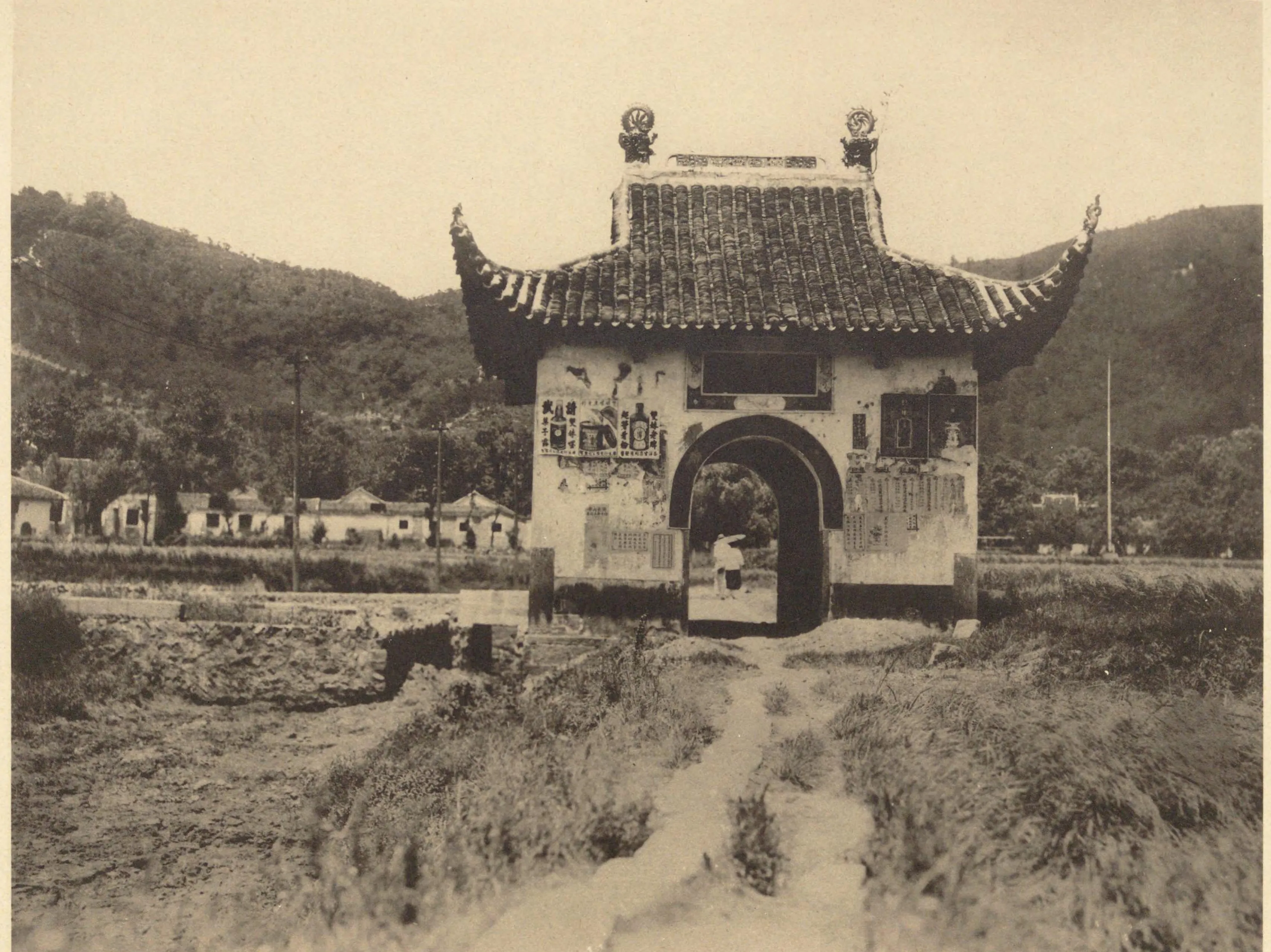
These three photographs, taken on the survey of Tokiwa Daijō and Sekino Tadashi, were published in 1939 in the third volume of Historical Monuments of Chinese Culture (《中国文化史迹》), issued by Hōzōkan. The photograph of the academy’s main gate bears on its lintel a plaque reading “Hunan Public Industrial Specialized School”; that school moved onto the old academy site in 1917 and was merged into the newly founded Hunan University in 1926, from which it can be seen that this group of photographs was taken between 1917 and 1926.
The first plate is captioned “Panorama of the Yuelu Academy”; the image shows a pavilion-style structure on the road before the mountain, with Yuelu Mountain in the distance.
The second image is the academy’s main gate, before which stand several men in long gowns; the gate couplet reads “Only Chu has talent; here it flourishes most.” Through the gate the form of the second gate within can still be glimpsed. The third image is a close view of the second gate, whose couplet reads “Gathered in the great foothills; stored in the famous mountain.”
1930 (published)
Installment 74 of the East Asia Pictorial Collection (《亚东印画辑》), “Changsha and Its Vicinity” (published September 1930), includes two photographs of Yuelu Mountain. The caption card for the academy photograph states that “today it has already become Hunan University,” and records that the four great characters “loyalty, filial piety, integrity, and temperance” written by Zhu Xi and the Stele of the Lushan Temple written by the Tang calligrapher Li Yong are carved on the gate wall; the other photograph shows the Chuixiang Pavilion in the pond before the academy’s Confucian temple, and its caption card states that the pavilion was first built in the Song.
1932 (published)
The front matter of Brief Records of Yuelu (《岳麓小志》), edited by Cheng Jiasen (Hunan News Agency, October 1932), includes one photograph of the Hexi Terrace.
References
- Historical Evolution (Yuelu Academy, Hunan University)
- 《岳麓小志》 (Brief Records of Yuelu), edited by Cheng Jiasen, Hunan News Agency edition of 1932, in the collection of the National Library of China