Introduction
In the fourth year of the Kaiyuan era of the Tang (716), the chancellor Zhang Yue was sent out to govern Yuezhou, and he would often invite men of letters to climb the western gate tower overlooking Dongting Lake and compose poems. From this, that gate tower—originally part of the city’s defenses—spread its fame under the name Yueyang Tower; and since the poets who afterward passed through Yuezhou were for the most part men in exile or demotion, the works they wrote on climbing it always bore the cares left upon them by journey and by the times. In the winter of the third year of the Dali era (768), Du Fu, sick and adrift, reached Yuezhou and at last climbed the Yueyang Tower of which he had so long heard; before him lay the lake that split Wu from Chu, beside him only a single lonely boat, and the fighting in the north had still not ceased. The next spring, Du Fu accompanied the local prefect up the tower again; by the lakeshore the plum trees were already in bloom and new grasses were sprouting in the mud, and the closing line of the poem—“From here I march farther south”—set down his resolve to press on to the south.
More than three hundred years later, Teng Zongliang, having incurred punishment, came to Yuezhou as its prefect. Climbing the tower, he not only found the old structure too cramped; he also feared that the poems inscribed by successive ages, scattered among literary collections and on the walls of the tower, would one day be lost. So he first ordered his subordinates to gather from the collected works of Tang and Song men of letters seventy-eight poems written on climbing it, to be carved on stone in order of period and set into the tower’s north and south walls. In the spring of the fifth year of the Qingli era (1045), Teng Zongliang assembled craftsmen to enlarge the old tower; in the sixth month of the same year he sent Fan Zhongyan the painting Late Autumn at Dongting, asking this friend, then far away in Dengzhou, to write a record for the new tower. Fan Zhongyan never went to Yuezhou in person, yet by way of Dongting Lake’s cloud and shine, wind and rain, he wrote the words “to worry before all under heaven worries, and to rejoice only after all under heaven rejoices”—and a local gate tower from then on passed down to posterity together with that essay.
More than thirty years later, in the tenth month of the first year of the Yuanfeng era (1078), fire broke out at the southwest corner of the inner city where the seat of Yuezhou lay, and the flames spread to the Yueyang Tower; the stone inscriptions in the tower toppled and cracked, and only the two characters “Xie Xian” could still be made out, while nothing was recorded of the fire’s cause. The following spring, Zheng Minzhan, acting prefect of Yuezhou, resolved together with his subordinates to restore its former appearance; it chanced that more than a hundred great timbers came floating across Dongting Lake, and he ordered the local people to salvage them for use in repairing the tower. In the first year of the Jiaxi era of the Southern Song (1237), the prefect of Yuezhou, Li Zengbo, still climbed the tower often in his leisure from public business; fourteen years later, passing through Yuezhou again on his way to take up office at Jingzhou, he found that the roofs and timbers of former days had long since turned to ashes, and neither the year nor the cause of the fire could any longer be established. A further year on, the prefect of Yuezhou, Zhao Rugui, completed a new tower on the abandoned site and sent the drawings to Li Zengbo, asking him to write a record of this rebuilding.
In the third year of the Chenghua era (1467), the prefect of Yuezhou, Wu Jie, seeing that the Yueyang Tower of his day was small in scale, wished to pull down the old and build anew. But the locality was then in famine and the prefectural treasury had no surplus, so Wu Jie had to set the plan aside for the time. In the seventh year of the Chenghua era (1471), when the granaries had stores of grain and the treasury had a surplus, Wu Jie and his subordinates drew upon the treasury’s surplus funds, added his own salary to them, began the work in the winter of that year, and completed it in the summer of the next. In the sixth month of the twelfth year of the Chongzhen era (1639), the Yueyang Tower caught fire once more, the cause again unrecorded. Tao Zongkong, judge of Yuezhou, and the prefect Dai Guangyu at once proposed rebuilding, with Tao Zongkong directing the work; as the workmen dug at the southeast corner of the tower’s foundation they unearthed a stone bearing the veining of plum blossoms, and to the left of the tower was added a Hall of the Immortal Plum to house this stone.
At the change from Ming to Qing, the city of Yuezhou was reduced to rubble in the warfare and its people scattered; though the Yueyang Tower did not fall, its frame leaned and was damaged. In the eighth year of the Shunzhi era (1651), Lou Sheng, the officer in charge of river defense, and Li Ruoxing, the prefect of Yuezhou, did not repair the tower at once, but first called back the displaced people and brought the garrison troops under discipline; only when the city had inhabitants again did the two men donate funds and hire labor to mend the tower’s fabric. In the eighteenth year of the Kangxi era (1679), when Li Yushi came to serve as prefect of Yuezhou, the locality had just passed through the rebellion of Wu Sangui and the famine that followed, the city was not yet settled, and the Yueyang Tower was leaning and near collapse. Li Yushi resolved to postpone the repair of the tower and to deal first with farming, relief, and public order. When the region had somewhat steadied, he and Zhao Shiheng, magistrate of Baling County, began to raise funds; but unexpectedly, in the twenty-second year of the Kangxi era (1683), a great fire broke out at Yuezhou’s west gate and the Yueyang Tower was again damaged, and it was not restored until the following year. Four years later another fire in the city burned the tower down; Sun Daolin, prefect of Yuezhou, set about rebuilding it in the fortieth year of the Kangxi era (1701), and the unfinished work was then washed away by a flood. Wang Guoying, magistrate of Baling County, and Bulantai, governor of Huguang, later continued the work in turn, in the fifty-fourth year of the Kangxi era (1715) and the fourth year of the Yongzheng era (1726).
In the fifth year of the Qianlong era (1740), Bandi, governor-general of Huguang, memorialized for the allocation of funds to repair the city of Yuezhou and to rebuild the Yueyang Tower, the work being directed by Tian Eryi, prefect of Yuezhou, and Zhang Shifang, magistrate of Baling County. The new tower completed the following year had three stories, with porches thrusting out on all four sides and a plan in the shape of a cross. In the thirty-ninth year of the Qianlong era (1774), Landixi, prefect of Yuezhou, and Xiong Weijiang, magistrate of Baling County, again memorialized for repairs to the tower; the following year the Pavilion of the Immortal Plum was rebuilt to the left of the tower and the Pavilion of Gazing upon the Immortals was added to the right, and from then on the main tower had a subsidiary pavilion on either side.
In the second year of the Xianfeng era (1852), when Lianchang, prefect of Yuezhou, and Hu Fanggu, magistrate of Baling County, built the barbican[1] outside the west gate, they repaired the Yueyang Tower at the same time; in the middle years of the Xianfeng era the Qing army and the Taiping forces fought more than ten engagements at Yuezhou, and the main tower and the surrounding city walls were all damaged. Not until the sixth year of the Tongzhi era (1867), when Zeng Guoquan, governor of Hubei, allocated the customs revenues of Yuezhou, were the main tower, the Doumu Pavilion, and the Pavilion of the Immortal Plum repaired; and in the course of this work the Doumu Pavilion was renamed the Pavilion of the Thrice-Drunken. More than ten years later, the waters of Dongting Lake again split open the tower’s foundations. Zhang Derong, prefect of Yuezhou, did not go on patching it in place, but in the sixth year of the Guangxu era (1880) moved the main tower and the two pavilions more than sixty feet back into the city and built a revetment[2] along the side facing the lake; the form that the main tower continues today is precisely that established by this rebuilding.
In the Republican era the warlords fought without cease, and the Yueyang Tower was used as barracks and stables, its doors and windows, inscribed boards and couplets, and stele inscriptions suffering constant damage. In the twenty-first year of the Republic (1932), the Hunan provincial government appropriated funds and raised subscriptions in the locality; Duan Heng, commander of the Yueyang garrison, and Liao Xingeng, director of the county bureau of education, presided over a great repair, and two years later the main tower, the Pavilion of the Immortal Plum, the Pavilion of the Thrice-Drunken, and the gate tower were all restored together. In the eleventh month of the twenty-seventh year of the Republic (1938), the Japanese army invaded and occupied the county seat of Yueyang, and established in the tower a police substation for gathering military and economic intelligence on the region from Yueyang to Wuhan, stockpiling ammunition and fuel oil there and forbidding Chinese to enter. In the seven years of the Japanese occupation of Yueyang, the precious cultural relics in the tower were also stolen in great numbers. In the ninth month of the thirty-fourth year of the Republic (1945), after Japan’s surrender, the Eighteenth Division of the Eighteenth Army of the Nationalist government’s forces accepted the surrender of the Japanese troops stationed at Yueyang and set up its divisional headquarters in the tower; in the eleventh month of the same year, Wang Dongyuan, chairman of the Hunan provincial government, issued a proclamation for the protection of famous sites, requiring that the troops not continue to occupy it.
In 1950 the People’s Government of Yueyang County for the first time appropriated funds to repair the Yueyang Tower, replacing rotted wooden members, strengthening beams and columns, repainting the tower’s fabric, and repairing the path up to it. When the city gate and the lakeshore foundations were repaired in 1955, the surviving forty-two stone steles bearing poems, texts, and images were set into the rear wall of the main tower. In 1975 and 1978 the Pavilion of the Thrice-Drunken and the by then leaning Pavilion of the Immortal Plum were successively dismantled and rebuilt; and by the early 1980s termites and long-standing leaks had again rotted many of the main tower’s beams and columns. With the approval of the state cultural-relics authorities, the city of Yueyang began on March 15, 1983, to take the Yueyang Tower down piece by piece; the dismantled members were examined one by one, old members that could still serve were repaired and kept so far as possible, and the whole was reassembled according to the Qing-dynasty form established in the sixth year of the Guangxu era. On May 1, 1984, the repaired Yueyang Tower opened anew. Over more than a thousand years the tower’s fabric has suffered water and fire and the flames of war time and again, its beams and columns have been replaced, and its site has shifted inward; generation after generation has raised the tower anew between the old site and the old form, and the climbings and inscriptions of Tang and Song and after have come down with it to the present day.
Historical Documents
Du Gongbu Ji (Collected Works of Du Fu)
昔闻洞庭水,今上岳阳楼。吴楚东南坼,乾坤日夜浮。
Long have I heard of the waters of Dongting; today at last I climb the Yueyang Tower. Wu and Chu are split apart to east and south, and heaven and earth float there day and night.
亲朋无一字,老病有孤舟。戎马关山北,凭轩涕泗流。
From kin and friends not a single word; old and sick, I have a solitary boat. War-horses north of the mountain passes—leaning on the balustrade, my tears stream down.
湖阔兼云雾,楼孤属晚晴。礼加徐孺子,诗接谢宣城。
The lake is broad, folded in cloud and mist; the tower stands alone, given over to the late clearing of evening. You extend to me the courtesy once shown to Xu Ruzi; your verse takes up the strain of Xie of Xuancheng.
雪岸丛梅发,春泥百草生。敢违渔父问,从此更南征。
On the snowy bank the clustered plums break into bloom; in the spring mud the hundred grasses spring to life. How should I dare refuse the fisherman’s question? From here I journey farther south.
Yueyang Lou Ji (Record of the Yueyang Tower)
庆历四年春,滕子京谪守巴陵郡。越明年,政通人和,百废具兴,乃重修岳阳楼,增其旧制,刻唐贤今人诗赋于其上,属予作文以记之。予观夫巴陵胜状,在洞庭一湖。衔远山,吞长江,浩浩汤汤,横无际涯,朝晖夕阴,气象万千。此则岳阳楼之大观也,前人之述备矣。然则北通巫峡,南极潇湘,迁客骚人,多会于此,览物之情,得无异乎?若夫霪雨霏霏,连月不开。阴风怒号,浊浪排空。日星隐耀,山岳潜形。商旅不行,樯倾楫摧。薄暮冥冥,虎啸猿啼。登斯楼也,则有去国怀乡,忧谗畏讥,满目萧然,感极而悲者矣。至若春和景明,波澜不惊,上下天光,一碧万顷,沙鸥翔集,锦麟游泳,岸芷汀兰,郁郁青青。而或长烟一空,皓月千里,浮光跃金,静影沉璧,渔歌牙答,此乐何极!登斯楼也,则有心旷神怡,宠辱偕忘,把酒临风,其喜洋洋者矣。嗟夫!予尝求古仁人之心,或异二者之为,何哉?不以物喜,不以己悲。居庙堂之高,则忧其民;处江湖之远,则忧其君。是进亦忧,退亦忧。然则何时而乐耶?其必曰:“先天下之忧而忧,后天下之乐而乐乎!”噫!微斯人,吾谁与归?时六年九月十五日。
In the spring of the fourth year of the Qingli era, Teng Zijing was banished to be governor of Baling Commandery. When the following year came, the administration flowed smoothly and the people were in harmony, and all neglected undertakings were revived; thereupon he rebuilt the Yueyang Tower, enlarging its former scale and having the poems and rhapsodies of the Tang worthies and of men of the present engraved upon it, and he charged me to write a piece recording it. As I see it, the finest scenery of Baling lies in the single lake of Dongting. It holds the distant mountains in its mouth and swallows the Long River, vast and rolling, stretching without shore; sunlit in the morning and shrouded at evening, its aspects are myriad. This is the grand spectacle of the Yueyang Tower, which men of former times have already described in full. Yet since it leads north to the Wu Gorges and reaches south to the Xiao and Xiang, exiled officials and wandering poets mostly gather here—can their feelings as they behold the scene fail to differ? When the long rains fall in drifting sheets and for whole months the sky will not clear; when the cold wind howls in fury and the turbid waves batter the sky; when the sun and stars hide their light and the mountains withdraw their forms; when merchants and travelers cannot pass, and masts topple and oars are broken; when late dusk closes in dark, and tigers roar and gibbons wail—to climb this tower at such a time is to feel that one has left the capital and longs for home, to dread slander and fear scorn; all before the eyes is desolation, and emotion mounts to the utmost of grief. But when spring is mild and the scene is bright, and the waves rise without a ripple; when the light of heaven above and below joins into a single blue of ten thousand acres; when sand-gulls wheel and settle, and bright-scaled fishes swim, and the angelica on the banks and the orchids on the isles grow lush and green; and when the long mists empty away all at once, and the bright moon spans a thousand li, its floating light leaping like gold and its still image sunk like a jade disc, while fishermen’s songs answer one another—what limit is there to such joy! To climb this tower at such a time is to feel the heart open and the spirit at ease, favor and disgrace alike forgotten; with wine in hand, facing into the wind, what gladness fills the heart! Ah! I once sought the heart of the humane men of old, and perhaps it differed from these two responses. Why? They did not rejoice because of outward things, nor grieve because of themselves. Dwelling high in the halls of the court, they worried for their people; dwelling far away among the rivers and lakes, they worried for their sovereign. Thus advancing, they worried; withdrawing, they worried too. Then when did they rejoice? Surely they must have said: “To worry before all under heaven worries, and to rejoice only after all under heaven rejoices!” Ah! Without such a man, with whom should I go?—The fifteenth day of the ninth month of the sixth year.
Qiu Ji Shu (Letter Requesting a Record)
六月十五日,尚书祠部员外郎、天章阁待制、知岳州军州事滕宗谅,谨驰介致书,恭投邠府四路经略安抚资政谏议节下:窃以为天下郡国,非有山水瑰异者,不为胜,山水非有楼观登览者,不为显,楼观非有文字称记者,不为久,文字非出于雄才巨卿者不成著。今古东南郡邑,当山水间者比比,而名与天壤同者,则有豫章之滕阁,九江之庾楼,吴兴之消暑,宣城之叠嶂,此外无过二三所而巳。虽寝历于岁月,挠剥于风雨,潜消于兵火,圯毁于难患,必须崇复而不使随圯者,盖由韩吏部、白宫傅以下,当时名贤辈各有纪述,而取重于千古者也。巴陵西跨城𬮱,揭飞观,署之曰岳阳楼,不知倜落于何人。自有唐以来,文士编集中无不载其声诗赋咏,与洞庭君山率相表里。宗谅初诵其言,而疑且未信,谓作者夸说过矣。去秋以罪得兹郡,入境而疑与信俱释,及登楼,而恨向之作者所得仅毫末尔。惟有吕衡州诗云:襟带三千里,尽在岳阳楼。此粗标其大致。自是日思以宏大隆显之,亦欲使久而不可废,则莫如文字。乃分命僚属,于韩、柳、刘、白、二张、二杜逮诸大人集中,摘出登临寄咏,或古或律,歌咏并赋七十八首,暨本朝大笔如太师吕公、侍郎丁公、尚书夏公之作,榜于梁栋间。又明年春,鸠材僝工,稍增其旧制。古今诸公于篇咏外,率无文字称纪。所谓岳阳楼者,徒见夫屹然而踞,岈然而负,轩然而竦,伛然而顾,曾不若人具肢体而精神未见也,宁堪久焉?恭惟执事文章器业,凛凛然为天下之时望,又雅意在山水之好,每观送行还远之什,未尝不神游物外,而心与景接。矧兹君山、洞庭,杰然为天下之最胜,切度风旨,岂不摅遐想于素尚,寄大名于清赏者哉!冀戎务尠退,经略暇日,少吐金石之论,发挥此景之美,庶漱芳润于异时,知我朝高位辅臣,有能淡味而远托思于湖山数千里外,不其胜与!谨以洞庭秋晚图一本,随书贽献,涉毫之际,或有所助。干冒清严,伏惟惶灼。
On the fifteenth day of the sixth month, Teng Zongliang—supernumerary gentleman of the Bureau of Sacrifices of the Department of State Affairs, awaiting edicts in the Tianzhang Pavilion, and administrator of the military and prefectural affairs of Yuezhou—respectfully sends a messenger bearing this letter, humbly submitted to Your Excellency, the Zizheng grandee and counselor of remonstrance, commissioner for military affairs and pacification of the four circuits at the prefecture of Bin: I venture to hold that of the commanderies and states of the realm, none is counted scenic unless it has mountains and waters of rare beauty; that mountains and waters are not made illustrious unless they have towers and belvederes for climbing and looking out; that towers and belvederes do not long endure unless they have writings to praise and record them; and that writings cannot become celebrated unless they issue from a mighty talent or a great minister. Of the towns and cities of the southeast, past and present, those set among mountains and waters are everywhere; yet those whose names are coeval with heaven and earth number only the Teng Pavilion of Yuzhang, the Yu Tower of Jiujiang, the Summer-Quelling Tower of Wuxing, and the Tiered Peaks Tower of Xuancheng—beyond these, no more than two or three places. Though they have lain abed through the years and months, been flayed and peeled by wind and rain, silently wasted by war and fire, and toppled and ruined by calamity, they have always been raised high again and not suffered to follow into ruin—this because, from Han of the Ministry of Personnel and Bai the Palace Mentor on down, the famous worthies of their times each made records of them, whereby they gained weight for a thousand ages. Baling on the west bestrides the city wall and rears aloft a soaring belvedere, inscribed with the name Yueyang Tower, though by whose free hand the name was bestowed is not known. Since the Tang, there has been no literary collection that does not carry poems and rhapsodies upon it, standing in mutual reflection with Dongting and Mount Jun. When I first read those words, I doubted and did not yet believe them, thinking that the authors had exaggerated. Last autumn I came by punishment to this commandery, and upon entering its borders my doubt and my disbelief were both dispelled; and when I climbed the tower, I rued that the former authors had captured no more than its hairs and tips. Only the poem of Lü of Hengzhou says: “Its girdle and collar of three thousand li—all lies at the Yueyang Tower.” This roughly marks out its general form. From that time I thought daily of how to magnify and exalt it; and wishing also to make it long endure, never to fall to ruin, I found nothing equal to writing. So I severally charged my subordinates to cull from the collections of Han, Liu, Liu, Bai, the two Zhangs, and the two Dus, down to the various great men, the pieces composed on climbing it—ancient-style or regulated, songs, chants, and rhapsodies, seventy-eight in all—together with works by the great brushes of our own dynasty, such as Grand Preceptor Lü, Vice-Director Ding, and Minister Xia, and to post them among the beams and pillars. The following spring we assembled timber and gathered workmen, slightly enlarging the former scale. Yet the various lords, ancient and modern, beyond their verses made no writings in record of it. The so-called Yueyang Tower is seen only towering as it crouches, gaping as it bears its load, soaring as it rears up, stooping as it looks about—as though a man possessed limbs and body but the spirit had not yet appeared in him: how could that long endure? I humbly consider that Your Excellency’s literary works and your capacity and deeds stand awe-inspiring as the hope of the age; and moreover your constant delight is in the love of mountains and waters, and whenever I read your poems of farewell and of sending off to distant parts, I have never failed to roam in spirit beyond things, my heart meeting the scene. How much the more, then, this Mount Jun and this Dongting, towering as the very finest sight in the realm! Taking the measure of your bent and spirit, would you not spread your far-ranging thoughts over this long-cherished scene and lodge your great name upon its pure delights? I hope that when the press of arms has somewhat withdrawn, on some leisure day amid your campaigns, you will let fall a little of your bronze-and-stone discourse to unfold the beauty of this prospect, so that men may sip its fragrant moisture in ages to come, and know that among the high ministers who assist our dynasty there was one able to savor quietude and send his thoughts in trust across several thousand li of lake and mountain—would that not be splendid? I respectfully send herewith one copy of the painting Late Autumn at Dongting, accompanying this letter as my gift; perhaps, as your brush dips, it may be of some aid. I have presumed upon your pure sternness; prostrate, I remain in fear and trembling.
Yueyang Jisheng Huibian (Compilation of the Scenic Marvels of Yueyang)
东南之国富山水,惟洞庭于江湖名最大,环占五湖,均视八百里。据湖面势,惟巴陵最胜。濒岸风物,日有万态,虽渔樵云鸟,栖隐出没,同一光影中,惟岳阳楼最绝。古今才人巨公,登临寄傲,流叹声藻,散在编简,或传诵于人口者,才不过一二。惟唐相张燕公文字最著,询之耆旧,则曰:楼得名始命于公矣。
The states of the southeast are rich in mountains and waters, but among the names of river and lake, Dongting is the greatest: it encompasses the five lakes round about, everywhere measuring eight hundred li. Considering the aspect and position of the lake, Baling is the finest of all. And of the scenery along its shores, which takes on ten thousand guises each day—though fisherfolk and woodcutters, clouds and birds, dwelling hidden or appearing, all share the same light and shadow—the Yueyang Tower is the most matchless of all. Of the talented men and great lords, ancient and modern, who climbed it and gave rein to their pride, pouring out sighs and sounding phrases, which are scattered among the bamboo slips or recited in men’s mouths, not one or two in ten survive. Only the writings of the Tang chancellor, Duke Zhang of Yan, are the most celebrated; and when I inquired of the old men of long standing, they said: the tower’s name was first bestowed by the Duke.
即指导往迹,参传其说,皆略而不书。顷罹三国,兹实战冲,镇守者间有贤杰,非尚智力,则任权术,处清境,殆距炉炭,岂暇优游坐啸,摅发清蕴也哉?六朝通三百三十七年,惟颜延年、阴子铿见于章句,余皆寂寥无闻。李唐恢宇,享祚甚宏远。岳去长安尤僻,在当时名贤辈出,能至此者,率自迁谪而来,故所属篇,类多离骚叹惋之意,然于徘徊幽觉,未尝出盈厌之语。殊俗移人,果如是乎?天宝中,苏源明刺东明,因石潴仿佛遐致,号小洞庭,芳晨良夜,以为留客宴喜之地。每冠盖盛集,酒行思缨,苏必雅吟自放,四顾赓唱,雕词丽句,传诵不泯。粤自元和五年,令狐楚节制汝上,相去方八十载,咨考故处,已茫然无得矣。既叹而愤,乃引金石以永好事之意。切寻古人之旷怀高韵,缅慕天末,写千里于一局之水,使彼时风月独异于他郡,所乐也犹如此,后贤惜其遗音逸事,孜孜重显之,盖于赏情爱景之心无少负也。
They then pointed out and guided me among the old traces and rehearsed the traditions about them, but all in outline and without written record. Of late, in the time of the Three Kingdoms, this was truly a thoroughfare of war; among those who garrisoned it there were worthy and heroic men, but if they did not exalt cleverness and force, they trusted in stratagem and craft, and to dwell in this clear realm was as if to sit by the furnace’s coals—how should they have had leisure to roam at ease, whistling as they sat, and give vent to pure inspiration? The Six Dynasties spanned altogether three hundred and thirty-seven years, yet only Yan Yannian and Yin Zikeng appear in verse; the rest are all silent and unheard of. The Li Tang expanded its realm and enjoyed a mandate most far-extended. Yet Yue is far and secluded from Chang’an, and of the famous worthies born in succession at that time, those who could reach this place mostly came by way of exile or demotion; thus the pieces belonging to it largely carry the plaintive, sighing mood of the Li Sao, though in their lingering musings and dark awakenings they never uttered a word of satiety or disgust. Can alien customs so alter men? It would truly seem so! In the Tianbao era, Su Yuanming, being prefect of Dongming, took a pool among the stones that in its likeness called this distant prospect to mind and named it Little Dongting, and on fragrant mornings and fine nights made it a place to detain his guests with feasting and joy. Whenever a great company in caps and canopies gathered and the wine went round and thoughts turned to their cap-strings, Su would chant elegantly in his freedom and look all round for answering songs; their carven words and lovely phrases have been recited without ceasing. Yet from the fifth year of the Yuanhe era, when Linghu Chu held military command over Rushang, it was just eighty years back; and when he inquired into and examined the former site, he could find nothing at all. Having sighed over it with indignation, he then set it down in bronze and stone to perpetuate the memory of that fondness for the place. I ponder the ancients’ untrammeled hearts and lofty airs, gazing in longing to the sky’s far edge, sketching a thousand li within a single stretch of water; that the winds and moonlight of that time should have differed from those of other commanderies—such was their delight in it! And that later worthies, cherishing their lingering tones and forgotten deeds, have diligently made them manifest again—surely in this they have in no way wronged their own hearts’ love of feeling and of scene.
况仆忝宰于今,旦暮为湖山主事,弗虑乎?一旦众作,与桡栋同沦委,则后之议我者以为何如,亦将恐风月仇人不浅矣。遂用崇新基址,遍索墙堵间,及本朝诸公歌诗古赋,纪以时代,次以岁月,不以官爵贵贱为升降,俾镵石置于南北二壁中,庶几他日有闻韶忘味,君子知仆之志也。然历世寝远,必多遗难备,直以所存者笔之。如其删繁撷英,请俟来者焉。
How much more should I, who unworthily govern it today and morning and evening preside over the affairs of this lake and mountain, fail to give thought to it? If one day the whole body of these works should sink and rot together with the rafters and beams, what will those who pass judgment on me hereafter think of me? I fear I shall have made myself no shallow enemy of the winds and moonlight. Accordingly, having newly raised the foundations, I searched everywhere among the walls and partitions, and among the songs, poems, ancient-style verse, and rhapsodies of the various lords of the present dynasty, and ordered them by period and arranged them by year and month, without raising or lowering any according to the rank or lowliness of his office, and had them carved in stone and set into the two walls, north and south—so that one day, should some gentleman hear the music of Shao and forget the taste of meat, he may know my intent. Yet as the ages grow ever more remote, much must have been lost that cannot be made complete; I have simply written down what survives. As for pruning the luxuriant and culling the blossoms, I ask that this await those who come after.
岳阳楼在洞庭之滨,延庚挹辛,于登临最胜,创者寝不可考。自唐相张燕公出守于此,其名始著。庆历中,滕子京作而新之,时人以范记、苏书、邵篆,与兹楼号为天下四绝。元丰元年十月,不幸火起于牙城之西南隅,延及于楼。已而同宾僚登古址,石刻皆仆地而裂,独谢仙二字存焉。夫谢仙者,雷部中之神也。神能保其碑,而不能及其屋,何其异也!明年春,议复旧观,适湘神涌水浮至巨木百余,亟命邦人取以为用,若相厥役者,又何异耶?楼成,因镵诸石,一以彰雷笔之灵,一以侈湘神之助。他如登临知胜概者,自得之心目,何待予言。亦有范公记。
The Yueyang Tower stands on the shore of Dongting, extended toward the geng quarter and facing the xin [both of the west]; for climbing and looking out it is the finest of all, but who founded it can no longer be traced. Only when the Tang chancellor, Duke Zhang of Yan, came out to govern this place did its name first become known. In the Qingli era, Teng Zijing built it anew, and the men of that time called Fan’s record, Su’s calligraphy, and Shao’s seal-script heading, together with this tower, the Four Perfections under heaven. In the tenth month of the first year of the Yuanfeng era, fire unhappily broke out at the southwest corner of the inner city and spread to the tower. When I afterward climbed the old site with my guests and staff, the stone inscriptions had all fallen to the ground and cracked, and only the two characters “Xie Xian” survived. Now this Xie Xian is a spirit of the Thunder Ministry. That the spirit could preserve his own stele, yet could not extend his protection to the building—how strange is that! The following spring we deliberated on restoring the former appearance, and it chanced that the God of the Xiang, making the waters surge, floated more than a hundred great timbers to us; I at once ordered the people of the country to take them up for use, as though they had come to aid the work—and how strange again! When the tower was finished, I accordingly had this carved in stone, both to glorify the numinous brush of the Thunder and to magnify the aid of the God of the Xiang. As for the rest—those who climb and look out and know its splendid prospect will find it in their own hearts and eyes; what need is there of my words? There is already Lord Fan’s record.
Kezhai Zagao (Miscellaneous Drafts of Kezhai)
洞庭天下之胜,岳阳楼又擅洞庭之胜。庆历之记尽矣,后有作者,未易加一辞。岁嘉熙丁酉,曾伯守是邦,每公余登眺,令人浮沤溟渤,培塿大块。缅怀唐开元而后,李、杜、张、孟诸贤,更赋迭咏,不可胜数。
Dongting is the finest sight under heaven, and the Yueyang Tower in turn possesses the finest of Dongting. The record of the Qingli era has said it all; for any who came after, it would not be easy to add a single word. In the dingyou year of the Jiaxi era, when I, Zengbo, was governing this country, I would climb and gaze whenever my public duties gave me leisure, so that I seemed a floating bubble upon the boundless sea, a little mound upon the great earth. In fond remembrance I thought of how, since the Kaiyuan era of the Tang, the various worthies—Li, Du, Zhang, Meng—had composed their poems one upon another, more than can be counted.
至我朝文正范公,惓惓焉以天下为忧乐,斯文一出,斯楼之伟观增重。去今二百载,星回物换,而江涛滚滚,与公风烈,盖巍然独存也。后十有四祀,曾伯以牧荆道过之,亟访徙倚,殆山川不可复识,乃知昔之栋宇久已灰烬,今楼非故楼矣,怆然为之感慨。越明年九月,郡侯浚仪赵汝归书来,以图示,则危栏杰观,葺废址而新之,君山本来面目,欣然如对立,属为之记。曾伯俯仰畴昔,虽不能忘情于此,率尔援笔,多见其不知量也。顾人事有因革,地势无古今,世之出新奇之见者,每至越故常,安简陋者又惮于改作,此天下事不能尽如人意者十八九。非有英材磊落之士,心眼轩豁,起古意于寂寥,舒世虑之郁勃,将视此为传舍,岂屑置念哉?如侯之心,足以经营四方,不以一楼而止。侯帝室之胄,所至有治行,及是楼与政俱成,会命提点本路刑狱,仍郡牧,徂重湖,泛巨波,川后山灵方尽听弹压,匪是亦畴克胜?余虽未获从侯凭高举酒,挹胜概于几席,意岳之人士将复见庆历气象,已于斯占之,庸记岁月云。楼之楹若干,暨费计若干,抑末耳,不书。
When it came to Lord Fan Wenzheng of our own dynasty, whose loyal heart took all under heaven as its worry and its joy—once this essay came forth, the tower’s grand spectacle gained immeasurably in weight. Two hundred years from that time to now, the stars have wheeled round and all things have changed, yet the river’s billows roll on, and together with the Duke’s noble influence it stands towering, alone surviving. Fourteen years later, when I passed this way on the road to take up the pastoral office of Jing, I hastened to visit it and lingered there; the very mountains and streams seemed no longer to be known, and I realized that the roofs and timbers of old had long since become ashes, that the tower of today is not the tower of old—and I was moved to melancholy feeling. In the ninth month of the following year, the commandery lord Zhao Rugui of Junyi sent a letter, showing me the plans: the soaring railings and heroic prospect had been newly built upon the ruined foundations, and Mount Jun’s true features seemed gladly to stand face to face with it again—and he charged me to write a record. As I bowed and lifted my head to days gone by, though I cannot be without feeling for this place, to take up my brush so hastily only shows the more how little I know my own measure. Yet human affairs have their continuities and their changes, while the lay of the land knows no past or present; those of this world who put forth novel views often overstep the old constants, while those content with the crude and humble shrink from building anew—and this is why the affairs of the world, in eight or nine cases out of ten, cannot go as one would wish. Without men of heroic talent and forthright spirit, whose hearts’ eyes are open and free, who raise the spirit of antiquity out of the silence and give vent to the pent-up cares of the age, a place like this will be looked on as a mere lodging-house—who would deign to give it a thought? With a heart like the lord’s, one is fit to order all four quarters, and does not stop at a single tower. The lord is a scion of the imperial house; wherever he has gone he has had the record of good government. When this tower and his governance were both complete, it happened that he was appointed judicial intendant of this circuit, while continuing as commandery pastor; journeying to the double lakes and sailing the great waves, the river gods and mountain spirits will all come under his ordering—were it not such a man, who could bear that? Though I have not been able to follow the lord in leaning on high and raising a cup, drawing in the splendid prospect across the mats, I believe the men of Yue will see again the aspect of the Qingli era—of this I have already had the augury. And so I have recorded the year and month. The number of the tower’s bays and the tally of its cost are trifling matters after all, and I do not write of them.
淳祐辛亥良月,覃怀李某记。
In the auspicious tenth month of the xinhai year of the Chunyou era, recorded by Li of Qinhuai.
Yueyang Fengtu Ji (Record of the Land and Customs of Yueyang)
岳阳楼,城西门楼也。下瞰洞庭,景物宽阔。唐开元四年,中书令张说除守此州,每与才士登楼赋诗,自尔名著。其后,太守于楼北百步复创楼,名曰燕公楼。山海经言:洞庭沅、澧之交,潇湘之渊,是为九江之门。按澧、鼎、沅、湘合诸蛮、黔南之水,汇为洞庭,至巴陵与荆江合而东,州据其上。水经云:湘水右会小青口,资水也,世谓之益阳江,右则沅水注之,谓之横房口,东到微湖,世谓之糜湖,西流注为江,谓之糜湖口。左则澧水,谓之武陵江。凡此五水,注为洞庭,北会为大江,名曰五潴。战国策曰:秦与荆战,大破之,袭郢,取洞庭五潴。楚辞帝子降兮北潴。皆其地也。寰宇记云:郡有青草、洞庭、巴丘二湖,青草湖中有青草山,冬春水■,皆■■也。洞庭,洞府之庭,上有洞庭真君庙堂,巴丘之名今不著。
The Yueyang Tower is the tower of the city’s west gate. Looking down upon Dongting below, its view is wide and broad. In the fourth year of the Kaiyuan era of the Tang, the president of the Secretariat, Zhang Yue, was appointed to govern this prefecture; he would often climb the tower with talented gentlemen and compose poems, and from that time its fame became known. Afterward a prefect founded another tower a hundred paces north of the tower, named the Tower of the Duke of Yan. The Shanhaijing says: where the Yuan and the Li of Dongting meet, the abyss of the Xiao and Xiang—this is the gate of the Nine Rivers. Note: the Li, the Ding, the Yuan, and the Xiang join with the waters of the various Man tribes and of Qiannan to form Dongting; at Baling it joins the Jing River and flows east, and the prefecture lies upon it. The Shuijing says: on the right the Xiang River meets the Little Qing mouth, which is the Zi River, called by the world the Yiyang River; on the right again the Yuan River flows in, called the Hengfang mouth; eastward it reaches Wei Lake, called by the world Mi Lake, and flowing west it pours into the river, called the Mi Lake mouth; on the left is the Li River, called the Wuling River. All these five waters pour into Dongting and join northward into the Great River; they are called the Five Pools. The Zhanguoce says: Qin fought with Jing and greatly defeated it, surprised Ying, and took the Five Pools of Dongting. The Chu Ci says: “The god’s child descends by the northern pool.” All refer to this place. The Huan Yu Ji says: the commandery has the two lakes Qingcao and Dongting, and Baqiu; in Qingcao Lake there is a Qingcao Mountain; in winter and spring the water is […], all […]. “Dongting” means the courtyard of the cavern-palace; upon it is the shrine of the True Lord of Dongting. The name Baqiu is no longer current today.
Chongjian Yueyang Lou Ji (Record of the Rebuilding of the Yueyang Tower)
岳阳楼在岳州府治西南右瞰洞庭左挹君山波光峦影万景在目诚一郡伟观也图志莫详创始然考之唐李杜诸贤皆有赋岳阳楼诗其来巳久至宋庆历间郡守滕宗谅子京重建范文正公希文作记而后岳阳楼之名益显于世庆历至是四百余年中间兴废不知其几矣成化丁亥进士眉山吴节以郎官有声出守兹郡登览之余怃然有感谓湖山景象不减旧闻而楼之规模大非昔比询之则后来郡人所构卑陋弗称亟欲改作还于旧观适视篆之初年饥用乏力未暇及久之政务渐举𡻕时渐稔廪有积粟库有积贰乃谋诸僚住稍出羡余兼助巳俸募工饬材撤其旧而新之始事于辛卯冬十一月讫工于壬辰夏五月杰栋峥嵘层檐翚飞高宏壮丽有加于前落成之日众皆欣悦以为盛事不可无述于是太守具事状介太仆寺丞邓君廷瓒来征予记嗟乎物不自美因人而美此理也夫以岳阳为楼据有洞庭之胜既云美矣而范公为记又历叙阴晴变态之妙以寓夫先忧后乐之心使人诵而味之非惟不出户庭而湖山景物尽在目中凡素存忧国忧民之念者自将惕然警省而油然兴起矣然则是楼之建岂为游观之好哉盖深有慕于公之为人而追寻芳躅思欲企而及之者也予闻太守治岳廉慎有为九载之间士安其教民安其政而吏亦怡然于禁令之下无敢侈然以肆者夫为郡而能仁于其民无愧于公之心也建楼无愧于公之文也公何人也希之则是子于太守有取焉于是乎书
The Yueyang Tower lies southwest of the seat of Yuezhou Prefecture, overlooking Dongting on the right and drawing in Mount Jun on the left; the light of the waves and the shadows of the peaks, ten thousand scenes before the eyes—truly the grand sight of the whole commandery. The maps and gazetteers do not record its founding in detail; yet when we consider that the various Tang worthies, Li and Du among them, all wrote poems on the Yueyang Tower, its coming is long indeed. When, in the Qingli era of the Song, the commandery governor Teng Zongliang Zijing rebuilt it, and Fan Wenzheng Xiwen wrote the record, the name of the Yueyang Tower became yet more illustrious in the world. From the Qingli era to this day is more than four hundred years, and how many times in between it rose and fell cannot be known. In the dinghai year of the Chenghua era, the jinshi Wu Jie of Meishan, who had won repute as a director in the ministry, came out to govern this commandery; climbing and looking out, he was moved to sigh, and said that the aspect of the lake and mountains was no less than what had been heard of old, but that the scale of the tower was far from matching former times; on inquiry, it had been built by the men of the commandery in later days, base and crude and unbefitting, and he wished urgently to build it anew and restore its former appearance. But it fell in the first years of his taking the seal, when the year was one of famine and resources were scarce, and he had no leisure to attend to it. After some time, as his administration gradually took hold and the harvests gradually ripened, the granaries had stores of grain and the treasury had stores of funds; then he took counsel with his colleagues, drew out a portion of the surplus, and added to it from his own salary; he hired workers and prepared materials, pulled down the old and raised the new. The work began in the winter, the eleventh month, of the xinmao year, and was finished in the summer, the fifth month, of the renchen year. The soaring ridgepoles towered, the layered eaves flew like wings, lofty and grand and beautiful, surpassing what had been before. On the day of its completion all rejoiced, and holding that so splendid an event must not go unrecorded, the prefect set down the facts of the matter and, through the good offices of Deng Tingzan, assistant minister of the Court of the Imperial Stud, came to ask me for a record. Ah, things do not become beautiful of themselves; they become beautiful through men—this is the principle of things. Now for the Yueyang Tower to possess the beauty of Dongting may be called beauty indeed; and Lord Fan’s record moreover recounts in turn the marvels of its changing aspects, fair and foul, so as to lodge therein the heart that worries first and rejoices last, causing those who recite and savor it not only to have all the scenery of the lake and mountains before their eyes without stepping beyond their door, but to be roused in vigilance and stirred to action if they have ever cherished the thought of concern for state and people. Thus the building of this tower was not for the pleasure of excursions; it was out of deep admiration for the Duke’s character, a wish to follow in his fragrant footsteps and to think to attain them. I have heard that the prefect governed Yue with integrity, prudence, and accomplishment, and that in his nine years the gentlemen were content with his teaching, the people were content with his governance, and the officials too were at ease under his prohibitions, none daring to be wanton and unrestrained. To govern a commandery and be humane to its people is to be unashamed before the Duke’s heart; to build this tower is to be unashamed before the Duke’s writing. And what manner of man was the Duke? The prefect aspired to him—and in this, you, sir, have taken the prefect as your model; and so I have written this.
Xianmei Tang Ji (Record of the Hall of the Immortal Plum)
崇祯十二年六月晦,岳阳楼灾。其明年冬,余衔天子命至其地,则郡守告成事矣。楼左筑掌大室,附耳为仙梅亭。讯之云:建楼时,掘东南隅数拏,获石,长尺许,阔三之一,石上有墨迹,斜折一枝,错落数萼,墨高于石,可半米,凌凌然具衔霜茹雪之致,观者诧为神物。此仙梅堂所由与楼伊始也。今其石故在壁间,予熟视之,良然。予闻之,掘土得石,譬则破肉得骨也。石之有画文,譬天之有云气,万象百怪,无所不可,何独于梅而异之。天下岂真有神仙出没人间哉?予于此窃有感也。
On the last day of the sixth month of the twelfth year of the Chongzhen era, the Yueyang Tower was destroyed by fire. In the winter of the following year, bearing the Son of Heaven’s commission, I came to that place, and the governor informed me that the work was complete. To the left of the tower a chamber the size of a palm had been built, with a side annex, the Pavilion of the Immortal Plum. On inquiry, I was told: when the tower was being built, they dug several spans deep at the southeast corner and found a stone, about a foot long and a third as wide, upon which there was a tracing of ink—a single branch aslant, with several blossoms scattered along it; the ink stood proud of the stone by some half a grain’s breadth, keen and sharp, with the air of one that holds the frost in its mouth and feeds upon the snow, and those who saw it marveled at it as a divine thing. This is how the Hall of the Immortal Plum began together with the tower. Today the stone still lies in the wall; I examined it closely, and it is truly so. I have heard that digging up earth and finding stone is like breaking flesh and finding bone. That a stone should bear a pictured pattern is like the clouds and vapors of the sky, which take on ten thousand forms and a hundred strange shapes and can be anything at all—why should one single out the plum as a marvel? Can there really be spirits and immortals going in and out among men in this world? And herein I privately found matter for reflection.
当夫赤焰浃月,寒烬经年,湖山黯淡,乌鹊栖迟,潸然顾之,大难为怀。一日而役千夫,兴百堵,居人过客,怂恿观成,而瑞呈若此,盈城罢市,相顾动色,人人如有所获,岂偶然之故乎?自昔祸福同门,其来莫测。是故,涸川可以得珠,崩崖可以得玉,亦莫不以其所损为其所益,以其所不祥为其所祥。引而伸之,外宁者必内忧,先忧者必后乐,理势实然,天下事皆应作如是观也。
When I think of those red flames that filled a whole month, and the cold ashes that lasted through the year; of the lake and mountains grown dim, the crows and magpies perching in hesitation—looking back upon it with tears, it is hard to bear such calamity. Then in a single day a thousand men were set to work, a hundred walls were raised, and inhabitants and passing travelers urged one another on to see it done; and when such an auspice appeared, the whole city left its markets, men looked at one another with changed countenances, and everyone felt he had received something—can this have been by chance? From of old, fortune and misfortune come from the same gate, and their coming cannot be fathomed. Thus a dried-up river may yield a pearl, and a fallen cliff may yield jade; in all such cases what was lost becomes what is gained, what was inauspicious becomes auspicious. Extend this further: outward peace always harbors inward worry; he who worries first will rejoice last. Such is truly the logic of circumstances, and all the affairs of the world should be viewed in this light.
且夫以梅之从来久远也,商、周之际,往往言之。然《说命》言味,《召南》言实,而皆略其华。故桃李舜英,竞胜于《国风》;江蓠杜若,齐芳于《楚骚》。独千百余年,梅无显者。崎岖六朝南北,而梅一日以花闻于天下。积渐至唐与宋,然后极盛。今兹之成形于石,埋光于土,迟之又久,达可而后大行,岂养晦待时,天地亦自然欤?君子观一物之得所、一物之失所,莫不有盛衰兴废之感焉!才人嗟遇,劳臣忧国,睹此将无动心欤!
Moreover, the plum’s coming is of great antiquity: at the juncture of Shang and Zhou it was already spoken of. Yet the Yue Ming speaks of its flavor and the Shao Nan of its fruit, and both pass over its flower. Thus the peach and the plum and the shrub-althea vie for pride in the Guo Feng, and the riverine lovage and the pollia share their fragrance in the Chu Sao; but for a thousand years and more the plum had no renown. Through the rough road of the Six Dynasties, north and south, the plum one day became known throughout the world for its flower. Gathering force through the Tang and Song, it then reached its height. That now its form should have taken shape in stone, its light buried in the earth, long delayed, and only on attaining this could it spread abroad—was this not a case of nurturing obscurity while awaiting its time, as heaven and earth also do by nature? When the noble man beholds a single thing obtaining its place or a single thing losing its place, he never fails to feel the rise and fall, the flourishing and ruin of things! When men of talent lament their fortune and toiling ministers worry for the state, how could they look upon this and not be moved!
予闻之,物之神者,其生也必有以,其出也必有为。云门之桃,可以疗饥;太原之枣,可以克贼,其往事也。今日者,戎马生郊,饥馑荐至。登斯楼也,诵杜老“凭轩涕泗”之句,聚麋子国循良之吏与介胄之士,究图荒政,箸筹牧圉,后乐先忧,梅其与有助焉。吾以是为梅祝,梅果仙矣!若为是区区藏石在土、画文在石而异之,而神仙之也,天下岂真有神仙在人间哉!
I have heard that when a thing is divine, its coming into being must have a cause, and its appearing must have a purpose. The peach of Yunmen could cure hunger; the dates of Taiyuan could defeat rebels—such are the old tales. Today war-horses breed in the outskirts and famine comes upon us year after year. If, climbing this tower and chanting old Du’s line “leaning on the balustrade, my tears stream down,” the good and order-loving officials of this land of the Viscount of Mi, together with the armored soldiers, were to study and plan measures against the famine and reckon the means of pasturage and defense, rejoicing last and worrying first, then perhaps the plum would lend its aid therein. With this I pray for the plum—then the plum is immortal indeed! But as for marveling at this mere stone hidden in the earth, with a pictured pattern upon it, and making an immortal of it—can there really be spirits and immortals among men in this world!
今天子文武,维后太平可俟,老成过计,或以外宁为忧,而好事者将侈谈蓬莱,以广大帝德。予不佞,断断然不敢以仙名梅,以自附于不著封禅之义,即以是记仙梅堂可矣!
Our present Son of Heaven is both civil and martial, and a successor-peace may be awaited; yet men of mature judgment, worrying beyond their due, might take this outward peace as a cause for concern, while lovers of marvels will discourse extravagantly of Penglai to magnify the emperor’s virtue. I, in my lack of talent, am firmly resolved not to name the plum an immortal and so attach myself to the righteousness of those who would not record the Feng and Shan sacrifices—and so let this serve as the record of the Hall of the Immortal Plum!
Nianyuan Cungao (Surviving Drafts of the Garden of Remembrance)
湖之有洞庭,楼之有岳阳,东南巨观也,详宋范文正公记中。历今数百年,兵燹之后,山川不改,而人民已非。楼虽岿然仅存,亦倾圯非故。顺治八年,江防兵备楼公晟、知府李公某来莅岳郡,郡则虚无人焉。盖自明末群盗所薮,虎狼榛莽,争此瓦砾之场。大清受命,王师底定楚疆,始留兵戍守,灶垒之外,虚无人犹昔也。赖两公竭力招徕之,然后负耒占茆者稍集。逾年,烟火渐繁,又以威辑兵,俾民与兵画然相安,郡称无事。两公乃登楼纵观而叹曰:域民不以封疆之界,固国不以山溪之险,威天下不以兵革之利,信乎吾与吾民乃今而后乐有斯楼也。于是捐金募役,因其坏缺而修葺之,计费不征派,劳不动众,楼之旧观顿复。
Of lakes there is Dongting; of towers there is Yueyang—the grand sight of the southeast, as is detailed in Lord Fan Wenzheng’s record of the Song. Several hundred years on, after the ravages of war, the mountains and streams remain unchanged, but the people are no longer the same. Though the tower alone still stands towering, it too leans and crumbles, no longer as of old. In the eighth year of the Shunzhi era, Lou Sheng of the river-defense command and Prefect Li came to govern the commandery of Yue; the commandery was empty of people. For since the end of the Ming, bands of brigands had made it their lair, and tigers and wolves and wild scrub contended for this field of rubble. When the Great Qing received the mandate and the royal armies brought the land of Chu to order, troops were first left to garrison it, but beyond the cooking-fires and ramparts it was empty of people as before. It was by the utmost efforts of these two gentlemen to summon and attract them that those bearing their plows and staking out their huts gradually gathered. After a year, the smoke of hearths gradually thickened; they also used their authority to bring the soldiers into order, so that the people and the soldiers dwelt in clear distinction and at peace, and the commandery was said to be without incident. The two gentlemen then climbed the tower and gazed out all around, and sighed, saying: “To keep the people within bounds is not by the borders of the fiefs; to secure the state is not by the defiles of mountains and streams; to overawe the realm is not by the sharpness of arms”—truly it is we and our people who from this day forth rejoice in possessing this tower. Thereupon they donated money and hired labor, repairing it wherever it was broken and deficient; the cost was not levied by apportionment, and the labor did not stir the multitude, and the tower’s former appearance was restored at once.
八年孟冬,予以使过而登之,两公具述其役,因属予为记。今夫孩提之童,父母爱之,不徒欲其饱暖之而已,或导之游戏之区,授之玩乐之具,凡以教之适心志,忘疲病也。岳父老子弟困极矣,彼习见知其地有大湖之奇、楼观之美,一旦沦废,未有不愀然伤之,不后其衣食者。今即嗷嗷者未息,而斯楼既复,郡之荒陋,楼之崇丽,足以盖之。朝夕登楼一望,犹见湖波晏然,估舶渔艇,往来停泊于楼之下,伊何人之赐邪?则两公今日之役,固所以率作其乐生之心,而两公之能乐民之乐,亦可知已。愿以嗣文正先忧后乐之旨。
In the first month of winter of the eighth year, I passed by on a mission and climbed it; the two gentlemen recounted the whole work to me and accordingly charged me to write a record. Now when a child in arms is loved by its father and mother, they do not merely wish it to be fed and warm; they lead it to places of play and give it things to play with—all to teach it to ease its heart and mind and forget its weariness and ills. The elders and young men of Yue had been hard pressed to the utmost; they had long known and seen that their land held the marvels of a great lake and the beauty of towers and belvederes; had these fallen to ruin, there is none who would not have grieved for them with a darkened countenance, no less than for his own food and clothing. Now though the cry of the hungry has not yet ceased, this tower has been restored, and the loftiness and beauty of the tower suffice to cover the desolation of the commandery. Morning and evening to climb the tower and gaze out—to see the lake’s waves calm and still, the merchant barges and fishing boats coming and going and mooring below the tower—whose gift is this? Thus this work of the two gentlemen today is indeed the means whereby they lead and raise up the people’s will to delight in life; and that the two gentlemen could rejoice in the people’s joy may also be known from this. May it carry on the purport of Wenzheng’s “worry first and rejoice last.”
Yuezhou Fu Zhi (Gazetteer of Yuezhou Prefecture)
山首衡岳,波首洞庭,此吾楚之大观也。洞庭浩淼八百里,纳九水而吞吐之,而惟岳阳收揽湖山之气,以约束其精华,故形胜甲于天下,此楼所由昉乎?楼之创始莫考,自子京增其式廓,希文力为表章,楼观直与湖山并传。后此兴废靡常,陵谷变迁,而兹楼如日星河岳之不可易。
The head of mountains is Mount Heng; the head of waves is Dongting—this is the grand spectacle of our Chu. Dongting stretches vast for eight hundred li, receiving nine waters and breathing them forth, and it is Yueyang alone that gathers in the spirit of lake and mountain and binds together their essence; thus its strategic beauty is the first under heaven—is this not whence this tower began? The tower’s founding cannot be traced; but since Zijing enlarged its frame and Xiwen strove to make it illustrious, the tower has been handed down together with the lake and mountains. Since then its risings and fallings have been inconstant, and ridges and valleys have changed, yet this tower stands like the sun, the stars, the rivers, and the marchmounts, which cannot be altered.
今上偃武修文,图成王会。我郡伯李公,于退食之暇,登临怀古,慨然以修复为己任,鸠工庀材,踵华增美,规模宏敞,顿复旧观。既成,属予纪其事。予惟湖山胜概,昔人已先我言之,何敢以不文续貂焉。读先忧后乐之语,未尝不三复流连也。姑即以往事证之:荆山铸鼎,骑龙上升,是帝子之所凭依也;张乐广野,钧天奏响,是神人之所窟宅也;湘灵鼓瑟,泪竹成斑,是妃子之所倘佯也。厥后祖龙浮湘,风涛大作,焚山赭树;武帝索酒香山,竟为东方生窃饮。两人求仙,而仙卒不至,山川似亦有灵焉。
Our present sovereign has laid aside arms and cultivates letters, planning to complete the assembly of kings. Our prefect, Lord Li, in the leisure hours after his meals, climbed the tower and cherished the past, and with deep feeling took it as his own charge to restore it; he assembled workmen and prepared materials, continued its splendor and added to its beauty, and its scale was grand and spacious, its former appearance at once restored. When it was finished, he charged me to record the affair. I considered that the splendid prospect of lake and mountain had been spoken of by the men of old before me; how should I dare, in my unlettered way, to tack a dog’s tail onto sable? Yet reading the words “worry first and rejoice last,” I have never failed to recite them thrice and linger over them. Let me for the moment attest them from old tales: when the tripod was cast at Mount Jing and the emperor mounted the dragon and ascended, this was what the god’s child leaned upon; when music was set forth on the broad plain and the music of heaven was played, this was the dwelling of gods and men; when the Xiang spirits played the zither and the weeping bamboo grew spotted, this was where the consorts lingered. Thereafter the Ancestor Dragon sailed the Xiang and wind and waves rose in fury, and he burned the mountain and stripped the trees bare; and Emperor Wu sought wine at the Fragrant Mountain, only to have it stolen and drunk by Master Dongfang. These two men sought immortals, and the immortals never came—the mountains and streams seem indeed to have a spirit.
夫山川之气,与天地相为表里。天地之所爱惜者,山川亦输诚效款;天地之所妒忌者,山川亦惨淡改观。勿谓此薮泽之微,无关于治乱剥复之数。由斯以观,有道之世,天河绳,器车出,醴泉涌,非虚语也。小范先忧后乐之旨,不旷世而同揆乎!比者河清海晏,湖光时露蜃楼之奇,是亦山川效灵之一证。
The spirit of mountains and streams stands in mutual reflection with heaven and earth. What heaven and earth cherish and love, the mountains and streams also serve with devotion; what heaven and earth envy and resent, the mountains and streams also darken and transform. Do not say that this little stretch of marsh and mere has no part in the numbers of order and disorder, of decay and return. Viewed in this light, in an age that possesses the Way, the Heavenly River becomes a plumb-line, the spirit-carriage comes forth, and the sweet springs gush—these are no empty words. The purport of young Fan’s “worry first and rejoice last”—is it not of one measure with this, though ages apart? Of late the river has been clear and the seas at peace, and from time to time the lake’s light reveals the marvel of the mirage-towers—this too is one proof of the mountains and streams’ rendering their spirit.
我公以政通人和之余,为此修废举坠之事,于以作镇方州,绍休芳轨,裨益于风俗、人心者不小,岂南楼之风月、黄鹄之烟云所能颉颃哉!是役也,力不劳于民,财不取于帑,经始于癸亥首春,落成于甲子仲夏。遥望层城,丹楼如霞,目之者不能发一语。游者熙熙,如登春台。吾有以卜:公之后天下之乐而乐矣!
Our lord, with the surplus of a government that flows freely and a people in harmony, has done this work of restoring the ruined and raising the fallen, thereby to make a bulwark for this region and carry on the fragrant track of his forerunners—his benefit to custom and to the hearts of the people is no small thing; how should the winds and moonlight of the South Tower or the clouds and mists of the Yellow Crane vie with it! In this work, the labor did not trouble the people and the funds were not taken from the treasury; it was begun in the first spring of the guihai year and completed in the mid-summer of the jiazi year. Looking out from afar at the layered walls, the crimson tower is like rosy clouds, and those whose eyes fall upon it cannot utter a word. The visitors come in glad throngs, as though mounting the terrace of spring. From this I may divine: our lord will rejoice only after all under heaven rejoice!
岳郡介在湖滨,西城上有岳阳楼,历年永久,兴废无常。予于己未秋叱驭至此,见楼欹斜将圯,宜葺而新之。然而君子居是官,则当尽是职。太守一官,主于勤农、赈贫、察奸、决讼、兴革利弊、鼓舞人文。昔贾琮升车褰裳,而百姓震悚;孙成赈发救饥,而户口益增;文翁兴学校于成都,能令风同齐鲁;龚遂卖剑刀于渤海,辄使俗务农桑。凡此政绩,迄今颂述不衰,未闻以楼台亭阁为事而播声誉于无穷也。况郡当逆陷,后继以饥馑,荆榛遍野,瓦砾盈城,窜者未归,窃者未靖,朴者不暇耕耘,秀者不遑弦诵,劳于王事者不得休息。若以修楼为先务,毋乃轻重失衡、缓急倒置,而大违致泽之初心乎?于是作而止,议而寝,以专精其思于吏治,不顾斯楼之日就圯。
The commandery of Yue lies betwixt the lakeshore, and upon its western wall stands the Yueyang Tower; through long years its risings and fallings have been inconstant. In the autumn of the jiwei year I drove my carriage here, and seeing the tower leaning and about to fall, I judged it fitting to repair and renew it. Yet when a noble man holds an office, he must give his all to that office. The single office of prefect is chiefly charged with diligently attending to agriculture, relieving the poor, detecting the villainous, deciding lawsuits, promoting what is beneficial and abolishing what is harmful, and inspiring learning and letters. Of old, Jia Cong mounted his carriage with lifted robes, and the hundred surnames trembled in awe; Sun Cheng distributed relief to the starving, and the registered households increased; Wen Weng raised schools in Chengdu and could make its customs one with Qi and Lu; Gong Sui had the swords and blades of Bohai sold off, and straightway made its people attend to farming and sericulture. All these deeds of governance have been praised without ceasing to this day; I have never heard of any who made towers and terraces their business and so spread their fame without end. Moreover, this commandery had fallen to the rebels, and famine followed upon it; thorns and brambles covered the fields, rubble filled the city, those who had fled had not yet returned, thieves were not yet stilled, the simple folk had no leisure to plow and weed, the talented had no time to chant their lessons, and those toiling in the king’s service could find no rest. If I had made repairing the tower my first task, would that not have unbalanced the weights and reversed the urgent and the slack, and greatly violated my first resolve to bring benefit? And so I set it aside and stopped, deliberated and laid it to rest, to bend all my thought upon the administration of officials, heedless that this tower was daily falling to ruin.
越三年,滇黔荡涤,四境晏如,疮痍起色,以暇以宁,融融然,彬彬然,非复昔日景象。夫然后登君山,瞻乌石,览洞庭,眺天岳,倍饶佳致,惜斯楼益欹斜不堪。予惟揽辔问俗以来,兴废举坠,罔敢传舍视也,独斯楼任其倾颓,宁不获罪创修诸先辈耶?乃从万难拮据中,点金匡正之,俾勿即于废。苦更桷加榜,置楹易楠,增陶瓦,立墉垣,施黝垩,图厥完壮,费实不赀,予何能胜任?恭请上台,捐囊首倡,谋诸僚庶,各输镪有差。远近欣然,而集者又复有人。遂购材募匠,弗烦民力,并日鸠工,而次第竣事焉。
After three years, Yunnan and Guizhou had been swept clean, the four borders were at rest, the wounds of war began to heal, and there was leisure and peace, all warm and concordant, all ordered and refined—no longer the sight of former days. Only then did I climb Mount Jun, gaze upon the Black Rock, survey Dongting, and look out to the Heavenly Marchmount, finding their beauty doubled—and I regretted that this tower leaned ever more, past bearing. I considered that since I had taken the reins and inquired into the customs, I had dared to look on nothing, in its ruin and restoration, as a mere lodging-house; and now to leave this tower alone to its decay—would that not be an offense against the forebears who founded and repaired it? And so, out of a thousand straits and a hundred hardships, I conjured gold to set it right, that it might not at once fall to ruin. I toiled to replace the rafters and add the beam-frames, set the columns and exchange the nanmu timbers, increased the earthen tiles, raised the walls, and applied the dark and white plaster, planning its completeness and strength; the cost was truly beyond reckoning—how could I have borne it alone? I respectfully petitioned my superiors, who opened their purses to lead the way; I took counsel with my colleagues and officers, and each contributed funds according to his degree; those near and far gladly gave, and still more gathered to join. Thereupon we bought timber and hired craftsmen, without troubling the people’s labor, joined days together to assemble the work, and so in due order it was finished.
考斯楼,唐以前不甚显。自开元初,中书令张燕公出守是郡,登临歌咏,日相播扬。暨宋庆历间,郡守滕子京重建,希文范公作记,流传海内。高人名士、缙绅先生,无不愿见之也。先是楼右有净土庵,废之久矣;今复构室三间,召浮屠栖之,则循古以为辙也。先是楼左有屋数楹,以有纯阳之梅在,谓之仙梅亭,然而其实非亭;今于故址建亭,以副厥名,此则更新以为弦也。岁在甲子,运届上元,斯楼焕然一新。士女讴吟,渔樵唱答,游人辐辏,则又天人之会合也。诸父老请予以示永久。嘻,有范公之记,予妄言之,岂非听白雪之音、观绿水之节,而东野巴人不自觉其蚩鄙,载笑载言也哉!诸父老固请无已,笔斯以勒于石,又置二碑:一以重刊文正公之记,一以胪列各捐修之数。俟后君子征前事,复征今事也。
Examining this tower: before the Tang it was not much in evidence. From the beginning of the Kaiyuan era, when the president of the Secretariat, Duke Zhang of Yan, came out to govern this commandery, climbing it and singing of it, its fame spread day by day. Then, in the Qingli era of the Song, the governor Teng Zijing rebuilt it, and Lord Xiwen of the Fans wrote the record, and it spread throughout the realm; of lofty men and famous gentlemen, the gentry and the great officers, there has been none who did not wish to see it. Formerly, to the right of the tower there was a Pure Land Nunnery, long fallen into ruin; I have now built three bays of rooms and summoned Buddhist monks to dwell there, thus following the old as my track. Formerly, to the left of the tower there were several bays of rooms which, because the plum of Chunyang was there, were called the Pavilion of the Immortal Plum, though in truth they were no pavilion; I have now built a pavilion on the old site to answer to the name—thus renewing it as its tuning. It was the jiazi year, and the cycle had come to the Upper Prime; the tower was wholly renewed. Gentlemen and ladies sang and chanted, fisherfolk and woodcutters sang in answer, and travelers gathered like spokes about a hub—this too was a meeting of heaven and man. The elders asked me to set this forth for all time. Ah—there being Lord Fan’s record, if I speak foolishly, is that not like hearing the notes of White Snow and beholding the measure of Green Water, while the rustic of the eastern wilds, a man of Ba, laughs and prattles unawares of his own boorishness! The elders pressed their request without ceasing, so I wrote this down to be engraved in stone, and set up two further steles: one to reprint the record of Lord Wenzheng, and one to set out in order the sums subscribed by each donor—so that gentlemen of later days may verify the former events and verify the present ones too.
Da Ming Yitong Mingsheng Zhi (Record of Famous Sites of the Unified Great Ming)
岳阳楼著名海内,创始不知为谁。唐开元年,张说出守是邦,日与才士登临,赋咏其中,自尔名著。宋庆历间,膝宗谅作而新之,范希文为之记,苏子美书丹,邵竦篆额,时称四绝。
The Yueyang Tower is famous throughout the realm; who founded it is not known. In the Kaiyuan years of the Tang, Zhang Yue came out to govern this country, and day by day climbed and looked out with talented gentlemen, composing poems in its midst; from that time it became famous. In the Qingli era of the Song, Teng Zongliang built it anew, Fan Xiwen wrote the record for it, Su Zimei wrote it out in red, and Shao Song wrote the heading in seal script—at the time these were called the Four Perfections.
诗记云:中书今张说,徙知岳州,为文凄婉,人以为得江山之助。贾至贬岳州司马,初至马陵,兴李白泛洞庭诗:枫岸纷纷落叶多,洞庭秋水晚来波。乘兴经舟无远近,白云明月吊湘娥。太白诗:洞庭西望楚江分,水尽南天不见云。日落长沙秋色远,不知何处吊湘君。孟浩然诗:八月湖水平,涵虚混太清。气蒸云梦尘,波撼岳阳城。欲济无舟楫,端居耻圣明。坐观垂钓者,徒有羡鱼情。杜子美诗:昔闻洞庭水,今上岳阳楼。吴楚东南圻,乾坤日夜浮。亲朋鱼一字,老病有孤舟。戒马关山北,凭轩涕泗流。按元稹作杜甫墓铭曰:子美扁舟荆楚间,竟以寓卒,旅殡岳阳。后四十年,子美之孙嗣业启枢葬于偃师,时元和之癸巳岁也。
The Poetry Record says: the president of the Secretariat, Zhang Yue, transferred to govern Yuezhou, wrote prose of a moving melancholy, and men thought he had obtained the aid of the rivers and mountains. When Jia Zhi was demoted to marshal of Yuezhou, on first arriving at Maling he made a poem on sailing Dongting with Li Bai: “Along the maple banks the falling leaves come down in hosts; on Dongting’s autumn waters the waves come late at night. Borne on our mood, light boat, near or far as it will; by white clouds and bright moon we mourn the Lady of the Xiang.” Taibai’s poem: “Gazing west from Dongting, the Chu River parts; the waters end, the southern sky is bare of clouds. The sun sets, Changsha’s autumn hue is far away; I know not where to mourn the Lord of the Xiang.” Meng Haoran’s poem: “In the eighth month the lake’s waters are level, holding the void, mingling with the great clarity; vapor steams over the Yunmeng marsh, waves shake the city of Yueyang. I wish to cross but have no boat or oar; to sit idle were shame before the sage and enlightened. Sitting I watch the angler, and feel in vain the longing for his fish.” Du Zimei’s poem: “Long have I heard of Dongting’s waters; today I climb the Yueyang Tower. Wu and Chu are split at the southeast; heaven and earth float day and night. From kin and friends not a single word; old and sick, I have a solitary boat. War-horses north of the mountain passes; leaning on the balustrade, my tears stream down.” Note: Yuan Zhen, in his grave inscription for Du Fu, wrote: Zimei drifted by small boat among Jing and Chu and in the end died there in his lodgings, and was encoffined as a stranger at Yueyang. Forty years later, Zimei’s grandson Siye exhumed the coffin and buried him at Yanshi; this was in the guisi year of the Yuanhe era.
滕子京岳阳集序云:六朝通三百三十七载,惟颜延年、阴子坚见于章句子。按延之有始安郡还都兴,张湘州登巴陵作,阴铿有渡青草湖诗,似非颛指岳阳楼者。然初盛唐诗但作巴陵城楼,未当名岳阳楼也。大历间,杜子美有今上岳阳楼之句,故后人颛目为岳阳耳。宋范致明有岳阳风土记三卷,国朝有岳阳纪胜巢编四卷。
Teng Zijing’s preface to the Yueyang Collection says: the Six Dynasties spanned altogether three hundred and thirty-seven years, yet only Yan Yannian and Yin Zijian appear in verse. Note: Yanzhi has the poem “Returning from the Commandery of Shi’an to the Capital, and Climbing the Tower of the City of Baling with Zhang of Xiangzhou,” and Yin Keng has a poem on crossing Qingcao Lake—these do not seem to refer specifically to the Yueyang Tower. But the poems of the early and high Tang say only “the tower of the city of Baling”; it was not yet named the Yueyang Tower. In the Dali era, Du Zimei had the line “today I climb the Yueyang Tower,” and so later men have fixed their eyes upon it as Yueyang. Fan Zhiming of the Song has a Record of the Land and Customs of Yueyang in three juan; our own dynasty has a Compilation of the Scenic Marvels of Yueyang in four juan.
风土记云:岳阳楼,城西门楼也。南楼、杨公台,皆见岳阳诗。访今并无遗迹可践。或云楚泽门,旧南楼也。又云:楚泽门、碧湘门,皆瓮城门,而楚泽门以经火不复治。
The Record of the Land and Customs says: the Yueyang Tower is the tower of the city’s west gate. The South Tower and the Terrace of Lord Yang both appear in Yueyang poems; seeking them today, there are no traces left to tread. Some say the Chuze Gate is the old South Tower. It also says: the Chuze Gate and the Bixiang Gate are both barbican gates, and the Chuze Gate, having suffered fire, has not been restored.
Wang Taichu Xiansheng Wuyue Youcao (Master Wang Taichu’s Travel Sketches of the Five Marchmounts)
楼阁古有名者,仲宣楼在荆州城上,所见惟平楚,亦非其旧址也。太白楼在济宁州城上,济、汶、泗水横络其前,帆樯千百,过酒楼下,时有胜致。及登南昌王阁,章贡大水西来注北,阁与水,称杰然大观,然不若武昌黄鹤楼。虽水与王来公不殊,而楼制工巧奇丽,立黄鹄矶上,且三面临水,又西对晴川楼、汉阳城为佳。总之又不若岳州岳阳楼。君山一发,洞庭万顷,水天一色,杳无际涯,非若滕王、黄鹤,眼界可指,故其胜为家。三楼皆西向,岳阳更雄
Of towers and belvederes famous since antiquity: the Zhongxuan Tower stands upon the wall of Jingzhou; what it sees is only the level land of Chu, and it is not its old site either. The Taibai Tower stands upon the wall of Jiningzhou, with the Ji, Wen, and Si waters lacing across its front and a thousand sails and masts passing beneath the wine-tower—a fine scene from time to time. When I climbed the Princely Pavilion at Nanchang, the great waters of the Zhang and Gong came from the west and poured north; pavilion and waters may be called a towering grand sight, yet it does not equal the Yellow Crane Tower of Wuchang. Though its waters are much the same as at the Prince of Teng’s pavilion, the tower’s workmanship is clever and wondrously lovely, standing upon the Yellow Swan Rock, with water on three faces, and facing west to the Qingchuan Pavilion and the city of Hanyang for good measure. And in sum, none of these equals the Yueyang Tower of Yuezhou. Mount Jun a single thread of hair, Dongting ten thousand acres, water and sky of one color, stretching dim without limit—not like the Tengwang and the Yellow Crane, where the eye’s reach can be pointed out; thus its beauty is a household of its own. All three towers face west; Yueyang is the more heroic
Hunan Tongzhi (General Gazetteer of Hunan)
岳阳楼在县西。风土记:城西门楼也。下瞰洞庭,景物宽阔。唐开元四年,中书令张说除守此州,每与才士登楼赋诗,自尔名著。其后,太守于楼北百步复创楼,名日燕公楼。三才图会:岳阳楼,其制三层,四面突轩,状如十字,面各二溜水。方舆胜览:岳阳楼宋滕宗谅作而新之,范希文为之记,苏子美书丹,邵竦篆额,时称四绝。府志:岳阳楼自明成化以后,屡圯。康熙二十二年重建,复灾。乾隆五年复修,始还旧观。
The Yueyang Tower lies west of the county seat. The Record of the Land and Customs: it is the tower of the city’s west gate; below it looks down on Dongting, and its view is wide and broad. In the fourth year of the Kaiyuan era of the Tang, the president of the Secretariat, Zhang Yue, was appointed to govern this prefecture; he would often climb the tower with talented gentlemen and compose poems, and from that time its fame became known. Afterward the prefect founded another tower a hundred paces north of the tower, named the Tower of the Duke of Yan. The Sancai Tuhui: the Yueyang Tower is built in three stories, with porches thrusting out on all four sides, shaped like a cross, each face shedding water in two streams. The Fangyu Shenglan: the Yueyang Tower was built anew by Teng Zongliang of the Song; Fan Xiwen wrote the record for it, Su Zimei wrote it out in red, and Shao Song wrote the heading in seal script—at the time they were called the Four Perfections. The prefectural gazetteer: from the Chenghua era of the Ming onward, the Yueyang Tower repeatedly collapsed. It was rebuilt in the twenty-second year of the Kangxi era, and again met with fire. It was repaired again in the fifth year of the Qianlong era, and only then restored to its former appearance.
Historical Photographs
c. 1900–1912
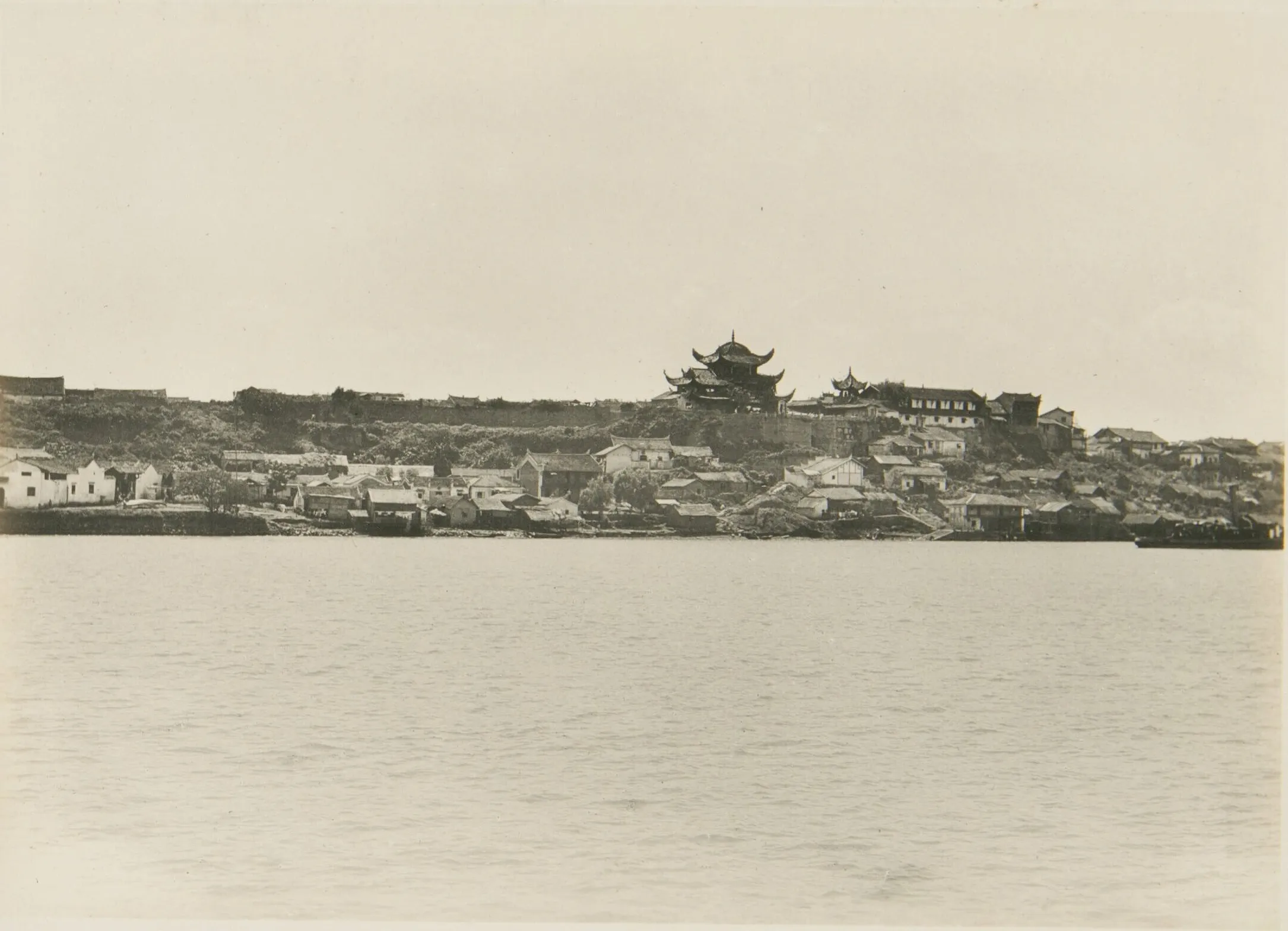
The Historical Photographs of China platform of the University of Bristol preserves lakeside views from three different years: Ba-s050 from the Banister Family collection, photographed around 1900; Sw13-043, taken by G. Warren Swire in 1906–1907, and Sw16-055, taken in 1911–1912. The original negatives are all held by the Archives and Special Collections of SOAS University of London, and the copyright belongs to John Swire & Sons Ltd. Taken from different distances, the three photographs preserve the relationship between the Yueyang Tower, the city gate, long stretches of the city wall, the dwellings along the lake, the moored boats, and the surface of Dongting Lake. The platform publishes these low-resolution images under a CC BY-NC-ND 4.0 license.
1926
The third volume of Ajia Taikan (Grand Views of Asia) preserves a panoramic old view of the Yueyang Tower and the city walls seen from afar from the Dongting Lake side; the original publication notes that it was photographed in 1926.
1920s to 1930s
The third volume of Shina Bunka Shiseki (Historical Sites of Chinese Culture), edited by Tokiwa Daijō and Sekino Tadashi, includes old views of the street-facing exterior of the Yueyang Tower and of its interior.
1932–1938
Two old photographs of the Yueyang Tower in the holdings of the Yueyang Municipal Archives were taken respectively after the great repair of the twenty-first year of the Republic and in the twenty-seventh year of the Republic: the former preserves at close range the form of the main tower, the side pavilions, and the courtyard; the latter was taken from outside the “Reaching South to the Xiao and Xiang” gate, showing the gate tower, the side pavilions, and the main tower. In the collection feature published by the archives for “Yueyang Tower Day” in 2025, there are also gathered paintings of the Yueyang Tower from the Song, Yuan, Ming, and Qing, photographs and plans from before and after the dismantling and great repair of 1983–1984, and photographs of the Record of the Yueyang Tower as written by calligraphers through the ages, including Mi Fu, Zhu Yunming, and Wen Zhengming.
1938
The 163rd installment of the tenth volume of Yadong Yinhua Ji (East Asia Pictorial Collection), titled “The Vicinity of Dongting Lake,” published a bird’s-eye view of the city of Yuezhou in February 1938, with dense dwellings spread along the lakeshore.
1938–1945
A postcard of the Yueyang Tower issued during the Japanese occupation, taken from the courtyard in front of the tower and showing the main tower and the side pavilions; the original image is now provided as public-domain material by Wikimedia Commons.

References
- Compiled by the Hunan Provincial Local Chronicles Compilation Committee: Yueyang Lou Zhi (Gazetteer of the Yueyang Tower), Fangzhi Publishing House, 2016, ch. 3, “The Rise and Fall of the Old Tower,” pp. 64–87.
- Compiled by the Hunan Provincial Local Chronicles Compilation Committee: Yueyang Lou Zhi (Gazetteer of the Yueyang Tower), Fangzhi Publishing House, 2016, ch. 6, “A Gathering of Literary Works,” sec. 2, “Prose,” pp. 165–180.
- Yueyang municipal local-chronicles system: Yueyang Lou Zhi (Gazetteer of the Yueyang Tower), ch. 6, “A Gathering of Literary Works,” sec. 2, “Prose”; the web content corresponds to pp. 165–180 of the book above.
- Yueyang municipal local-chronicles system: Yueyang Lou Zhi (Gazetteer of the Yueyang Tower), Chronicle of Major Events, with entries on the acceptance of surrender and the stationing of troops in 1945, the repair of 1950, and the dismantling and great repair of 1983–1984.
- Yueyang municipal local-chronicles system: Yueyang Shi Zhi (Gazetteer of Yueyang City), sec. 5, “The Administration of the Yueyang Tower”, recording the successive repairs and administration after the founding of the People’s Republic of China.
- Yueyang Municipal Archives: “Completion of the Great Repair Project of the Yueyang Tower”, recording the dismantling and great repair of 1983–1984.
- China News Service: “Thousand-Year-Old Yueyang Tower Completes Great Repair in the Rain, Keeping Its Historical Appearance”, September 28, 2010.
- Liu Qingli and Wu Shiyu: “Yueyang in the Archives: ‘Yueyang Tower Day’—One Tower, One Record, One Spirit”, Yueyang Municipal Archives, 2025.